
Location page SEO is the practice of building one dedicated URL per service area, where each page proves to Google you actually serve there with unique content, schema, and local proof, and things a template cannot fake: a real address or service radius, on-site photos, and at least one review from that area. Pages that spin a template and swap the city name get labeled doorway pages by Google and demoted. Every page our lead-generation team builds starts with that proof.
It is on-page optimization applied to geographic landing pages, so you rank for queries like "garage door repair Aurora" by signaling relevance, proximity, prominence, and helpfulness. BrightLocal's 2023 local search report found 76 percent of nearby searchers visit a business within 24 hours, but only if your page earns the click.
A location page is for a place you operate from; a geo page covers an area you serve but hold no office in. Location pages can rank in the map pack, while geo pages compete only in the blue links.
Location pages separate ranking for "plumber" from ranking for "plumber Aurora CO": the broad keyword goes to directories like Angi, the city keyword to local operators with dedicated pages. Or had zero rankings outside downtown Denver before we built his, and now ranks page one for 14 suburb queries. Location pages earn their value from details you cannot template, like the driving time from your shop. The test: remove the city name, and if the page still fits anywhere, it is thin doorway spam.
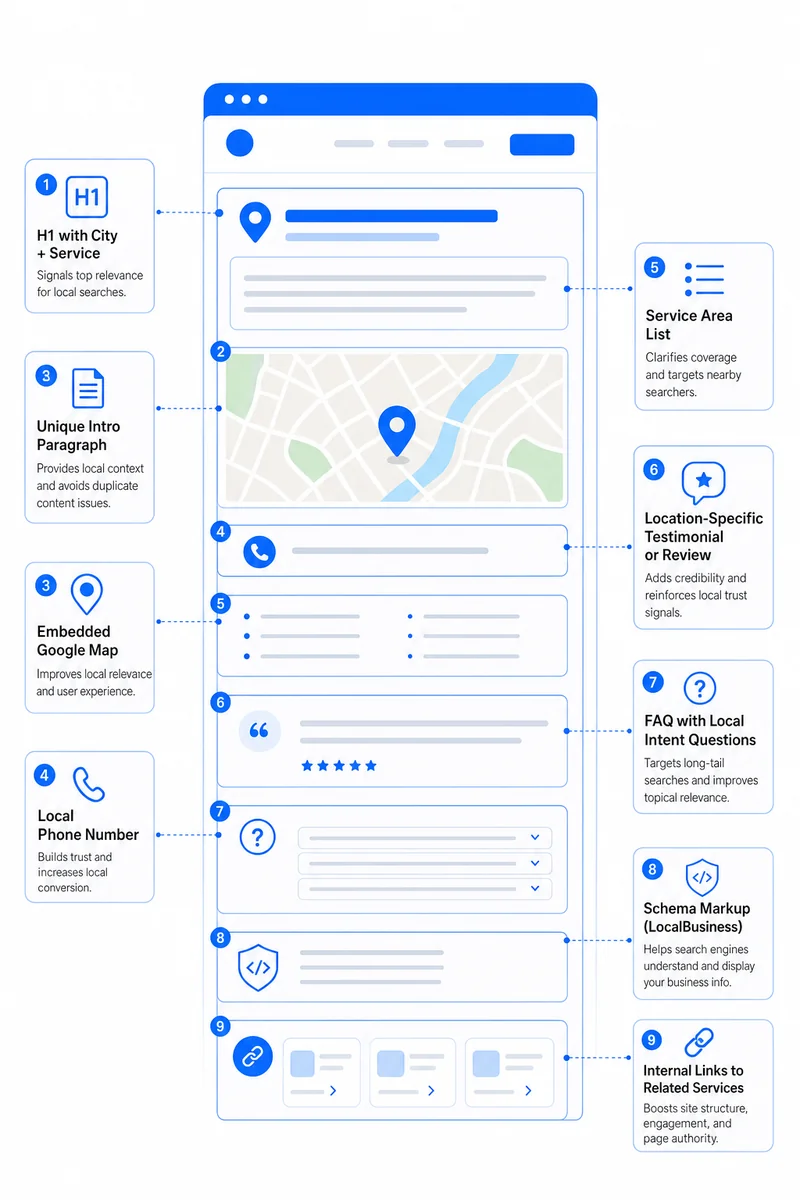
When Or hired me, he had one homepage targeting "Denver garage door repair" and nothing else. His competitor held 253 Google reviews, so instead of matching that overnight we built nine neighborhood pages across Aurora, Highlands Ranch, Parker, and six more suburbs. Each got 1,200 to 1,800 unique words, on-site photos, reviews from that ZIP, and a paragraph on the building stock. The full playbook lives in our guide to SEO for garage door companies.
Or now ranks page one for 14 city-modifier queries and beats the 253-review competitor on seven, with 13 reviews of his own. Content beats raw review counts when the competitor is coasting.
"I thought I needed 200 reviews before I could rank. Lior showed me I needed nine pages instead. We did it for less than the cost of one Google Ads month." - Or, denvergaragedoor.com
| Tool | Use case | Price range | Honest take |
|---|---|---|---|
| Google Search Console | Find queries you nearly rank for | Free | The single best source for location page ideas. |
| Google Business Profile | Pull localized reviews to embed | Free | Filter reviews by ZIP via customer names. |
| Screaming Frog | Audit existing page templates | Free to 500 URLs | Catches duplicate meta and thin content fast. |
| SEMrush / Ahrefs | City-level keyword research | $130-$500/mo | Inflated volume, useful for gap analysis. |
| Surfer SEO | Word count and entity targets | $89-$219/mo | Optimization by formula. Skip it if you care about voice. |
| Schema.org generator | Build LocalBusiness JSON-LD | Free | Use it, then validate at Schema Markup Validator. |
One free tactic beats every paid tool: schema. None of the top five competitors for "location page seo" use any structured data. Deploy LocalBusiness, Service with areaServed, and FAQPage, covered in schema markup audit.
Location pages are not always right. If your Google Business Profile already owns the map pack in your one city, 12 neighborhood pages dilute your authority; a stronger single page plus an active GBP wins, which I covered in SEO for service area business. Build them when you serve five or more cities with inconsistent rank; skip them when you dominate one.
| Tier | Monthly | What is included | Best for |
|---|---|---|---|
| Starter | $750 | One location page per month, full schema, on-page optimization, one revision | Solo operators in one metro |
| Pro | $1,500 | Two to three pages per month, existing-page optimization, link building, reporting | Contractors targeting suburbs |
| Custom | From $2,500 | Multi-city build-outs, technical audits, link acquisition, content refreshes, Slack access | Multi-location businesses or franchises |
Most freelancers charge $150-$400 per page, one-time, with no maintenance or ranking accountability once the page ships. The full breakdown sits in our affordable SEO packages. On timing, a new domain needs three to six months while an established site takes six to ten weeks, see the full breakdown in our SEO timeline guide.
These pages now have to be readable by ChatGPT, Perplexity, and AI Overviews, which favor explicit Q&A blocks, named entities, and schema. My client Tomer at Pine Garage Doors in Denver fields two to three weekly calls that open with "ChatGPT told me to call you". Answer the question in the first line of each section, and let schema fix names and prices.
Agencies that outsource their builds ship identical CTAs across every page. Google reads that sitewide pattern as templated content, so vary your CTAs per page, the variation itself is a signal.
The link from your homepage to your location pages outweighs third-party backlinks for local rankings. I moved one chimney sweep client's rankings in three weeks just by swapping his footer city list for an inline paragraph linking four cities.
Google also reads your location page against your Google Business Profile. If the two disagree on which cities you serve, those pages struggle. I find this mismatch in 8 of 10 audits.
One URL, one city or service area, built around a city-modifier query like "plumber Aurora". It needs unique content, schema markup, and proof you serve there. A homepage with a city in the title is not one.
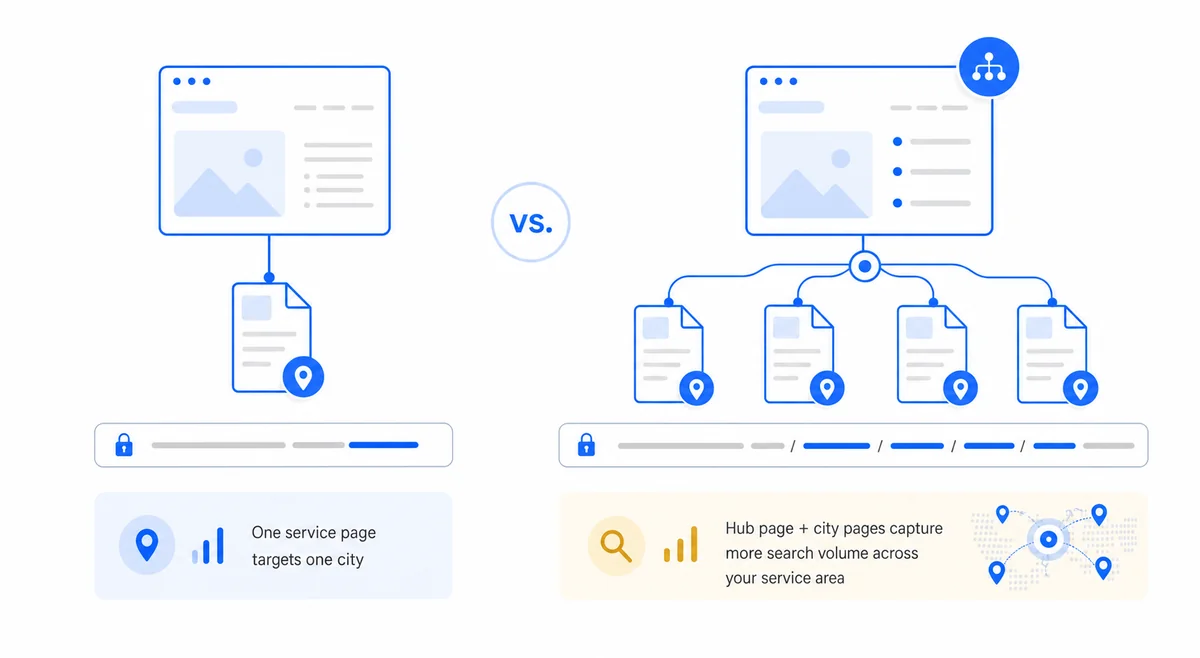
Without them you only rank in your immediate area, and a customer one suburb over sees your competitors instead. They let you appear for service-plus-city queries across every market you serve, which is how Or grew from one city to nine.
Add details only a local would know: building stock, common ZIP-level problems, a nearby landmark, driving time. Embed reviews from that area and a real job photo. If you can swap the city name and the page still fits anywhere, Google treats it as a doorway.
I am biased, since I run one. The honest test: ask any agency to show three live pages they wrote in the last 12 months, then check the schema. Our positioning is at our agency philosophy page.
Draft with AI, never publish without human revision. It defaults to generic phrasing that reads identically across every city, and pages published verbatim get penalized.
A service page targets the service ("garage door spring repair"); a location page targets it in a place ("spring repair in Aurora"). The best architecture has both, with location pages linking up to the relevant high converting service page.
If your location pages look like spun templates, or you have zero coverage for the suburbs you serve, this is fixable in 60 to 90 days. Book a free SEO consultation and I will show you which neighborhoods to target first, no contract pressure. Prefer the audit first? See our technical SEO audit service.
About the author: Lior Daniel is the founder of HouseCall SEO, an SEO agency built for US home service businesses. He is a software developer and SEO specialist with 6+ years of experience, previously building internal systems at government and airline-sector organizations. Today he helps US plumbers, garage door pros, locksmiths, and chimney sweeps rank in Google and get cited by AI engines like ChatGPT and Perplexity.

I specialize in home services SEO: taking websites that sit invisible on page three and turning them into the business Google and ChatGPT recommend first. I started on the developer side, writing software and doing SEO on the side, until I saw how much home-service owners were overpaying for work that quietly hurt them. So I built a method that fixes the broken technical work and the outdated thinking behind it.
From garage door companies to plumbers, roofers, locksmiths and cleaning services, the playbook is the same: rank where your customers actually search, earn real reviews, and back it with a fast site that books the job. No PBNs, no bought reviews, no directory spam. Only work that survives Google’s next five updates. See exactly how it’s priced on the pricing page.
Free 30-minute strategy call