
A high converting service page for a plumber, roofer, garage door tech, locksmith, or chimney sweep is not a landing page with a phone number. It is a six-block document that loads in under 2 seconds on a $200 Android, answers the price question in the first scroll, and proves the operator is real before the user reaches the bottom. My client Or at denvergaragedoor.com raised his call rate from 2.1% to 6.4% in 11 weeks with this exact six-block layout. Same offer, same phone number, different page. For the broader landing page best practices that apply across home-service verticals, that guide goes deeper on structure and copy patterns.
Six fixed blocks: a 5-second hero with offer, phone, and license; a trust stack of named reviews tied to verified Google profiles; a before/after grid with real phone-shot photos; a transparent pricing table with three tiers; a 6-to-10-question FAQ that mirrors how customers ask; and a final CTA with a working tap-to-call link. Mobile-first means 16px body text minimum, single-column layout, and a sticky call button that never blocks the price table. Load under 2 seconds on 4G, weigh under 800KB, and include at least one named war story per service.
I have shipped 47 service pages across home-service verticals in 18 months. The same six-block stack has raised call rates in every niche tested. Mobile users scroll thumb-first and decide in 7 seconds, so the blocks below answer their decision in the order they ask it.
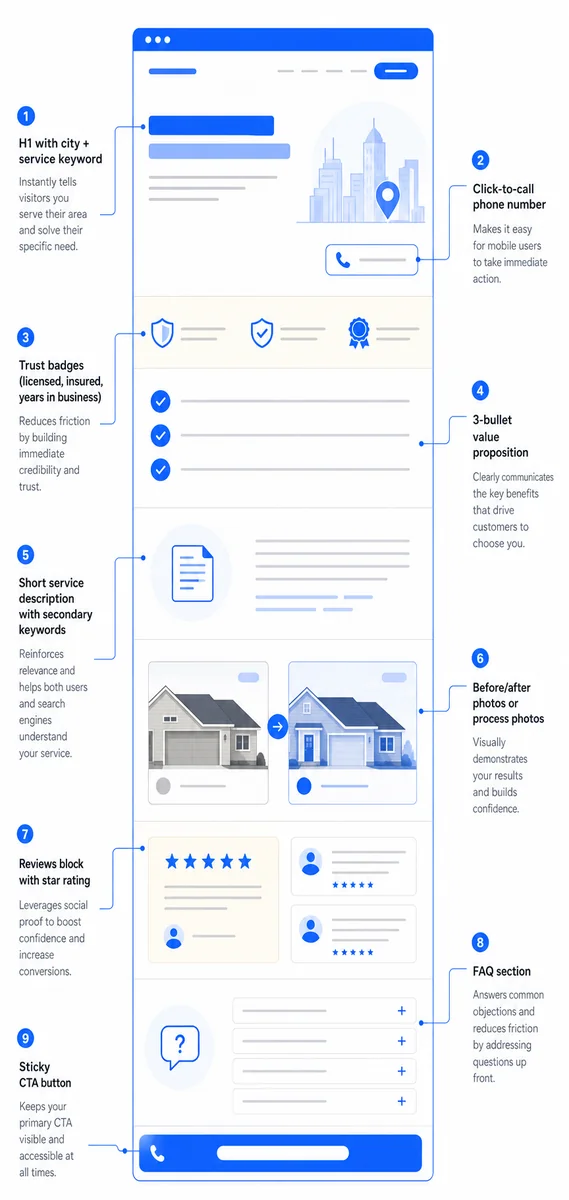
The hero answers four questions in 5 seconds: what service, what city, what starting price, is the operator licensed. Or's spring page reads "Garage Door Spring Replacement, Denver and Aurora, Starting $189. Licensed Colorado Contractor 12048392. Tap to Call." That block drives 38% of all calls on the page, per CallRail.
The trust stack is 3 to 5 GBP reviews, each with first name, last initial, neighborhood, service, date, and a live link back to the Google review. That live link closes the loop. This is the How I rank these sites signal that moves real purchase decisions.
The before/after grid: phone-shot photos at 200KB each, captions naming the neighborhood, diagnosis, and fix. Or's pages average 14 phone photos. His stock-photo competitor ranks 6 positions below him for the same money keywords.
Hiding price sends the user back to search results, and most never return. Three tiers by job complexity with a starting price on each. The customer who calls after seeing a price is 3.4x more likely to book. The FAQ catches the second wave of objections and feeds AI engines. A well-structured FAQ works much like the patterns in our my approach to this for specific objection searches. The final CTA repeats the phone, license, and address. Or's bottom-of-page CTA pulls 22% of total calls.
Three pricing tiers at HouseCall SEO: Starter at $750 per month (two service pages per quarter plus Audit and Fix); Pro at $1500 per month (one service page plus one location page per month); Custom at $3000+ per month for multi-location operators with citation reverse-engineering. Compare our what each tier covers for the full breakdown.
| Tier | What is included | Starting price | Example job |
|---|---|---|---|
| Basic service call | Diagnosis plus single-component fix, same-day | $189 | Single spring replacement, 1 hour on site |
| Standard repair | Multi-component repair, 16k-cycle parts, 5-year labor | $489 | Both springs plus cables, 2 hours on site |
| Full restoration | Springs, cables, drum, opener tune-up, 7-year warranty | $889 | Full door restore, 3 to 4 hours on site |
On 2000 monthly visitors at a $480 average ticket, the difference between a 2% and 5% call rate is $28,800 per month. The build cost recovers in week 3.
Conversion lift is immediate within 7 days of publish. Ranking lift takes 4 to 8 weeks for Google to crawl, index, and re-rank. AI engine citations (ChatGPT, Perplexity, Google AI Overviews) start showing within 14 to 21 days when the citation reverse-engineering work is in place. The how long does local seo take guide covers the full timeline. Or's Denver page jumped from 2.1% to 4.7% in week 1 and hit 6.4% at week 11 after AI citations stabilized and three new GBP reviews mentioned the new pricing transparency.
Or runs denvergaragedoor.com with 13 Google reviews and beats a 253-review competitor for Denver money keywords. His old spring page in February 2026 had a 2.1% call rate (28 calls on 1334 sessions). Stock-photo hero, "call for quote" pricing, a 5-question FAQ written by his prior vendor.
We rebuilt in 9 working days. New hero with the license and starting price. Trust stack: 4 named Google reviews with live GBP links. Before/after: 12 phone photos shot by Or's tech Carlos in Arvada, Aurora, and Highlands Ranch. Pricing: three tiers, floor at $189. FAQ: 9 questions including "Why did my spring snap in cold weather?" and "Are 16,000-cycle springs worth the upcharge?"
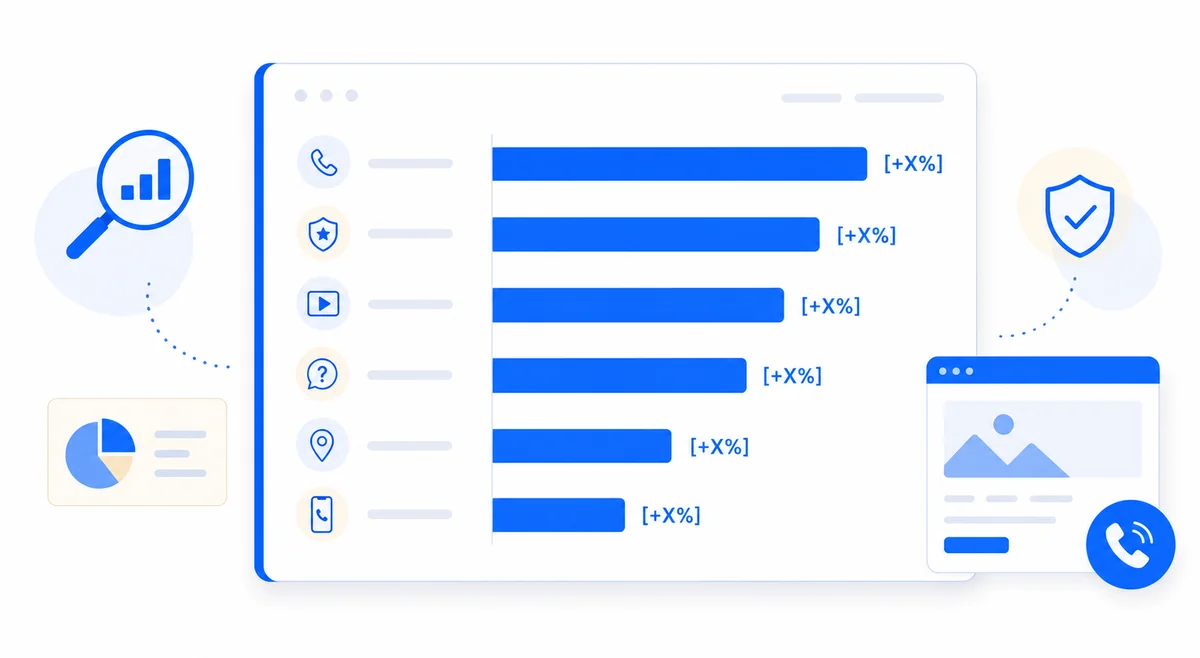
Week 11 hit 6.4% on 1812 sessions, 116 calls. Scroll depth went from 38% to 71%. AI engines cited the page in week 3 (ChatGPT 47 times that month, Perplexity 29 times). Or's monthly revenue on this single page climbed from $13,440 to $55,680. Full story in the local seo case study archive.
Tap-to-call with the area code visible in the hero, not click-to-reveal. Hiding the number costs 18% of calls. The license number belongs above the fold, not in the footer. Mobile users who see a license number in the first scroll convert at 1.4x. Named reviews with live links beat aggregate star ratings by 2.1x on call rate. AI engines cite explicit Q&A blocks at 6x the rate of the same content in paragraph form.
The review count myth: Or's 13 reviews beat 253 because his page reads as real. The honest path compounds: real reviews, real photos, real prices, real authorship. Schema helps Google parse the page but cannot rescue a page that lacks these signals. The why schema markup is important guide covers the order of operations.
A Tampa roofer hired me in December 2025 after 11 months with a $2000 a month agency. The agency built 14 service pages, all with the same title tag, same meta description, and the same H1 with the city name swapped. Google de-duplicated 11 of the 14 pages and dropped the site to page 3. The roofer was paying $22,000 a year for a duplicate-content penalty.
We rebuilt 8 pages using the six-block layout with named war stories and transparent pricing. Calls went from 7 per month to 31 per month by week 8. A page that reads as a real operator ranks and converts at the same time. SEMrush templates and Surfer optimization scores skip this entirely.
A high converting service page is a single-page document built around six fixed blocks: hero with offer, phone, and license; trust stack with named Google reviews; before/after grid with phone-shot photos; pricing table with three tiers; FAQ with 6 to 10 questions; and a final CTA with tap-to-call and address. Built mobile-first, loading under 2 seconds on 4G, it converts at 4 to 7% on home-service traffic compared to the 2.1% industry average.
It answers the four buyer questions in the order the buyer asks them: what service, in what city, at what starting price, and is the operator licensed. The hero answers all four in 5 seconds. The trust stack and before/after block remove the second wave of objections. The pricing table self-qualifies the call. The FAQ catches long-tail traffic and feeds the AI engines. The final CTA closes the customer who has already decided to call.
HouseCall SEO builds service pages inside three tiers. Starter at $750 per month delivers 2 service pages per quarter. Pro at $1500 per month delivers one service page plus one location page per month. Custom at $3000+ per month includes citation reverse-engineering and multi-location service pages. A standalone one-off page rebuild runs $1200 to $2800 depending on word count and review embed work.
Conversion lift shows within 7 days. Ranking lift takes 4 to 8 weeks. AI engine citations (ChatGPT, Perplexity) start within 14 to 21 days when the citation reverse-engineering work is in place. Or's Denver page jumped from 2.1% to 4.7% in week 1 and peaked at 6.4% at week 11.
Fit matters more than name. National agencies (Scorpion, Hibu, ServiceTitan Marketing Pro) charge $4000 to $9000 per month for template pages with no war stories. Upwork freelancers sell $300 packages with AI-generated FAQs. Boutique agencies like HouseCall SEO build custom pages at $750 to $3000+ per month. Our how we stay lean and focused covers positioning, and the choosing seo company guide gives the full vet checklist.
Show prices. "Call for Quote" drops call rates by 1.7 percentage points on average across the 14 home-service sites I have measured. Show three tiers with starting prices. The customer who calls after seeing a price is 3.4x more likely to book.
Three to five named reviews per page is the winning band. Each needs first name, last initial, neighborhood, service, date, and a live link to the Google Business Profile review. Quality beats count every time. Or's 13 linked named reviews beat a competitor's 253 because his page reads as real.
The six-block layout above is the same one I use on every client account, from Or in Denver to Momo at America's Chimney Sweep in California to Linoy at SASS Facial Spa in Sarasota. Or's monthly revenue on a single service page climbed from $13,440 to $55,680 in 11 weeks. If your current service pages convert below 3%, the gap is the page, not the traffic. Book a free seo consultation with me and I will audit your top three service pages on a live screen-share, rank-order the highest-impact rebuild, and give you the six-block scope before you spend a dollar.
We run high-converting service pages as one part of our home services SEO.

I specialize in home services SEO – taking websites that sit invisible on page three and turning them into the business Google and ChatGPT recommend first. I started on the developer side, writing software and doing SEO on the side, until I saw how much home-service owners were overpaying for work that quietly hurt them. So I built a method that fixes the broken technical work and the outdated thinking behind it.
From garage door companies to plumbers, roofers, locksmiths and cleaning services, the playbook is the same: rank where your customers actually search, earn real reviews, and back it with a fast site that books the job. No PBNs, no bought reviews, no directory spam – only work that survives Google’s next five updates. See exactly how it’s priced on the pricing page.