
SEO for service area business means ranking a no-storefront contractor in Google Maps, the local pack, and AI engines like ChatGPT without a public address. The work has four parts: hide the address cleanly on Google Business Profile with real service area polygons, build neighborhood pages that prove you work each zone, fix NAP consistency across the directories AI engines cite, and answer the questions homeowners ask after a ChatGPT recommendation. Skip any layer and you lose calls.
SEO for service area business ranks a no-storefront contractor (plumbers, HVAC techs, garage door shops, locksmiths, chimney sweeps) in Google search, Google Maps, and AI engines for the queries homeowners type when they need work at their address. Google built a dedicated profile mode for this case in 2016 and tightened it in 2024. The output is one number: booked house calls per month from organic and AI search. The discipline has four sub-areas: GBP setup in hidden-address mode, service area page architecture, citation building across directories AI engines read, and review acquisition that fits a truck-based workflow.
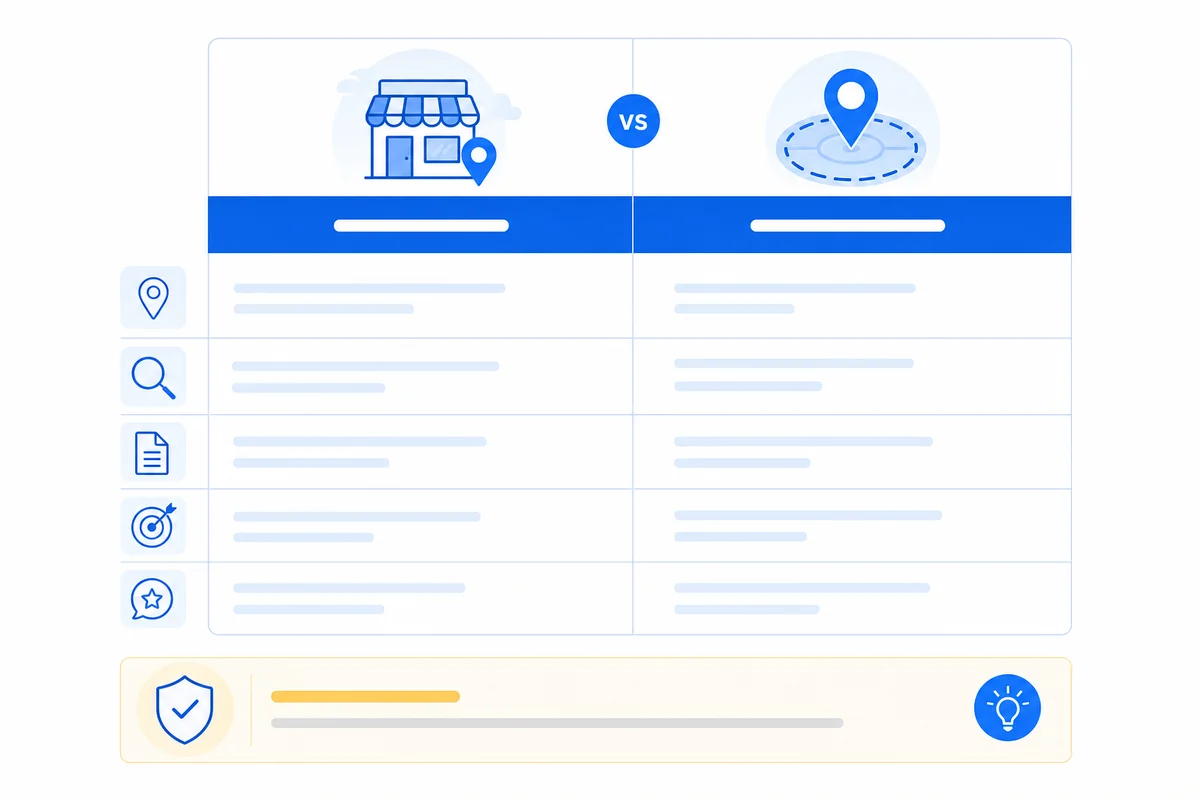
A storefront business shows its address publicly and the proximity filter on Google favors that address for nearby searchers. A service area business cannot rely on a public location. Google surfaces you based on declared service area polygons and geographic signals across your site, citations, and reviews. The center of gravity shifts from "where is your shop" to "where do you actually work and can you prove it." Most competitors fake it with a single template city page. The operator who builds real neighborhood pages wins.
The stack I actually use, with what each tool does and the rough monthly cost: You can run lean on the free tiers plus a citation manager.
| Tool | Use | Approx cost |
|---|---|---|
| Google Search Console | Indexation, query and click data | Free |
| Google Business Profile Manager | Profile, posts, Q&A, insights | Free |
| Screaming Frog | Crawl, broken links, internal link audit | $259/year |
| Ahrefs | Keyword research, competitor backlinks | $129/month |
| BrightLocal | Citation audit, rank tracking by city | $39/month |
| ChatGPT Plus + Perplexity Pro | Citation reverse-engineering, AI testing | $40/month |
| CallRail | Call tracking by source | $45/month |
A single-operator SAB runs around $350 a month with all paid licenses, or near $50 on the free tools alone. One overlooked source: your Google Business Profile category setup and the BBB profile both feed the NAP record AI engines read, so keep the name, address, and phone identical on each. The how I rank these sites covers the lean stack.
I have audited more than sixty SAB profiles in three years. The same errors repeat. Skip these and you skip most of the recovery work.
The biggest myth in local SEO for service area businesses is that hiding your address costs you visibility. It does not. Google explicitly supports service area mode and ranks SABs in the local pack. What erodes visibility is faking an address you do not use, or hiding it on GBP while leaving it public elsewhere. A hidden fake address gets removed in the next sweep with no recovery path. Or's address is hidden and he sits in the map pack for Denver garage door queries. The proximity filter still uses the verification address as a quiet center of gravity, so rankings are strongest near the real shop.
A SAB website needs three tiers: home page and core service pages (what you do), one city or neighborhood page per geographic target (where you do it), and supporting content like blog posts, case studies, and FAQs (how deep your knowledge runs). Or has unique pages for Cherry Creek, Stapleton, Park Hill, and a dozen more Denver neighborhoods. Cherry Creek homes from the 1950s carry a different door inventory than Stapleton homes built post-2000. Google reads that as genuine local content. ChatGPT cites it. SEO location pages goes deeper on structure.
Before we worked together, Or had seven indexed pages, ten organic clicks a day, a wrong primary category, three photos, and no Q&A. The address was hidden, the one thing he had right.
The work: GBP rebuild, geo-tagged photos uploaded weekly by his techs, city pages for Cherry Creek, Stapleton, Park Hill, Highlands, and more. Citation reverse-engineering pulled 47 niche directories ChatGPT and Perplexity cite for the garage door niche in Colorado, none touched by the outfit he used before. Reviews come in by a link the tech sends before leaving the driveway.
By month 3.5, the first lead spike. By month six, ChatGPT cited Or by name for Denver garage door repair. By month nine, his 13 reviews were beating the 253-review competitor on booked calls. That competitor faked a storefront, got suspended in the 2024 wave, and never recovered. The same four-layer approach drives local SEO for garage door companies, local SEO for plumbers, and restoration local SEO. Full case at local SEO case studies.

| Channel | Typical cost per lead | Lead ownership | Ramp time | Compounds |
|---|---|---|---|---|
| SAB SEO (organic + AI) | $15 to $50 after month 6 | You own the asset | 3 to 6 months | Yes |
| Google Ads / LSAs | $45 to $150 per lead | Google owns the channel | Days | No |
| HomeAdvisor / Angi | $40 to $120, shared | Platform owns the channel | Days | No |
| Thumbtack | $25 to $80, shared | Platform owns the channel | Days | No |
Paid channels turn on fast but do not compound. SAB SEO is slow for three to six months, then cost per lead drops below every other channel. Momo at America's Chimney Sweep stopped paying for ads at month four.
Your GBP shows in three high-intent surfaces: the local pack on Google search, the Maps app, and the knowledge panel when someone searches your brand name. The 2024 cleanup wave removed fake addresses, virtual offices, and mass-created lead-gen profiles en masse. For a service area business, the fields that matter most are: primary category matched to money work, service area cities you actually drive, a real description with neighborhood names, 15 to 25 clean service items, geo-tagged photos weekly, and consistent review acquisition. The Google Business Profile optimization services page covers field-by-field detail. For the current AI tools for Google Business Profile optimization, HouseCall SEO has the 2026 rundown.
SAB SEO is a subset of local SEO for service area businesses. The two share most tactics (GBP optimization, citation building, review acquisition, content, internal linking) and differ on execution details specific to whether you host customers or travel to them. The local SEO for home services page covers the full discipline. HouseCall SEO also runs SEO for painting contractors and local SEO for remodeling contractors using the same four-layer approach.
The proximity ghost is real. Even with the address hidden, Google uses the verification address as a quiet center of gravity. Pushing the service area more than 25 miles from it weakens rankings. Verify from the address closest to the center of your actual service footprint, not the cheapest address available.
AI engines favor named-entity recognition in long-form content over raw review count. Past roughly 30 to 50 reviews, one more review adds almost nothing. Or proves this with 13 reviews against 253. Content and AI citation are the deciding factors, and most of the field skips both. The SAB market is wide open for the operator who adds the AI layer.
A service-area business (SAB) is a business that travels to customers instead of hosting them at a public storefront. Plumbers, HVAC techs, garage door shops, locksmiths, and chimney sweeps are the classic examples. Google has a dedicated profile mode for SABs: the address is verified during setup and hidden from public view, and the business defines a service area by cities, zip codes, or driving radius.
No. Hiding a real address is supported by Google and does not hurt SEO. What hurts is faking an address you do not use, or hiding it on GBP while leaving it public elsewhere. A clean SAB with a hidden real address can rank in the local pack across its declared service area.
HouseCall SEO charges transparent monthly fees: $750 for single-location SABs covering one core city, $1,500 for a metro with five to eight cities, and $3,000 or more for multi-metro or highly competitive niches. Compared to paid ads at $45 to $150 per lead, SAB SEO typically drops cost per lead below $50 by month six. Full detail on the SEO packages page.
HouseCall SEO is built for US home service SABs in plumbing, HVAC, garage door, locksmith, chimney sweep, electrician, and adjacent verticals. Look for named clients with live URLs you can call, transparent pricing, no PBNs, and case studies with real numbers. The vetting checklist covers what to look for before you sign. How to improve brand visibility in AI search engines covers the AI citation tactics in depth.
If you run a home service SAB and want exclusive organic leads instead of shared HomeAdvisor leads, the work starts with one call. I am Lior Daniel, founder of HouseCall SEO: software developer and SEO specialist with six-plus years in home services, previously at IDF Home Front Command and El Al Israel Airlines. I run every client engagement directly. Book a free SEO consultation and I will review your GBP, website, citation profile, and AI engine visibility. I give you a real timeline, real numbers, and a straight answer.

I specialize in home services SEO – taking websites that sit invisible on page three and turning them into the business Google and ChatGPT recommend first. I started on the developer side, writing software and doing SEO on the side, until I saw how much home-service owners were overpaying for work that quietly hurt them. So I built a method that fixes the broken technical work and the outdated thinking behind it.
From garage door companies to plumbers, roofers, locksmiths and cleaning services, the playbook is the same: rank where your customers actually search, earn real reviews, and back it with a fast site that books the job. No PBNs, no bought reviews, no directory spam – only work that survives Google’s next five updates. See exactly how it’s priced on the pricing page.