
Schema markup for local SEO is structured code that labels your business data so Google and AI engines understand it without guessing. A service area business needs LocalBusiness with NAP and opening hours, a Service block per niche with areaServed and a real price, FAQPage tied to a visible Q and A, BreadcrumbList on non-home pages, AggregateRating from real reviews, and sameAs linking GBP and social. Hand-written, validated, monitored. Plugins alone fail this stack.
Schema is a shared vocabulary at schema.org that labels every meaningful element on a page: name, address, phone, hours, service area, prices, reviews. Wrap those labels in code and engines stop inferring; leave them out and Google has to guess. Worth knowing: of the top 5 ranking pages for this query, all 5 ship zero schema on the page, Google's own docs included. A clean local stack walks in through that gap. Local schema differs from generic in the type (LocalBusiness or one of 80+ subtypes like Plumber, not plain Organization), the geography (PostalAddress, areaServed, geo), and the operations (opening hours, telephone, priceRange). Generic schema misses all three, which is why the Local Pack ignores it.
Start with Local Pack eligibility. A LocalBusiness block with full NAP, areaServed, and opening hours tells Google your business exists at a real address, serves named cities, and keeps set hours. Strip it out and Google infers from page text, and inference loses to labels. The same labels drive AI citation: ChatGPT, Perplexity, Gemini, and Google AI Overview prefer structured data, and we see citations show up 30 to 90 days after a deploy.
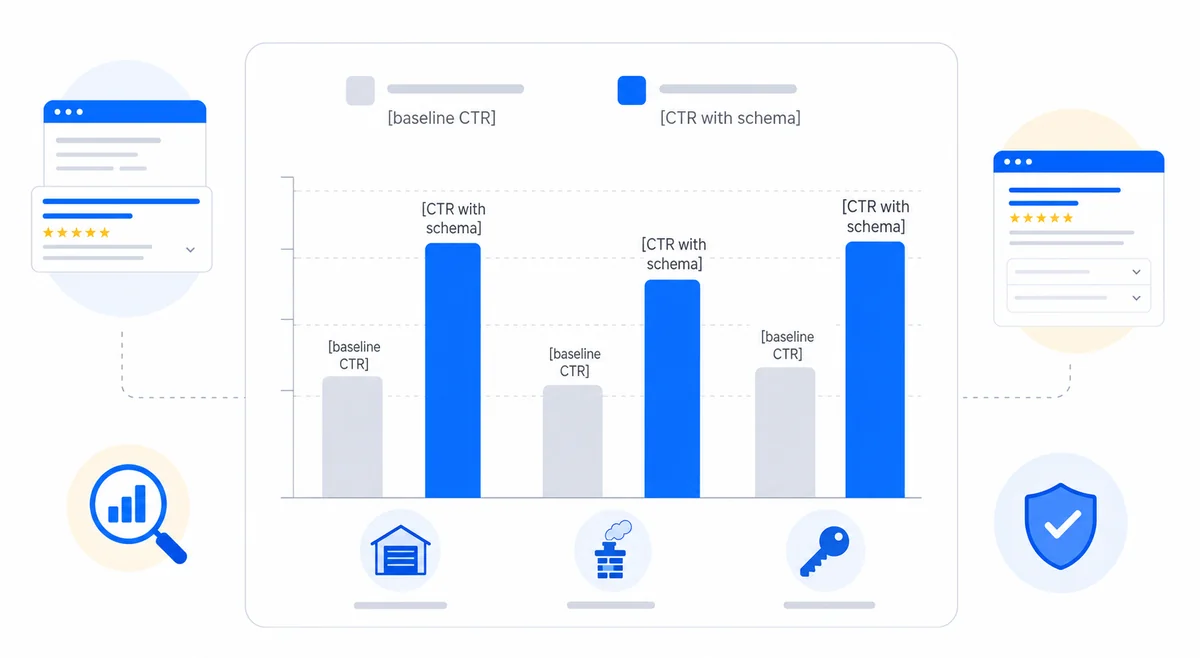
Then there is the Trust Stack. My client Or runs denvergaragedoor.com with 13 Google reviews and outbooks a competitor on 253, partly because engines read his labels and render his pages larger. Google plus AI is a trust multiplier no raw review count beats.
Structured data lets engines read your page as labeled objects instead of loose text. Of the three syntaxes, Microdata and RDFa break when designers touch templates, so use JSON-LD, the self-contained block Google recommends. It builds a knowledge graph: each block is a node, each property an edge, and the deeper the graph, the more contexts an engine can place you in. This is the foundation of any honest schema markup audit: map the graph, then count what is missing.
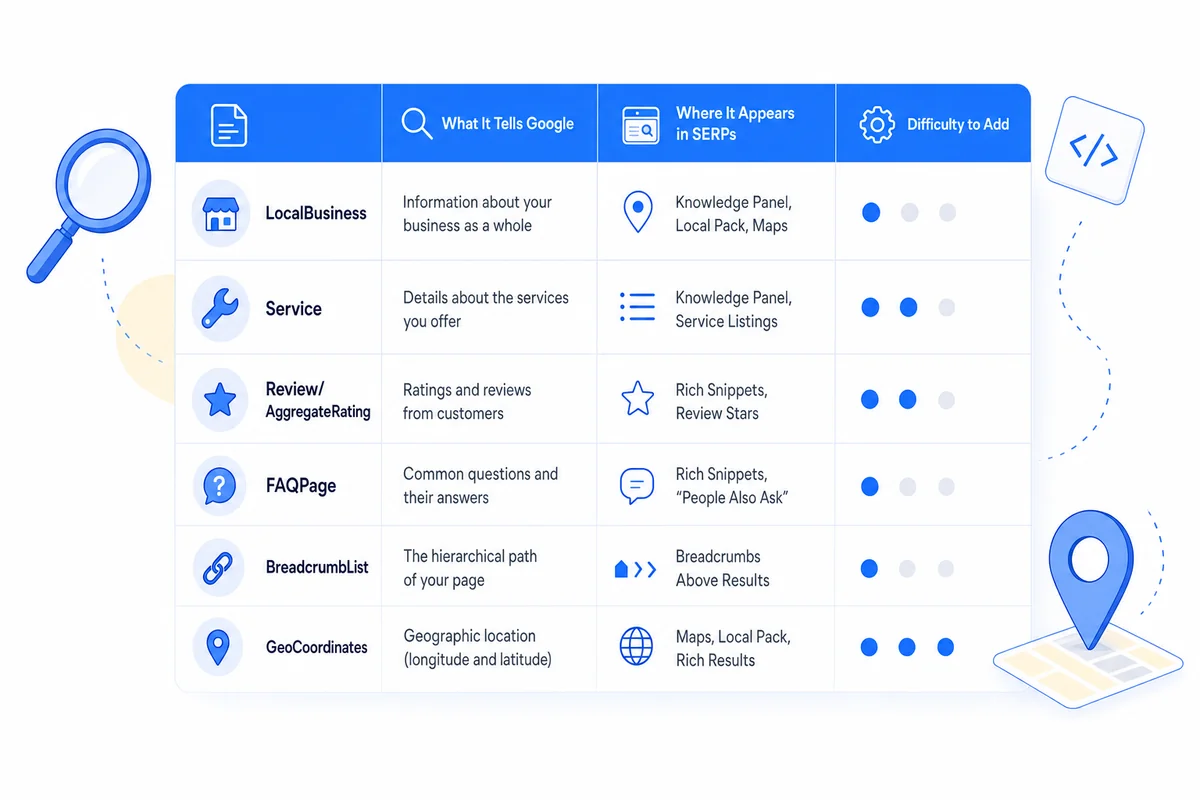
Each block earns a different visual: LocalBusiness opens up the knowledge panel and Local Pack, a Service offer shows a price, FAQPage adds accordions, BreadcrumbList swaps the raw URL for a clean path, and AggregateRating shows gold stars. A listing with all of those takes 3 to 5 times the real estate of a plain blue link, yet none of the top 5 ship any of those blocks on their pages.
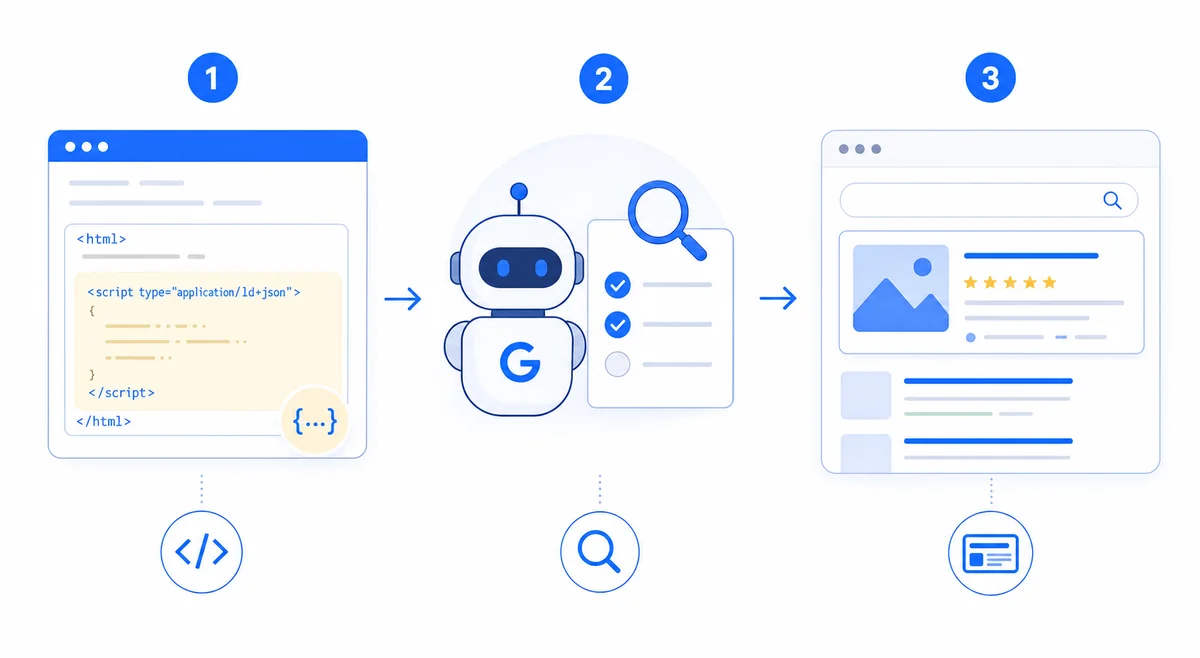
Schema is page-specific. The home page declares the entity with Organization and LocalBusiness, service pages declare the offer with Service and FAQPage, location pages declare the geography, and every non-home page carries a BreadcrumbList. Three pages is a thin graph; forty pages with the right blocks per type wins AI citations. The same logic applies to a schema markup for ecommerce website, where Product and Offer nodes replace Service blocks, though local businesses lean harder on geography fields.
AI engines read pre-structured data, weight it heavily, and skip pages without it. A LocalBusiness with rich areaServed, an FAQPage with 8 to 12 Q and A, and a Service with a specific offer is the shape they reward. For every client I start by asking ChatGPT or Perplexity the niche query in the client's city, checking which directories come up, registering the client there, and then adding Service schema for those queries. ChatGPT started naming Or for "best garage door repair Denver" within 60 days, the same playbook we package as the best generative AI SEO work we run today.
Schema markup for AI optimization is the same code as classic schema, tuned for a different reader. The blocks are identical, but AI engines weight the geography, operational, and offer fields heavier. Use real data and engines cite you. Fabricate any field and they catch it.
| Tool | Purpose | Cost |
|---|---|---|
| Google Rich Results Test | Tests eligibility for stars, FAQ accordions, breadcrumbs | Free |
| Schema.org Validator | Pure syntax check, catches misspelled property names | Free |
| Google Search Console Enhancements | Real schema parsing on live pages, sustained reporting | Free |
| View Source (browser native) | Detects duplicate blocks from plugins fighting each other | Free |
| Merkle Schema Generator | Drafts a starting block for hand-tuning | Free |
| Schema App | Enterprise editor with auto-population from CMS data | Paid, $50+/mo |
Run all six on every important page and fix any red flag before moving on.
Or started with zero schema, a duplicate Organization block from his theme, 7 unindexed pages, and a 253-review competitor above him in the Local Pack. After the rebuild: a hand-written nine-block stack, all 7 pages indexed inside 14 days, AI engines citing him for Denver and Aurora queries inside 60 days, and his 13 real reviews showing as stars. The competitor still has more reviews; Or ranks above him. I ran the same rebuild for Tomer at pinegaragedoors.com and Momo at americaschimneysweep.com, stripping plugin duplicates and a fabricated rating. The foundation under all three is what we call My approach to this: schema wired into the architecture from day one, not bolted on later.
Schema has two advantages over the other levers: speed and compounding effect. A local schema deploy lands in 3 to 30 days and feeds AI citations for a one-time dev cost. Backlinks take 3 to 6 months at $100 to $500 per link and stay the strongest long-term move, but cost more. Review acquisition lifts the Local Pack without feeding AI engines the way schema does. A clean stack on a 20-page site shows in GSC Enhancements inside two weeks, and the citation gains compound without recurring cost.
sameAs is almost always skipped. Generalist agencies list two URLs; the strongest arrays I've built run 8 to 12: GBP, Facebook, Instagram, LinkedIn, YouTube, BBB, Yelp, Angi. Or's knowledge graph confidence visibly jumped the week we grew his from 3 to 11 URLs.
Opening hours are where home service sites silently lose AI citations. Plugin output declares 9-to-5 weekday hours while the real business answers calls Sunday night. ChatGPT, asked for 24/7 emergency garage door in Denver, picks the competitor whose schema actually says 24-hour operation.
The @id graph is the silent gatekeeper for Local Pack velocity. A coherent graph, LocalBusiness referenced from every Service, the FAQPage pointing back, gets parsed as one entity instead of isolated blocks. I moved one client from page 3 to the Local Pack in 8 weeks on @id work alone. Most agencies still skip schema markup for local SEO in 2026, so any owner willing to write real code picks up ground the competition leaves open.
None of the top 5 ranking pages publish pricing. We do. If these tiers do not fit, the SEO packages page lists the rest.
| Package | Price | What you get |
|---|---|---|
| Starter local schema | $750/mo | LocalBusiness with full NAP, Organization, BreadcrumbList per non-home page, FAQPage on top 3 service pages, Service per niche, sameAs to 8+ profiles, monthly validation |
| Pro local schema | $1500/mo | Full nine-type stack including AggregateRating, Review, Person, Article on every blog post, AI citation tracking on ChatGPT and Perplexity, weekly GSC Enhancements the first month, quarterly audit |
| Custom local schema | $3000+/mo | Multi-location branch nodes, multilingual Service blocks, custom HowTo and Event schema, dedicated developer time, real-time GBP sync, Trust Stack monitoring across 6 AI engines |
Every tier includes the House Call Method audit and Rich Results Test validation pre-launch. Bundle with our technical SEO audit service for compounding results.
Starter is $750 a month, Pro $1500, Custom $3000+, all hand-written and validated.
GSC Enhancements detects new schema in 3 to 14 days, rich results in 14 to 30, and AI citation gains in 30 to 90. We see Local Pack lifts inside 60 days alongside basic on-page work.
Look for one that hand-writes the code for your niche, validates every page before launch, and ships real client examples in public. HouseCall SEO does all three across garage door, plumbing, HVAC, locksmith, and chimney sweep clients.
An SAB needs LocalBusiness or its subtype with a full address even when customers do not visit, areaServed naming every city, opening hours, telephone, sameAs, and a Service block per niche. The address anchors the entity while areaServed carries the geography.
Ready to deploy schema markup for local SEO that shows up in Google and ChatGPT? Request your free schema audit and I will send the priority brief inside 48 hours.
We run local schema markup as one part of the home services SEO playbook.

I specialize in home services SEO: taking websites that sit invisible on page three and turning them into the business Google and ChatGPT recommend first. I started on the developer side, writing software and doing SEO on the side, until I saw how much home-service owners were overpaying for work that quietly hurt them. So I built a method that fixes the broken technical work and the outdated thinking behind it.
From garage door companies to plumbers, roofers, locksmiths and cleaning services, the playbook is the same: rank where your customers actually search, earn real reviews, and back it with a fast site that books the job. No PBNs, no bought reviews, no directory spam. Only work that survives Google’s next five updates. See exactly how it’s priced on the pricing page.
Free 30-minute strategy call