
Local SEO for garage door company owners means getting your shop into the Google Maps 3-pack and into ChatGPT, Perplexity, and Google AI Overview when a homeowner searches for a broken spring, on a phone, in minutes. A complete program runs five layers: GBP health, city and neighborhood pages, profile cleanup tied to AI-read directories, review velocity, and quotable on-page Q&A blocks. This niche needs its own playbook because Google treats garage door and locksmith as its two highest-fraud categories.
Generic local SEO assumes Google trusts your category. It does not. Google lived through a wave of fake garage door listings, one inside a US military base, and now applies extra friction to every verification and review here. A dentist can list an address and rank in 30 days; a garage door shop can wait months, then get suspended over a category change.
Generic SEO also assumes the buyer reads. A homeowner with a car trapped in a garage reads three lines and taps a number. Service area is the model, too: a shop that says "we serve Denver" loses to one with a real Highlands Ranch page and a real Aurora page. My SEO for service area business guide goes deeper.
Bad-faith operators built fake garage door listings at addresses they did not own, ranked, and sent strangers who overcharged homeowners. Google reacted with blanket suspensions, and legit shops have paid the trust tax since. Four mistakes cause most suspensions.
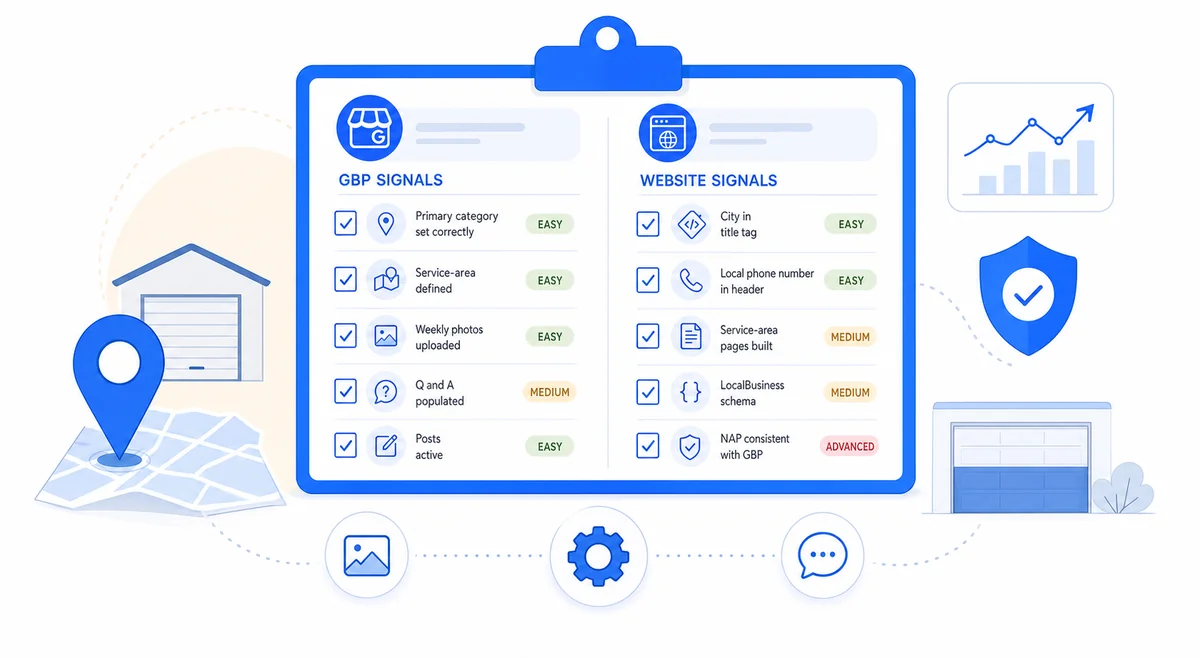
Many owners run trucks from home and check "hide my address" on GBP. The setting is allowed, but it pairs hidden addresses with the fraud signature and raises risk. I push every client toward a photographable address Google can verify.
I have seen profiles with 40 services including "locksmith" and "general contractor." Google reads that as a category-cannibal listing and pushes it off the map. Strip the list to garage door work: openers, springs, panels, cables, commercial doors, emergency repair. Specificity is the strongest trust signal here.
"Denver Garage Door Repair 24/7 Same Day Service" is not a business name. The keyword belongs in the categories, description, and website. Your GBP name should match the legal name and storefront sign.
"Garage Door Supplier" and "Garage Door Installer" pull different ranking neighborhoods, so I set the primary to the highest-margin service. My Google Business Profile category breakdown lists the setup, and my GBP suspension recovery guide covers the appeal evidence.
Or owns denvergaragedoor.com in Denver, Colorado. He came to me with 13 Google reviews against a competitor with 253. Starting state: 7 pages indexed, about 10 clicks a day, zero organic leads. His previous marketer billed $4 for every $1 he now pays me.
We rebuilt from the foundation: real photos, dealer logos, price ranges in titles, neighborhood pages for 20-plus zones, and service pages reverse-engineered past the top five competitors. Inside 90 days, clicks tripled, ChatGPT and Perplexity named the shop, and commercial calls landed. Or sent one line: "You are a magician."
The insight came from his buyers. Denver homeowners asked ChatGPT for a recommendation, then Googled the name to verify. That is the Trust Stack: Google plus AI is a trust multiplier that no review count beats. His old marketer admitted it: "He has 13 reviews, you have 253, and he brings you more work than I do."
Tomer runs Pine Garage Doors in Denver and came through Or's referral. Same Trust Stack, with first leads by 3.5 months and a first commercial maintenance contract at 4.5. One happy client brings two more.
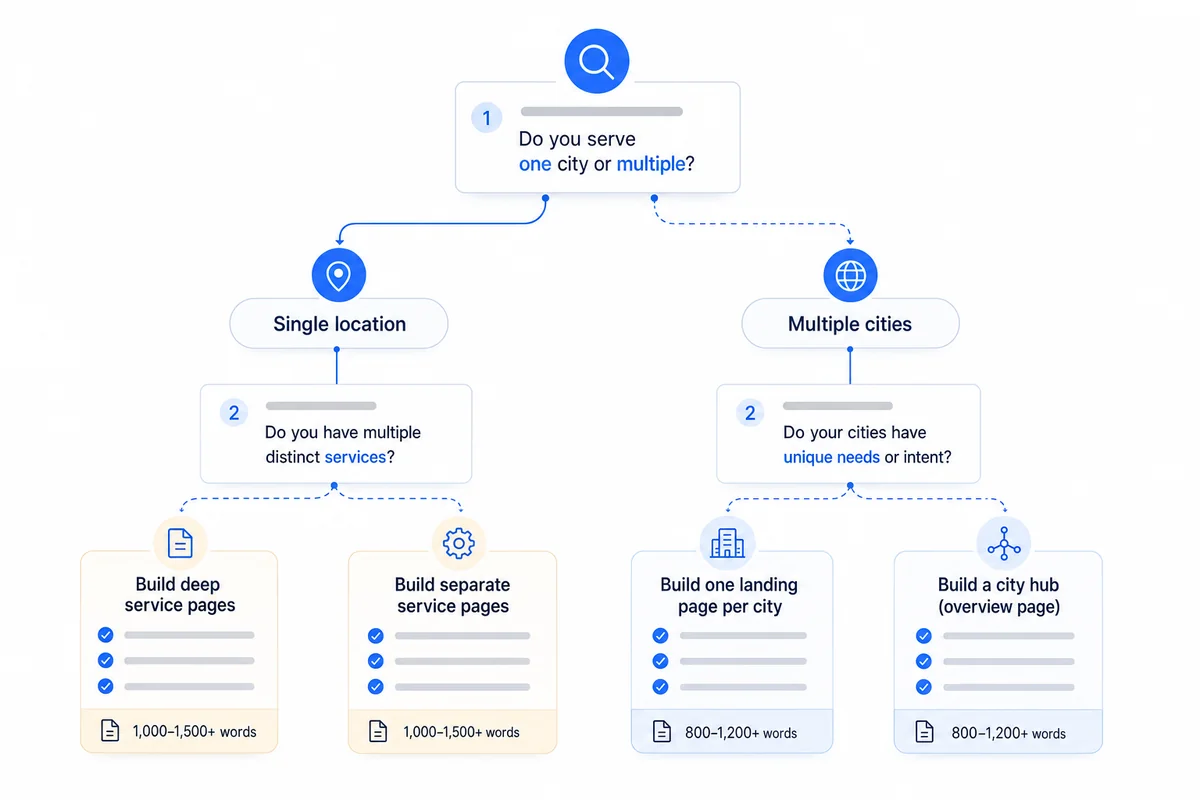
A single-metro shop needs one root city page and a real neighborhood page per priority zone. Denver breaks into Highlands Ranch, Aurora, Lakewood, Parker, Centennial, and more, each with a different income profile, door style mix, and competitor pool. Treat them all as "Denver" and you lose. A real neighborhood page is not 600 words of "we serve [neighborhood]." It covers local history, the door styles common there, a job photo, and three real FAQs. Google demotes templated pages, and ChatGPT will not cite a thin one.
Rival agencies still treat citations as a 2014 problem: Yelp, BBB, Angi, done. That is the trust floor, but it does not feed the AI engines now sending 20 to 40 percent of qualified leads to a well-optimized site. My technique on every intake: I ask ChatGPT, Perplexity, and AI Overview for the most trusted garage door companies in the city, then click every source link. The result is 30 to 60 directories the engines cite, most obscure, many free.
For garage door, the high-trust list includes Clopay dealer directories, LiftMaster pro locators, Chamberlain and Wayne Dalton dealer pages, IDA member listings, and BBB Accredited profiles. The NAP rule applies to all of them: Name, Address, Phone in identical format, since a missing suite number breaks the consistency check. My local citations checklist covers the broader playbook. Owners running paid channels alongside this work should also read garage door advertising for the real cost per job.
The competitor's 253 reviews stopped two years ago, so Google read them as stale. Or collected one or two a week with photos and named services, which reads as an active shop. The playbook: ask every paying customer the day the job ends, make it a one-tap link, and reply inside 48 hours including the negatives. A profile of 100 reviews all saying "great, fast, professional" looks fake; 30 naming real services and neighborhoods look genuine. My how to get more reviews on Google guide has the templates.
Get 1 through 5 right and most metros open up. The shops that skip them spend a year wondering why nothing moves.
Four phases, each feeding the next, the structure behind Or's 13-review shop beating a 253-review competitor inside 90 days.
A full crawl-health written report of indexation, speed, mobile, schema, internal links, GBP health, NAP consistency, citation footprint, and AI visibility. A written audit, not a tool PDF. It typically uncovers 20 to 40 problems a previous marketer missed.
Broken pieces first, because nothing compounds on a broken foundation. Crawl issues cleared, duplicate meta tags rewritten, stale GBP attributes corrected, schema deployed, NAP cleaned. 14 to 30 days.
City and neighborhood pages published. Service pages rebuilt with AI-citable Q&A. The citation list executed, review velocity workflows installed, internal linking balanced. 60 to 90 days. Calls, ads and referrals all feed into this, and where garage door leads really come from breaks down the math.
Rankings in Google and AI engines, organic leads, GBP impressions, citation count, review velocity, price-in-title CTR. Monthly reports with action notes. My SEO attribution model page covers the lead-tracking setup.
A shop that sells one package to every trade treats a garage door owner like a dentist and misses two pains. First, Google's distrust of the category weights every signal harder. Second, commercial expansion that generic writers cannot build. The most valuable client is commercial: a warehouse with 12 bay doors, a parking garage with 30. One annual maintenance contract beats 20 residential repairs, yet none of the top five competitors have a commercial page. That six-figure gap is why my plan adds tracks for warehouses, auto shops, and industrial parks, where revenue per lead runs 5 to 20 times higher. Most contractor-focused local SEO and home services local SEO programs never build it.
I publish pricing because none of my competitors do. No setup fees, no long contracts.
| Tier | Monthly | Included | Best for |
|---|---|---|---|
| Starter | $750 | Audit, GBP optimization, schema, NAP cleanup, 30+ citations, 2 pages per quarter, monthly call | Single-city shops, 10 to 30 jobs a month |
| Pro | $1500 | Starter plus 6 pages per quarter, AI Overview optimization, review velocity, link earning, biweekly calls | Multi-zone shops scaling past $50k monthly |
| Custom | $3000+ | Multi-location build, commercial vertical pages, full link building, weekly publishing and reporting | Shops with 5+ locations or commercial-heavy work |
Most clients land on Pro. First ranking lift inside 60 to 90 days, AI citation inside 90 to 120. See my what each tier includes for the menu. Every tier is garage door SEO services built as specialized home services SEO for the fraud-defense layer this niche demands.
AI engines do not cite pages because they rank in Google. They cite because the page answers the question in a quotable block, the source is trusted, and the entity appears across enough citations to clear the confidence threshold. Every page I write targets Q&A blocks with one focused answer, real numbers that survive a fact check, and a citation footprint wide enough that the engines trust the source. That is why Or outranks a bigger competitor who never optimized for the AI layer. My how AI engines source your brand and AI optimization and LLM optimization guides cover it.
I run a free audit on every qualified shop: a written report with GBP score, citation gap, schema gap, page-by-page issues, and a prioritized fix list with effort scores. Delivered inside five business days, with no pitch deck attached. Book through the no-pitch audit request. Each neighborhood page should target one of the phrases in the keyword groups I build garage door sites around.
The trust threshold is higher here because Google flagged the category for fraud. A shop missing from the map pack and from ChatGPT loses calls to whichever shop did the work. The lead is high-intent and cheaper than paid ads.
It is the work that makes a homeowner find your shop first, whether they search Google Maps or ask ChatGPT for a garage door pro near them. The payoff is measured in booked house calls, not rankings, and it is the cheapest reliable lead source in the trade.
Pricing is published above. Starter $750, Pro $1500, Custom from $3000, all month to month with no setup fees. Most clients pick Pro because their service area is wider than one zone.
First ranking lift lands inside 60 to 90 days for a single-city shop, and AI citation starts inside 90 to 120 days. Lead volume compounds over months 4 through 9: reviews, citations, and content each add weight to the others. Anyone quoting 30 days is making unrealistic promises.
Design controls conversion: slow loads, broken mobile menus, and hidden phone numbers kill calls. Content controls ranking and AI citation eligibility. You need both. My HouseCall SEO and my approach to this cover the build standards.
Ask for a real client URL you can call. Ask to see a sample audit before signing. Ask how they handle AI citation and GBP suspension defense. Vague answers on any of those three should end the conversation. My choosing SEO page has the framework.
If your shop is stuck behind a competitor with more reviews and less useful content, the gap is fixable inside one quarter. Book a free SEO consultation and I reply inside 24 hours with the next step.

I specialize in home services SEO: taking websites that sit invisible on page three and turning them into the business Google and ChatGPT recommend first. I started on the developer side, writing software and doing SEO on the side, until I saw how much home-service owners were overpaying for work that quietly hurt them. So I built a method that fixes the broken technical work and the outdated thinking behind it.
From garage door companies to plumbers, roofers, locksmiths and cleaning services, the playbook is the same: rank where your customers actually search, earn real reviews, and back it with a fast site that books the job. No PBNs, no bought reviews, no directory spam. Only work that survives Google’s next five updates. See exactly how it’s priced on the pricing page.
Free 30-minute strategy call