
Understanding why schema markup is important starts with how AI engines pick winners. When ChatGPT picks which plumber to recommend, it reads schema. When Google decides whether to show your stars or price range in the SERP, it reads schema. None of the top 5 ranking pages for this query had any schema markup on their own site. That gap is the reason this page exists.
Schema is a vocabulary at schema.org that labels every meaningful element on a page: business name, address, phone, opening hours, price range, review count, service type, FAQ questions. You wrap those values in JSON-LD, place the block in the head of your HTML, and engines read it as structured data. The page has two layers: visible HTML for humans, schema JSON-LD for engines. Engines reward the clarity with rich results, local SEO schema markup citations, and knowledge graph entries.
Plain HTML asks Google to infer intent. Schema removes the inference: you hand it a labeled JSON object and it stops guessing. The result is faster indexing, rich result eligibility, and a better shot at being the cited answer.
In 2026, AI search is the stronger driver. ChatGPT, Perplexity, and Google AI Overviews prefer pre-structured data. A LocalBusiness block tells ChatGPT the exact phone number, area served, and opening hours. When a homeowner asks which 24/7 plumber in Denver answers calls Sunday night, ChatGPT reaches for the page that gave it labeled data. Pages without schema lose the citation. Customers also verify ChatGPT picks on Google and vice versa, so ranking in both compounds credibility fast. Schema is the only layer that works in both.
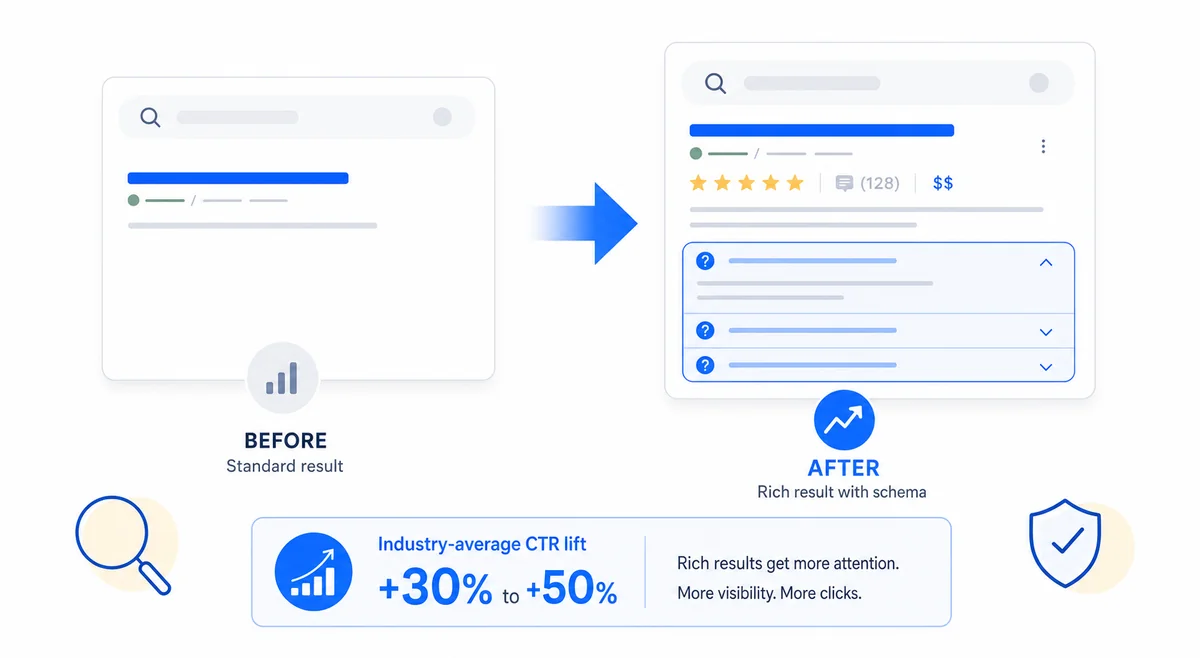
Generic SEO was written for blogs and e-commerce. Home services live in a different SERP shape: local query, user wants a phone number or booking slot. A page that doesn't declare itself as a LocalBusiness with hours, phone, address, and area served gives Google nothing structured to show in the Local Pack. Schema lets home service pages earn SERP real estate without ads: AggregateRating shows stars, FAQPage shows expandable questions, Service schema surfaces the price. My client Or at denvergaragedoor.com has 13 Google reviews and beats a competitor with 253. Schema is part of why.
Three syntaxes exist: Microdata, RDFa, and JSON-LD. The first two break when designers edit templates. JSON-LD is a self-contained block in your head section that Google explicitly recommends. Each block is a knowledge graph node: Organization connects to Service, Service connects to FAQPage. Competitors with no schema have an empty graph and can't be cited for niche queries.
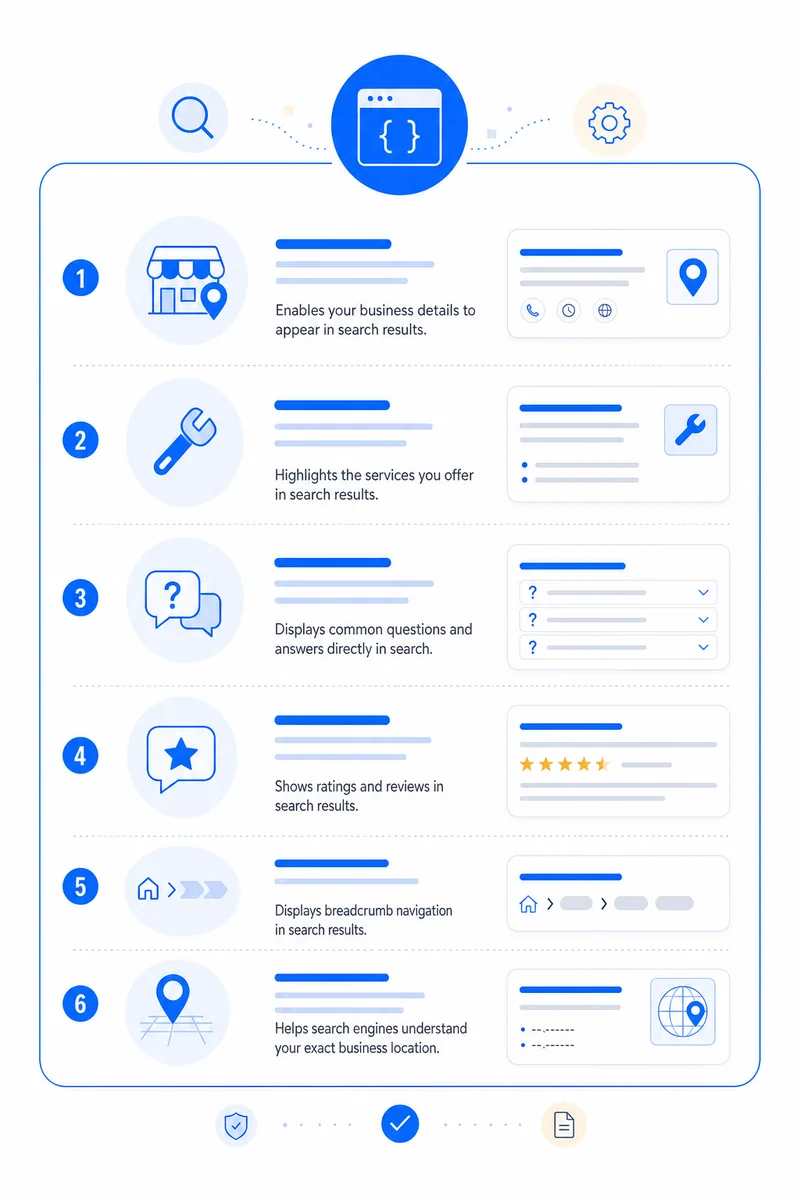
| Schema type | What it does | Placement |
|---|---|---|
| LocalBusiness | Business, hours, phone, address, area served | Home page |
| Service | Each service with price and area | Each service page |
| FAQPage | Expandable SERP questions | Any page with 4+ Q and A |
| Article | Blog content with author, date, headline | Every blog post |
| BreadcrumbList | Page hierarchy for SERP breadcrumbs | Every non-home page |
| AggregateRating | Review score with stars in the SERP | Service pages and home page |
| Review | Individual reviews with author and rating | Testimonial and service pages |
| Person | Author or founder with credentials | About page |
| Organization | Legal entity, logo, sameAs links | Home page, once site-wide |
Plugin conflict is the most common disaster I find. Yoast, RankMath, and the theme each output a LocalBusiness block, and Google ignores all three. I took over a client who had paid $2,000 a month for 14 months with duplicate blocks in View Source and rankings flat the whole time. The fix: disable the theme schema, pick one source of truth, hand-write the service-page blocks, validate. Inside 60 days the page broke into the top three. My site-wide conflict scanner catches this in the first hour.
Schema says "open 7 to 7" but the visible page says "open 9 to 5." Google treats that as misleading and deprioritizes the page. Every property must match what the user sees.
Adding a 5.0 rating with 100 reviews when the business has none triggers a manual action. Only use real review counts from a verified profile, updated when the count changes.
Yoast plus Schema Pro plus a theme setting produces conflicting blocks Google ignores. Pick one source, disable the rest, validate by counting @type LocalBusiness in View Source. The correct count is one.
Schema names one city but the business serves a 30-mile radius. ChatGPT picks the competitor whose schema lists Aurora when asked for a garage door company there. List every city you'll drive to as City-type entries inside areaServed.
View Source on every page, count schema blocks, run Rich Results Test, log the gaps. For Or's site: 7 unindexed pages, zero schema, one stray Organization block from the theme.
Disable conflicting plugin or theme schema, remove fabricated values, correct property names until every page validates and every block is intentional.
Hand-write the full nine-type stack. Each block uses @id to link to the others, each matches the visible page content, and every page validates in Rich Results Test before going live.
GSC Enhancements weekly the first month, monthly after. AI citation tracking on ChatGPT, Perplexity, and Google AI Overviews. Schema drifts. A recurring check catches the drift before it costs rankings.
Schema markup for AI optimization is the same JSON-LD, read by a different audience. AI engines prefer dense, labeled, factual blocks: LocalBusiness with areaServed, FAQPage with 8 to 12 questions, Service with a specific offer block. My move for every client is citation reverse-engineering: ask ChatGPT the niche query in the client's city, note which directories it sources from, register the client in every one. HouseCall SEO's generative AI SEO work runs on this loop.
A schema markup audit on a typical home service site finds 6 to 12 issues. Quarterly checks: one LocalBusiness block, one Organization block, BreadcrumbList on non-home pages, Service with offer on service pages, FAQPage where 4+ visible questions exist, AggregateRating matching the real review count, openingHoursSpecification matching GBP, sameAs listing every active profile, every block validating in Schema.org Validator, every page passing Rich Results Test, GSC Enhancements clear of errors, View Source on 5 random pages confirming no duplicate blocks.
None of the top 5 competitors for this query show pricing. I publish mine. The SEO packages page has more detail.
| Package | Price | What you get |
|---|---|---|
| Starter schema | $750/mo | LocalBusiness, Organization, BreadcrumbList, FAQPage, Service. Hand-written, validated, monitored monthly |
| Pro schema | $1,500/mo | Full nine-type stack, AI citation tracking, GSC Enhancements report, quarterly audit, Article schema for blog posts |
| Custom schema | $3,000+/mo | Multi-location LocalBusiness, multilingual Service blocks, custom HowTo and Event schema, dedicated dev time |
Every tier includes the House Call Method audit and Rich Results Test validation before launch. Pair with How I rank these sites or a my approach to this retainer.
Or runs denvergaragedoor.com. Starting state: zero schema, one duplicate Organization block from WordPress, 7 unindexed pages, a 253-review competitor outranking him. After the rebuild: nine-block stack validated, all 7 pages indexed in 14 days, AI engines citing him for Denver and Aurora queries, 13 real reviews showing as stars on every service page. Or now ranks above the 253-review competitor.
Tomer at pinegaragedoors.com had Yoast and a theme both outputting LocalBusiness and 14 months of stalled rankings. We disabled the theme schema, hand-wrote the full stack, validated every URL. FAQ rich results stabilized in 30 days. Click-through rose 22% month over month.
Momo at americaschimneysweep.com had fabricated AggregateRating left behind by the previous vendor. I removed it, hand-wrote real AggregateRating tied to his actual Google review count, deployed Service schema with offer per niche. Google AI Overview began citing him within 60 days.

| Feature | HouseCall SEO | Typical SEO agency |
|---|---|---|
| JSON-LD | Hand-written every page, no plugin fallback | Plugin auto-generates, never reviewed |
| Validation | Rich Results Test + Schema.org Validator pre-launch | Ships without checking |
| Conflict detection | View Source on 5 pages every audit | Trusts plugin output |
| AI readiness | Dense labeled blocks, citation tested | Client-rendered, AI invisible |
| Data accuracy | Real review counts, real hours | Templated values, often fabricated |
| Pricing | Public on this page | Hidden behind a sales call |
| Developer | Lior Daniel, 6+ years software, IDF, El Al's website | No named developer |
Two years ago schema was a nice rich-result bonus. In 2026 it's the entry price for AI search. ChatGPT, Perplexity, Gemini, and Google AI Overview cite the labeled block before the unlabeled paragraph. A home service site without schema is invisible to all four. My Ai citations marketing tracks how the citation graph evolves.
The top 5 competitor pages for this query miss four things: zero schema on their own pages, no pricing, no home-service JSON-LD examples, no named author or developer credentials. Pricing is above. Author is Lior Daniel, IDF and El Al's website background, 6+ years in software and SEO. Every recommendation here runs on Or, Tomer, and Momo's live sites.
Want to know whether your schema is helping or hurting? Fill in the form. I'll View Source on your top 5 pages, run Rich Results Test on each, and send a one-page brief within 48 hours. No popup, no pressure.
Send your details through the contact page and I will take it from there.
Schema markup gives Google and AI engines a labeled, machine-readable description of your page: rich result eligibility like stars, FAQ accordions, prices, and hours, citation in ChatGPT and Perplexity, knowledge graph entries, and higher click-through rates. Most benefits are blocked if schema is missing or malformed.
Schema in SEO is structured data in JSON-LD format using the vocabulary at schema.org, labeling the meaningful elements on a page: name, address, phone, hours, reviews, services, prices, questions, answers. Google explicitly recommends JSON-LD over Microdata or RDFa.
Schema removes ambiguity. Plain HTML asks engines to guess what a page is about. Schema tells them. Pages with valid schema are eligible for rich results, more likely to be cited in AI Overview and ChatGPT responses, and home service sites retain Local Pack eligibility and review-star display.
AI engines prefer dense, labeled blocks because they parse faster. ChatGPT, Perplexity, and Google AI Overview each weight structured data when picking sources to cite. In 2026 this is the main reason to deploy schema.
LocalBusiness drives the knowledge panel and Local Pack. Service with Offer surfaces a price under your result. FAQPage creates expandable accordions. AggregateRating shows gold stars. BreadcrumbList replaces the URL with a category path. Each type adds real estate to your listing against plain blue-link competitors.
Write a JSON-LD block for each schema type, place it in the head section, match every property to a visible element, validate with Google Rich Results Test and Schema.org Validator, monitor GSC Enhancements weekly for the first month.
Starter is $750 per month for the core five types. Pro is $1,500 per month for the full nine-type stack plus AI citation tracking and quarterly audits. Custom starts at $3,000 per month for multi-location or multilingual needs.
Look for one that hand-writes JSON-LD for your niche, validates every page before launch, monitors GSC Enhancements the first month, and shows real examples. HouseCall SEO does all four, built on garage door, plumbing, HVAC, locksmith, and chimney sweep clients across Denver, San Francisco, and California.
Ready to deploy schema that shows up in Google and ChatGPT? Request your free schema audit and I'll send the brief within 48 hours.

I specialize in home services SEO – taking websites that sit invisible on page three and turning them into the business Google and ChatGPT recommend first. I started on the developer side, writing software and doing SEO on the side, until I saw how much home-service owners were overpaying for work that quietly hurt them. So I built a method that fixes the broken technical work and the outdated thinking behind it.
From garage door companies to plumbers, roofers, locksmiths and cleaning services, the playbook is the same: rank where your customers actually search, earn real reviews, and back it with a fast site that books the job. No PBNs, no bought reviews, no directory spam – only work that survives Google’s next five updates. See exactly how it’s priced on the pricing page.