
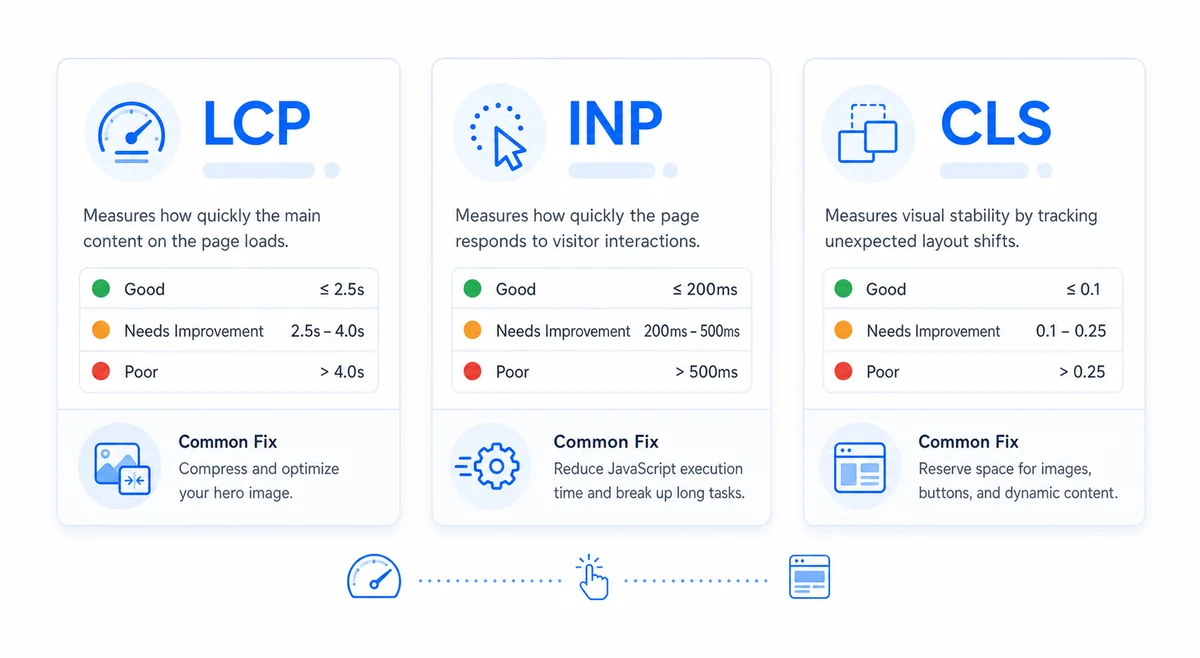
A core web vitals optimization service measures Largest Contentful Paint, Interaction to Next Paint, and Cumulative Layout Shift against Google's thresholds (LCP 2.5s, INP 200ms, CLS 0.1). A specialist then fixes slow assets, blocking scripts, and shifting layouts so 75% of real mobile sessions pass all three. For home service sites this means lighter hero images, deferred chat widgets, and stable button placement. HouseCall SEO offers this at $750 or $1,500 monthly, or custom from $2,500, with month-to-month contracts and a written audit.
Core web vitals are three metrics Google built into its ranking systems in 2021, updated in March 2024 when INP replaced FID. LCP is how long the biggest element takes to load. INP is how fast the page responds to a tap. CLS is how much content jumps during load. A core web vitals consulting engagement is the work to bring all three green for at least 75% of mobile sessions, measured with real Chrome users via the CrUX dataset, not a lab test on fiber. Core Web Vitals are one slice of the wider technical SEO I run for home-service sites.
Why does this matter for a plumber or chimney sweep? Because 64% of local searches happen on mobile, and slow sites lose roughly 40% of users who wait more than 3 seconds. I have watched contractors spend $4000 a month on ads while their LCP sits at 6.8s. The ads bring traffic. The site bleeds it.
A plugin compresses files. A core web vitals consultant finds out why your real visitors wait, page by page, and fixes the cause. On contractor sites the cause is usually the same three things: a large hero image, a chat or review widget that loads first, and a theme that moves buttons while the page loads.
| Tool | What it does | Cost | When I use it |
|---|---|---|---|
| PageSpeed Insights | Field and lab data per URL | Free | First touch on every audit |
| WebPageTest | Filmstrip and waterfall | Free / $20 mo | When LCP is bad but not why |
| CrUX Dashboard | 28-day origin history | Free | Tracking improvement after fixes |
| Lighthouse CLI | Repeatable lab tests in CI | Free | Catching regressions before deploy |
| Chrome DevTools Performance | Frame-by-frame INP trace | Free | Finding main-thread blockers |
| Web Vitals JS library | Real user monitoring in GA4 | Free | When traffic is too low for CrUX |
| Search Console CWV report | Pages by Poor / Needs Improvement / Good | Free | Prioritizing which URLs to fix |
| Cloudflare | CDN, Brotli, full-page cache | Free / $20 mo | TTFB problems on shared hosting |
I do not use SEMrush or Ahrefs for this work. Their site audit gives you a score, not a fix. The free tools above are what Google itself uses to grade you.
A developer runs Lighthouse, gets a 95, calls the site fast. I pull CrUX and 62% of real mobile users sit in the red. Lab is one test; field is everyone.
The hero photo has loading="lazy" on it, which tells the browser to wait, and LCP gets destroyed. One attribute change, worth 1.5 seconds on most pages.
WP Rocket plus Autoptimize plus LiteSpeed Cache plus a CDN plugin equals a slow site that breaks every Thursday. Pick one, configure it, done.
Booking widget, review carousel, Facebook pixel, TrustPilot embed. Each looks small. Together they can add seconds of delay on a typical roofer site.
Most traffic lands on /plumbing-near-me/ or /water-heater-repair/. If those score 41 while the homepage scores 98, the homepage win does not count.
Linoy runs SASS Facial Spa in Sarasota, Florida, on Squarespace. Every developer told her core web vitals could not be fixed on the platform. They were wrong. Her field LCP was 4.2s, CLS 0.18, INP 280ms, and she was losing position to a competitor with worse reviews because her site felt sluggish on a phone.
The homepage banner served a 1.8MB JPEG, so I shipped a 184KB version and LCP dropped 1.1 seconds overnight. I removed the auto-playing mobile video for another 0.6 seconds, and moved her booking widget to a button-triggered modal, dropping INP from 280ms to 145ms. Explicit width and height on every service image fixed 60% of the CLS.
After 31 days of field data: LCP 1.4s, CLS 0.04, INP 138ms. All green. Organic clicks for her top 5 service keywords rose 47% in 60 days. Visit sass-srq.com on a phone and see it. To pair speed work with a full rebuild, see how I rank these sites.
| Option | Typical cost | What you get | Best for |
|---|---|---|---|
| DIY with PageSpeed Insights | $0 | Generic tips, no execution | Developer-owners with time to learn |
| WordPress performance plugin | $60-$200/year | Caching, minification, lazy-load | Sites already near green |
| Generic web developer | $1000-$3000 once | Lab score fix, no field follow-up | Sites where lab is the only concern |
| HouseCall SEO | From $750/mo | Field data fixes, monthly review, SEO context | Home service sites that rank on speed |
| Full site rebuild | $8000-$25000 | New platform and template | Sites with an unsalvageable theme |
Google uses mobile-first indexing, so your mobile score decides ranking. Most themes look fine on a monitor and ship 6 seconds of LCP on an iPhone 11 with weak signal. I check mobile first and look at desktop only if mobile passes. Common mobile issues: layout shift from sticky headers, desktop-resolution images served to phones, and tap targets too small that cause INP spikes. Each has a defined fix.
Milestone's platform is enterprise CMS with performance features for multi-location brands. For a 400-location dental group, it is a real option. For a single-location chimney sweep or a 3-location plumbing company, it is overkill and overpriced. The same field-data discipline applies on any platform: measure, fix, remeasure. My client Momo runs americaschimneysweep.com on WordPress with a free theme, no migration, LCP 1.7s, CLS 0.05. The claim that you need a $5000-per-month platform to pass is a sales pitch, not a technical truth.
Website core web vitals metrics are three measurements Google uses to grade real-user page experience. LCP measures loading speed at the 2.5s threshold. INP measures responsiveness to taps at the 200ms threshold. CLS measures visual stability at the 0.1 threshold. A page passes when 75% of real-user sessions hit good on all three. Mobile and desktop score separately, and mobile affects ranking for local home service queries. The core web vitals thresholds (LCP 2.5s, CLS 0.1, INP 200ms) are non-negotiable minimums.
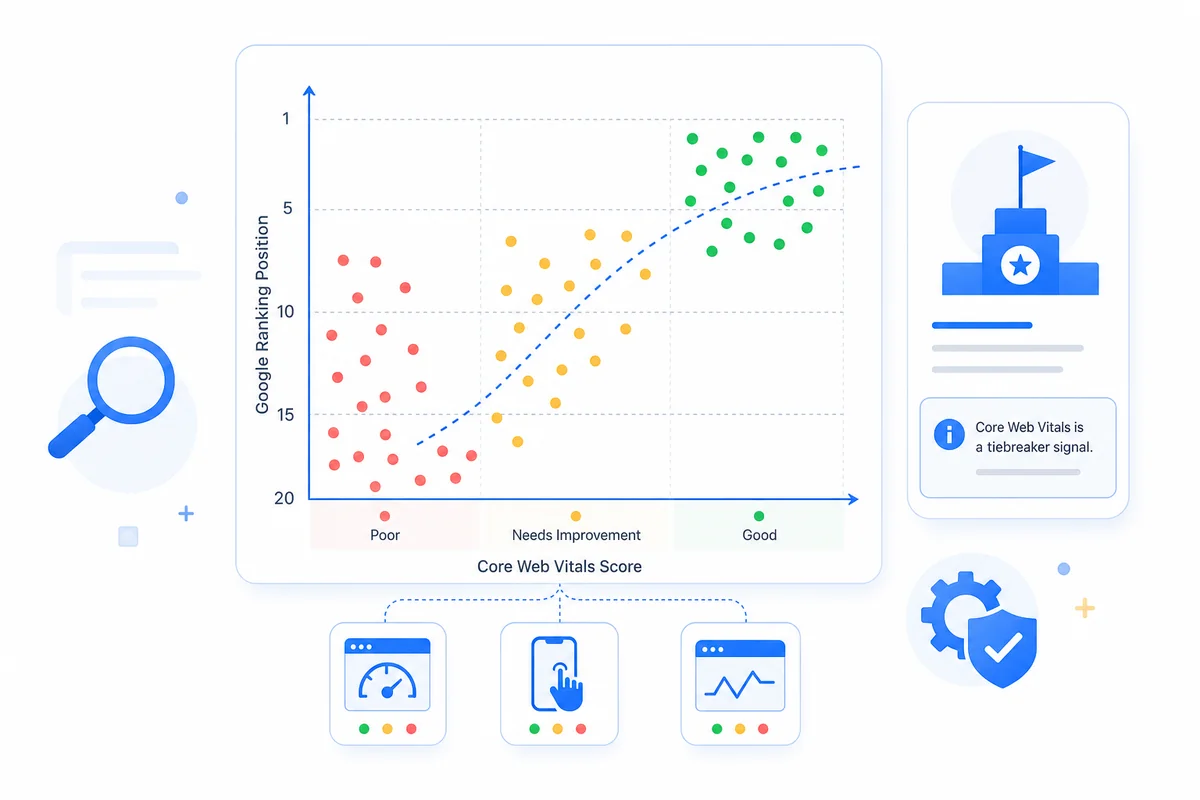
Fixing core web vitals moves three numbers that matter to a contractor. Rankings go up: page experience is a confirmed signal and most competitors still fail it. Form submissions rise: on contractor sites I've measured, a 1-second LCP gain correlates with an 8% lift. And Google rewards fast landing pages with lower CPCs, so paid traffic costs less. Whether you hire an agency or run a wordpress core web vitals plugin, the metrics care that the work gets done.
| Tier | Monthly | What is included | Best for |
|---|---|---|---|
| Starter | $750/mo | Quarterly audit, image pipeline fix, basic caching, monthly CrUX report | Single-location sites, 1-15 pages |
| Pro | $1500/mo | Monthly audit, script triage, font and critical CSS work, INP debugging, CDN setup | Multi-location sites, 20-80 pages |
| Custom | From $2,500/mo | Full engineering retainer, CI with Lighthouse, real-user monitoring, theme rebuild | 100+ pages or migration in scope |
Most home service businesses land on Pro. Starter is for sites close to green that need cleanup. Custom is for franchises needing a dedicated engineer each month. We do not use PBNs, fake reviews, or automated content. Month-to-month, no lock-in. A technical SEO audit service covers speed plus indexing, schema, and on-page in one engagement.
Most contractor themes ship with a hero video nobody watches, and removing it is my highest-impact change, often a two-second LCP win from one delete. Chat widgets are almost always net negative here, because customers call, they do not chat. A widget loading 600KB of JavaScript for 2 leads a month is a bad trade, so defer it to a button click.
The fastest site I have audited belongs to my client Or at denvergaragedoor.com: sub-second LCP on mobile, CLS 0.02, INP 89ms. He has 13 Google reviews and beats a competitor with 253 on the Denver garage door pack. Speed plus content beats review count every time. And SEMrush and Ahrefs audit scores do not match field data, because they guess at lab conditions and never pull CrUX. One prospect refused to hire me over a 92 on SEMrush; his CrUX showed 68% of mobile sessions failing LCP. He came back six months later, and the data had not moved.
It is the engineering process of measuring LCP, INP, and CLS from real Chrome users via CrUX, diagnosing the assets and scripts causing failures with Lighthouse, fixing them, and validating with another 28 days of field data. The goal is 75% or more of real mobile sessions hitting green on all three.
Yes, and more so in 2026 than 2021. INP replaced FID in March 2024, making responsiveness stricter, and Google confirmed page experience is part of its ranking systems. The honest argument: slow sites lose business regardless of ranking. Fixing Linoy's LCP from 4.2s to 1.4s lifted organic clicks 47% in 60 days.
At least 75% of real-user sessions on your origin must hit the good threshold: LCP at or under 2.5s, INP at or under 200ms, CLS at or under 0.1. Pull this from CrUX through PageSpeed Insights. Measure with field data, diagnose with lab data, fix the heaviest assets first, then validate with 28 more days.
Real users are having a poor mobile experience. Common causes: a hero image over 500KB, a chat widget loading on page-load instead of click, missing width and height on images, render-blocking fonts, and third-party scripts stacking up to 2 seconds of delay. Each has a fix.
HouseCall SEO offers three tiers. Starter at $750 per month covers quarterly audits and basic caching for sites with 1 to 15 pages. Pro at $1500 covers monthly audits, script triage, font work, and CDN setup for 20 to 80 pages. Custom starts from $2,500 and is a full engineering retainer. One-time fixes typically run $1500 to $5000.
I pull CrUX live during the consultation, walk you through your three numbers, and tell you which fix is worth doing first. No deck, no pitch. Just your real numbers and a plain answer. Book a free SEO consultation and let's look at the data together.

I specialize in home services SEO: taking websites that sit invisible on page three and turning them into the business Google and ChatGPT recommend first. I started on the developer side, writing software and doing SEO on the side, until I saw how much home-service owners were overpaying for work that quietly hurt them. So I built a method that fixes the broken technical work and the outdated thinking behind it.
From garage door companies to plumbers, roofers, locksmiths and cleaning services, the playbook is the same: rank where your customers actually search, earn real reviews, and back it with a fast site that books the job. No PBNs, no bought reviews, no directory spam. Only work that survives Google’s next five updates. See exactly how it’s priced on the pricing page.
Free 30-minute strategy call