
I am Lior Daniel, founder of HouseCall SEO: six years in SEO, a software developer background from government and airline-sector organizations, and a specialty in AI-engine optimization. I work only with US home service operators, and every example on google business profile categories below comes from a real client file.
Google Business Profile categories are predefined labels you pick to tell Google what your business does. Each profile gets one primary category that drives roughly 70% of category-based local rankings, plus up to 9 secondary categories for extra services. Google controls the list, about 4,000 options, and home service trades use a tight subset of 30 to 50. The most common mistake is a generic primary: an operator under "Repair Service" loses to one under "Garage Door Supplier" because specificity drives ranking. The automated side is covered in AI tools for Google Business Profile optimization 2026.
GBP categories are closed-set labels inside the Google My Business (GMB) dashboard that classify what your business sells. When someone searches "emergency plumber" or "chimney sweep," Google pulls profiles whose categories match that intent. Per Whitespark's 2024 Local Search Ranking Factors survey, primary category ranks number 1 among 149 variables tested, and BrightLocal found 44% of local-intent clicks go to the Local Pack. A wrong primary makes you invisible to the queries that pay your bills, while secondaries cover the long tail.
Your primary carries the heaviest weight. It controls which Local Pack queries you fire for and which competitor set you sit inside, and it drives roughly 70% of category-based ranking weight per Sterling Sky and Whitespark testing. Pick the primary that matches your highest-value query, not the one that sounds impressive. Secondaries extend range without diluting that signal, up to a hard limit of 9, but stuffing them backfires: a roofer who lists "Gutter Cleaning Service" without cleaning gutters triggers spam flags over 30 to 90 days. Only list services you genuinely perform.
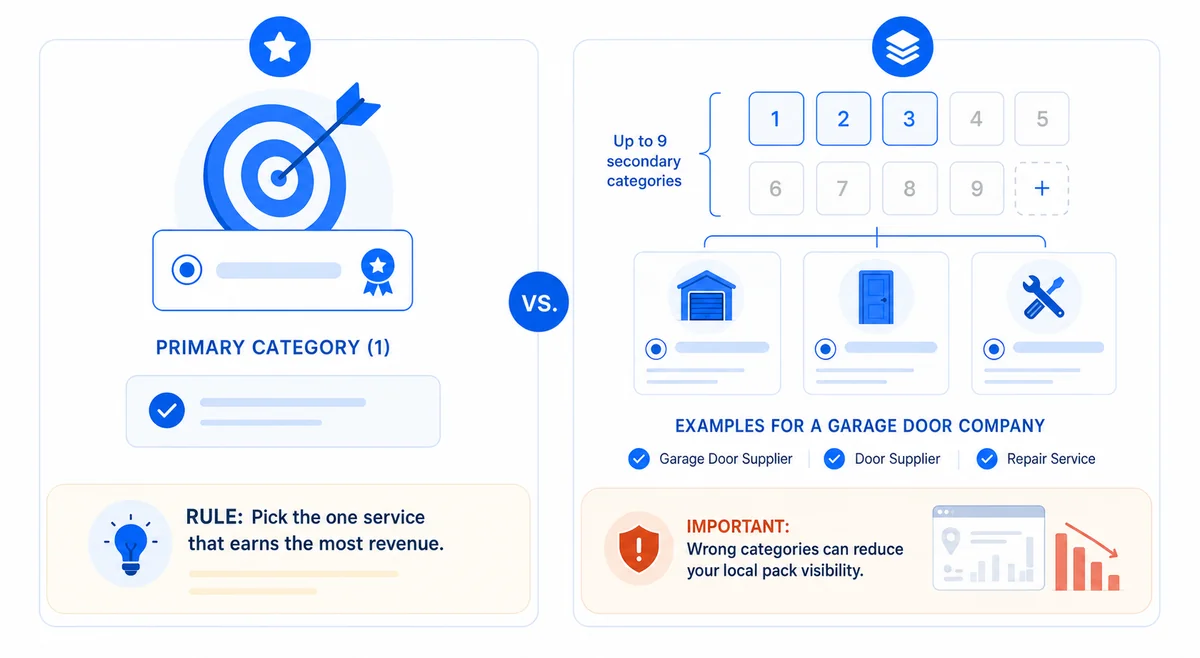
The primary also controls which optional features appear, so the wrong one quietly costs you conversion levers. Plumber, Electrician, and HVAC Contractor open up emergency hours and the "online estimates" attribute. Med Spa and Beauty Salon get access to Reserve with Google, Restaurant gets the menu attribute, and Auto Repair Shop gets make and model fields.
Google shows only secondary categories as service tags, never the primary. Three reliable ways to extract the full list:
| Tool | What it does | Cost | Best use |
|---|---|---|---|
| GMBspy | Reveals competitor primary and secondary categories | Free | Daily competitive research |
| PlePer | Full GBP category database lookup | Free | Validating new categories |
| Local Falcon | Grid-based local rank tracking | From $24/mo | Measuring category swap impact |
| Google Business Profile dashboard | Edit primary and secondaries | Free | Making the actual change |
Or owns Denver Garage Door, an American operator with a full English site. He held a verified GBP for 18 months and got 3 leads in that window. The previous SEO set his primary to a generic repair category, stuffed 9 mismatched secondaries, and left the service area on a fake address.
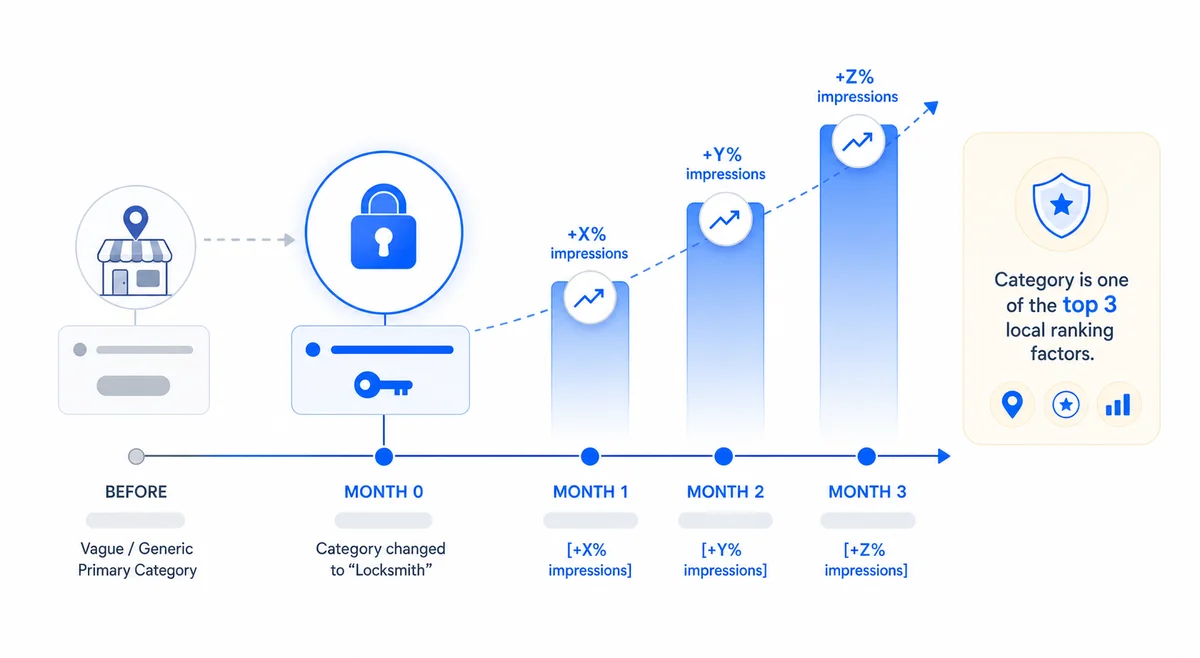
The fix took 4 weeks: switch primary to Garage Door Supplier, trim secondaries to 4 trade-specific ones, reset service area to Denver metro, strip the stuffed name. By week 9 he ranked in the Local Pack for 6 head queries; by month 6 he was getting daily leads. The category swap drove about 40% of the lift, and none of the rest worked until the category was right. Or also rode out a suspension wave during cleanup, which is where My approach to this fits the picture.
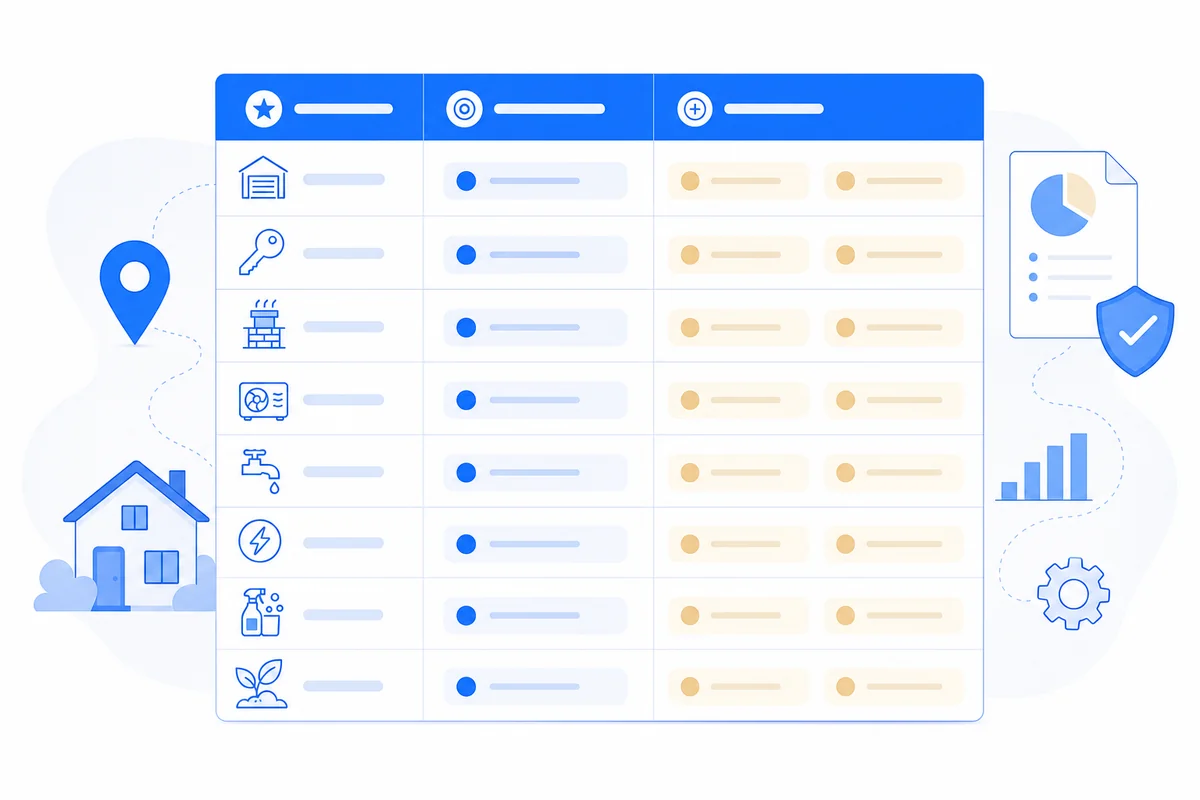
Live category stacks from client profiles I manage or have audited:
| Element | What it is | Ranking weight | Where to edit |
|---|---|---|---|
| Categories | Predefined trade labels (Plumber, HVAC Contractor) | Highest: 70% of category rank | "Business category" |
| Services | Custom service names (drain cleaning, water heater repair) | Medium: keyword relevance | "Services" section |
| Attributes | Yes/no flags (online estimates, wheelchair accessible) | Low for rank, high for conversion | "Attributes" section |
Categories control which queries you appear for; services and attributes support rank and conversion once you do. Get categories right first.
Three patterns show up in my audit logs that the major local SEO blogs skip. First, contractors confuse category fit with prestige. A plumber sets primary to "General Contractor" because it sounds bigger, but that is a demotion: the parent ranks for parent queries, and the child ranks for the calls you want. Second, Google cross-checks category claims against your website, so an "Emergency Plumber" primary with no 24/7 mention on the homepage loses trust over 30 to 90 days. Third, duplicate listings dilute the signal, so if a stale profile is splitting your rank you should request a Google Business Profile duplicate review before touching categories.
The Trust Stack also matters more than category alone. My clearest example is Or's 13 Google reviews beating a 253-review competitor, a win that combined category fit, content depth, and AI engine citations. The right category is the anchor that makes the rest believable. I apply the same framework to painting contractor SEO, where the choice between "Painter" and "Painting Contractor" creates the same precision problem, and my full breakdown shows why category accuracy now feeds AI citation ranking too.
| Package | Price | What is included | Best for |
|---|---|---|---|
| One-time category audit | $350 | Full category review, recommendations, competitor pull, written report | Contractor handling GBP in-house |
| HouseCall Starter | $750/mo | Monthly GBP optimization: categories, posts, photos, Q&A, review monitoring | 1-location operator |
| HouseCall Pro | $1,500/mo | Starter plus website SEO, AI engine optimization, citations, reports | Growth-focused contractor |
| HouseCall Custom | From $2,500/mo | Pro plus multi-location management and a dedicated strategist | Multi-location or franchise |
If you want a category review done properly, I run a free 30-minute GBP audit for US home service operators. I pull your current primary, your top 3 competitor primaries, your service area accuracy, and your suspension risk, and you leave with a written list of changes. I do not pitch services or ask you to sign anything. Read Google review request best practices before the call, because review velocity and categories work together.
They are predefined labels in the GBP (formerly GMB) dashboard that tell Google what your business does. Each profile picks one primary and up to 9 secondaries from a Google-controlled list of about 4,000 options. Primary drives roughly 70% of category-based local rankings per Whitespark testing, and specificity wins: "Emergency Plumber" beats "Plumber." GBP and GMB are the same platform, rebranded from Google My Business in 2022.
Open Google Search Console, find your top 5 money queries, and pick the primary that serves query 1. Pull competitor primaries with GMBspy or PlePer to see what is winning, then add 3 to 5 secondaries for services you actually perform. Save, wait 7 days, and measure rank shift with Local Falcon. Quarterly rechecks keep your stack current.
Install the free GMBspy Chrome extension and open a competitor's profile in Google Maps to reveal primary and secondary categories in a sidebar. Or paste a Google Maps URL into PlePer's lookup at pleper.com. As a backup, view the page source and search for "category" in the JSON payload. GMBspy is fastest, PlePer is most reliable.
My one-time category audit is $350 and includes a primary and secondary review, a competitor pull, and a written report. Ongoing GBP management runs $750 a month on Starter and $1,500 on Pro. Doing it yourself costs only time, since the tools above are free or near $24 a month.
Indirectly, yes. ChatGPT and Perplexity pull from Google Maps when answering local-intent queries, so profiles with accurate categories and strong Local Pack rankings get cited more often. Google rankings feed AI citations and AI citations validate them. Get the category right and AI visibility follows.
If your GBP is sitting in position 5 or below, the category set is the first thing to fix. Or sat at 3 leads in 18 months until we swapped his primary, and he gets daily leads now. Same business, same owner, same city. The difference was 4 weeks of work that started with one category change. Book a free SEO consultation and I will run your category audit live on the call. You leave with a written list of changes, whether or not we work together after that.

I specialize in home services SEO: taking websites that sit invisible on page three and turning them into the business Google and ChatGPT recommend first. I started on the developer side, writing software and doing SEO on the side, until I saw how much home-service owners were overpaying for work that quietly hurt them. So I built a method that fixes the broken technical work and the outdated thinking behind it.
From garage door companies to plumbers, roofers, locksmiths and cleaning services, the playbook is the same: rank where your customers actually search, earn real reviews, and back it with a fast site that books the job. No PBNs, no bought reviews, no directory spam. Only work that survives Google’s next five updates. See exactly how it’s priced on the pricing page.
Free 30-minute strategy call