No, but they are related. Google AI Mode is a tab inside Google Search. Gemini is a separate chat assistant at gemini.google.com and in the Gemini app. AI Mode runs on a version of Google's Gemini models, which is why people mix them up.
The practical difference for a contractor: AI Mode is a search result, so it pulls from Google's index and your Google Business Profile at the moment someone searches. Gemini is a conversation, so it answers from what the model already knows about your business and from web results it chooses to look up.
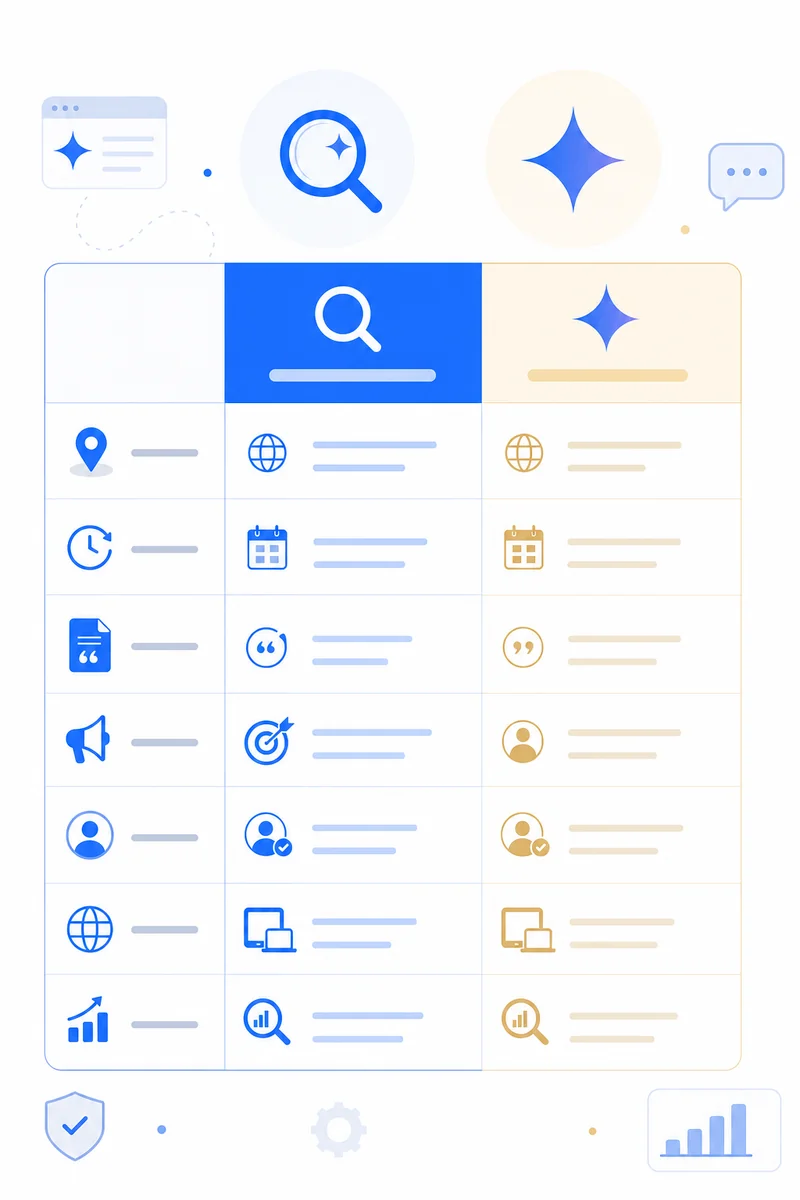
| Google AI Mode | Gemini | |
|---|---|---|
| Where it lives | A tab on google.com and in the Google app | gemini.google.com and the Gemini app |
| What it is | A search experience | A chat assistant |
| Typical homeowner moment | Ready to hire: "emergency plumber near me" | Still deciding: "why is my garage door spring loud" |
| What gets you named | Ranking pages, clear answer blocks, a complete GBP | Consistent mentions of your business across the web, plus the same page signals |
AI Mode first. It sits on the search results page where people with a broken water heater already are, and the work that gets you cited there (indexed service pages, answer blocks, a clean Google Business Profile) is the same work that lifts your normal rankings. Gemini visibility follows once your business is mentioned consistently on directories and local sites.
Google AI Mode vs Gemini is a comparison that matters for home service owners: both surfaces share Google's index, but they serve answers differently. Google AI Mode is a feature inside google.com. The user taps the AI Mode tab and gets a generative answer built from indexed web pages, citation chips, and follow-up prompts, all without leaving Google. Our google business profile optimization checklist covers which signals push a home service brand into those citation slots.
Gemini is a standalone conversational assistant at gemini.google.com, closer to ChatGPT than to a SERP. Users ask any question or ground answers in a live web search through Search Grounding. Both run the same model family, but serve different user intents. In AI Mode, the searcher has active buy intent: answer, phone number, service call. In Gemini, the user is in research mode, asking "what should I do about my garage door spring" before they ever search near me. AI Mode is the buying moment. Gemini is the deciding moment. Our GBP optimization for service-area businesses covers both surfaces because GBP data feeds directly into each surface's local answer.
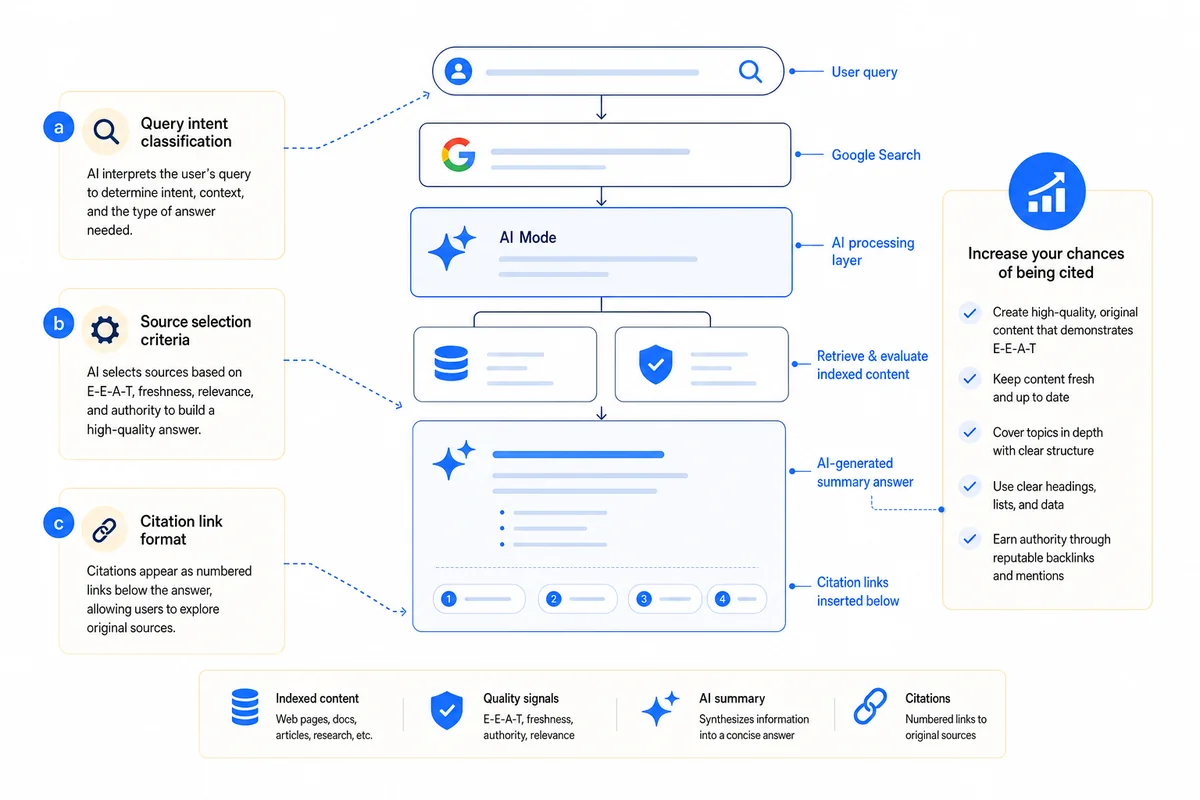
Google AI Search Mode is a generative answer tab inside google.com. The user selects AI Mode and gets a conversational synthesis from indexed web pages, with citation chips and a sidebar of source links. Follow-up questions carry context from the previous answer. It started as a Google Search Labs experiment and runs on a version of Google's Gemini models tuned for breaking a question into parts and citing sources.
Google AI Mode began as an opt-in Search Labs experiment in the US, then opened to US searchers without joining Labs. Google has since moved it to newer Gemini model versions. Rollout timing varies by country, query type and signed-in state, so check what your own customers see on their phones.
Google AI Search Mode is available to most signed-in Google accounts in the US on desktop and mobile and Google keeps expanding it to more countries and languages. The tab is most visible on informational and commercial queries. Home service queries trigger AI Mode results frequently in metro areas, less so in smaller markets where the local index is thinner.
AI Overviews appear automatically at the top of many Google results, with no opt-in. AI Mode goes further: a dedicated tab where the entire result is generative and the user can ask follow-up questions. Being named in AI Mode is a higher-stakes win because no blue links compete on that tab.
All three major AI engines run the same pipeline: query decomposition, retrieval, scoring, synthesis, attribution. ChatGPT pulls from Bing when web search is on. Perplexity prefers fresh citation-dense pages. Gemini and AI Mode pull from Google's index. A page earns a citation when it ranks for the query or a variant, contains a self-contained answer block, and the brand is entity-verified across the open web. Or, the owner of denvergaragedoor.com, earned his first AI Mode citation after we added 11 niche directory entries and three Reddit replies in r/Denver, even though his on-page work was already done. The entity layer is what opens this up.
FAQPage, HowTo, LocalBusiness, and Service schema correlate most with AI Mode and Gemini citations. FAQPage lifts question-answer pairs directly into AI Mode answer paragraphs. Write FAQs as real customer questions ("How much does a garage door spring repair cost in Denver?"), keep each answer 40 to 80 words and fact-dense. LocalBusiness gives the model verified NAP facts. Service names specific offerings. The trap is schema-page mismatch: when the model finds a discrepancy, the citation slot closes. Read the full breakdown in our schema markup is important explained and local patterns in our schema markup for local businesses resource.
Three formats earn citations across both surfaces. First, Q&A blocks: a real customer question followed by a 40 to 100 word answer with one specific number and one named entity. Second, stat blocks: a paragraph opening with a specific number ("Garage door spring repair costs $180 to $360 in Denver"). That is the format I use on every garage door SEO page. Third, clean pricing or comparison tables. Content with no numbers and no named places gets rejected fast. Specificity is the cheapest edge you can build in 2026.
Open ChatGPT, Perplexity, and Gemini. Type the query a customer would use ("best garage door company in Denver"). Note every directory and listing the AI cites. Register on every one with consistent NAP and service descriptions. Plenty of SEO providers still sell directory submissions from a 2018 list. The 2026 version is to ask the AI which directories it uses for your niche in your city, then register there. That list shifts every quarter.
Google Business Profile feeds directly into AI Mode and Gemini local answers, which is the same fight as ranking a locksmith in Maps. Four mistakes block citations consistently. First: incorrect Service Area Business setup that hides the address, leaving Google unsure where the business operates. Second: keyword-stuffed services lists with 40+ overlapping entries that trip the spam filter. Third: wrong primary category. "Plumber" is generic when "Emergency Plumber" is your actual operation. Fourth: a spam-sounding business name. Clean, brand-like names signal legitimacy to AI engines. Our full map listing audit handles the full audit sequence.
Our internal tool fires 20 to 50 priority queries per client monthly across ChatGPT, Perplexity, Gemini, and Claude, split into service, comparison, and education buckets. Each runs three times for natural variance. We track citation rate, position in answer, source coherence, and competitor displacement, and fold results into the monthly client report alongside Search Console and Local Pack data. Read the framework in our monitor SEO performance in AI search guide.
Our stack is deliberately small. Google Search Console is the primary source of truth, supplemented by a paid SERP API for AI Mode detection. For AI citation tracking we use our internal tool; no commercial product tracks at the depth we need. SEMrush and Ahrefs sell keyword data out of sync with what users search in ChatGPT and Gemini. Surfer SEO and Clearscope push every page toward the same content shape, removing differentiation. I use AI in research and analysis, not for final published content. Read more in our generative engine optimization framework.
A homeowner who gets a Gemini recommendation opens Google in the next tab and searches the brand name. If the brand shows up with a strong GBP and a clear service page, trust holds. Or, the owner of Denver Garage Door, put it plainly: customers search Google and ChatGPT just to be safe, and seeing the same name in both places gives them trust. He built that dual presence with 13 reviews against a competitor holding 253. Entity coherence and answer-format quality are what separate the contractors getting cited from those getting skipped. Read more in our brand-in-AI visibility guide.
AI citation tracking is part of every plan. Starter at $750/month includes quarterly AI-citation tracking. Pro at $1,500/month tracks AI citations monthly and adds competitor reverse-engineering. Custom starts at $2,500/month for multi-location businesses. No contract, and I do not guarantee rankings. See what each plan includes for the full deliverables.
Google AI Mode is a SERP tab inside google.com that returns generative answers from a Gemini variant when the user opts in. Gemini is a standalone conversational assistant at gemini.google.com. AI Mode is a search experience; Gemini is a chat experience. Both use the same model family and pull from Google's index, but they serve different user intents and require different optimization tactics.
Yes. Both surfaces share content fundamentals (indexed pages, FAQ schema, structured answer blocks) but diverge on the entity layer. AI Mode leans on page-level signals because it fetches live. Gemini leans on brand-level entity citations because it often answers from training data. Optimizing only one leaves significant traffic to competitors.
In my experience it takes months, not weeks. AI Mode citations come first when the page already has a strong organic baseline. Gemini takes longer because inbound mentions across directories, Reddit, and YouTube must accumulate before the model registers the brand.
At HouseCall SEO: Starter at $750/mo with quarterly AI-citation tracking, Pro at $1,500/mo with monthly AI-citation tracking and competitor reverse-engineering, and Custom from $2,500/mo for multi-location businesses. No contract. Full breakdown in our how the tiers compare page.
Yes. Or at Denver Garage Door outranked a 253-review competitor on AI Mode citations for "garage door spring repair Denver" with only 13 reviews. AI engines weight entity coherence, answer-format quality, and citation triangulation, not review count alone.
FAQPage, HowTo, LocalBusiness, and Service schema all help. FAQPage is the highest-impact type for home service pages because the question-answer format maps directly to how both surfaces extract answers. LocalBusiness anchors the brand to a place. Service names specific offerings the model can match against user queries.
I am Lior Daniel, founder of HouseCall SEO, a software developer and SEO specialist for 6+ years with prior work at government and airline-sector organizations. I specialize in AI-engine optimization for US home service businesses and do the work directly on every account. If you want to know where your brand stands across Google AI Mode, AI Overviews, ChatGPT, Perplexity, and Gemini, Book a 30-minute call or get the free 24-hour audit.

I specialize in home services SEO: taking websites that sit invisible on page three and turning them into the business Google and ChatGPT recommend first. I started on the developer side, writing software and doing SEO on the side, until I saw how much home-service owners were overpaying for work that quietly hurt them. So I built a method that fixes the broken technical work and the outdated thinking behind it.
From garage door companies to plumbers, roofers, locksmiths and cleaning services, the playbook is the same: rank where your customers actually search, earn real reviews, and back it with a fast site that books the job. No PBNs, no bought reviews, no directory spam. Only work that survives Google’s next five updates. See exactly how it’s priced on the pricing page.
Free 30-minute strategy call