To monitor seo performance in ai search, you need more than a rank tracker. You track whether your brand appears inside ChatGPT, Gemini, Perplexity, or Google AI Overview when a homeowner asks a service question. Traditional SEO monitoring tracks your position on a Google results page; AI search monitoring generates the answer first, then reads the reply for brand mentions, source links, and accuracy. The output is a citation share across a fixed prompt list, charted month over month. The gap between what Google Search Console reports and what AI engines surface surprises most operators.
A homeowner in 2026 asks ChatGPT or Gemini first, then verifies on Google. Pew Research Center reported in 2025 that 38 percent of US adults under 50 use a generative AI tool weekly. My client Or runs a garage door shop in Denver and logged 11 calls last quarter where the homeowner said "ChatGPT told me to call you," up from 2 the prior year. The Trust Stack explains why: customers verify a ChatGPT recommendation by Googling the brand, and verify a Google result by asking ChatGPT. When both agree, trust multiplies. The playbook for getting inside the Trust Stack is on the how to improve brand visibility in AI search engines page.
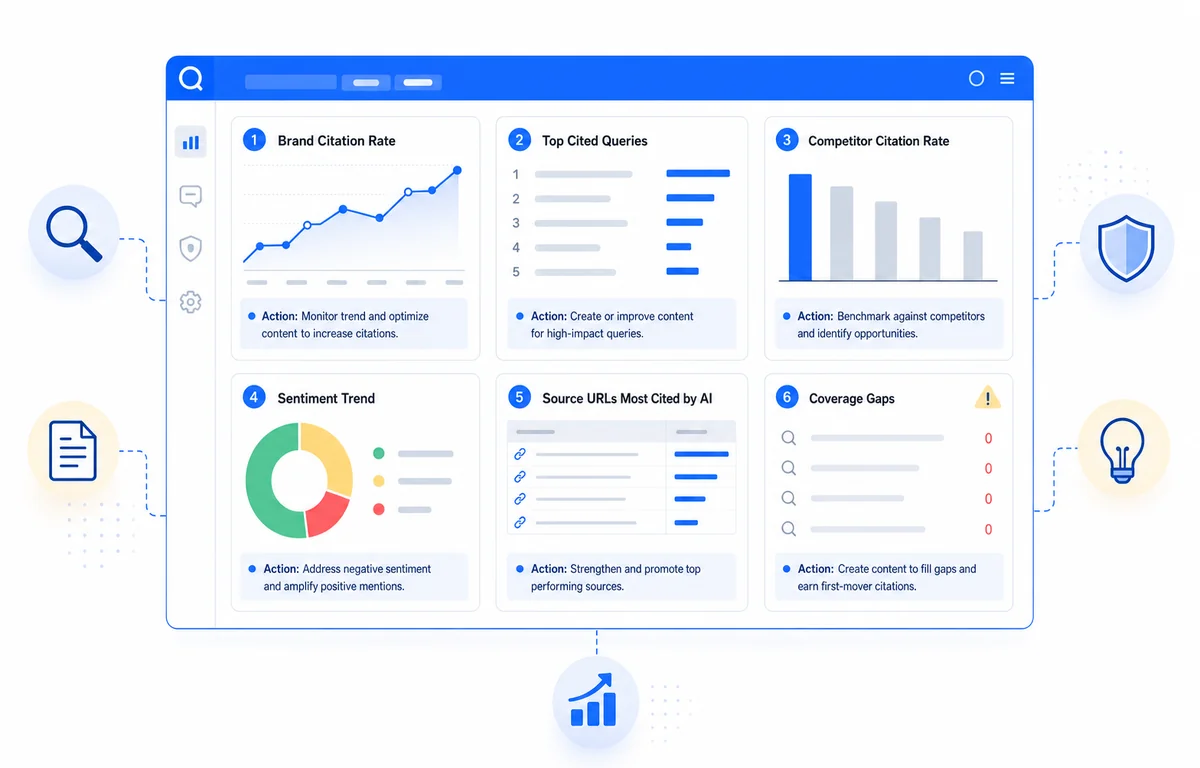
Six numbers make up a real monitoring program: citation presence, citation rank, source link inclusion, factual accuracy, query coverage across engines, and change over time. Citation rate and position in Google AI Overview are the two headline KPIs. The branded versus non-branded split matters most for revenue: a citation on "best garage door repair near me Denver" earns a new customer; "Or's Garage Door reviews" is already a customer who found you.
AI search tracking is the practice of measuring how often, where, and how accurately the AI answer engines name your brand inside their generated answers. Instead of position on a results page, you measure presence inside the model's spoken response across all four engines. A program without a monthly cadence is not tracking. It is a one-off screenshot.
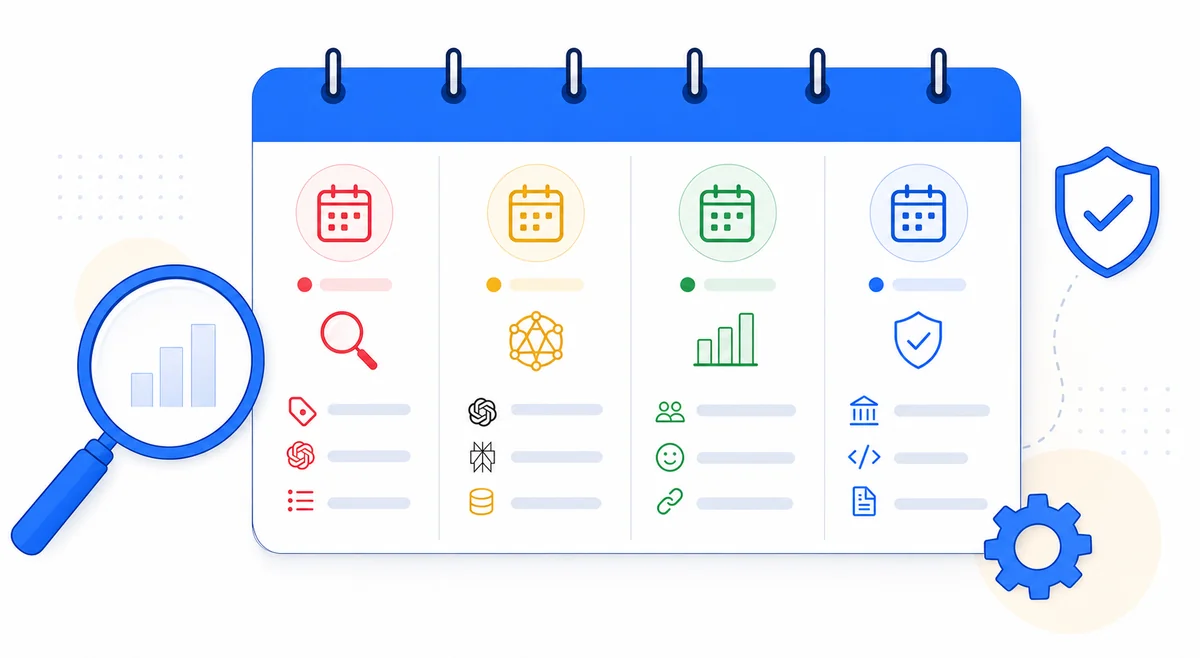
Every retainer runs the same workflow on the first of every month. Month one: we build the prompt list from SEMrush keyword research, Knowatoa prompt mining, and direct client interviews. A single-service plumber lands at 20 prompts; a multi-service contractor at 35. The list is locked so the time series stays comparable.
On the first of every subsequent month, the runner fires the full list. Each prompt hits all four engines three times to absorb variance. A parser extracts brand names, source URLs, mention order, and factual claims, then compares them against the client's ground-truth file. Any contradiction is flagged as a hallucination, a check almost no commercial tool runs. By the second, a six-section report lands: executive number, engine breakdown, prompt-level table, win list, gap list, next-month plan. Or at denvergaragedoor.com has received it on the third of every month for fourteen months. Every prompt that named a competitor becomes a ticket in the next sprint.
For every prompt the client lost, we ask the same prompt back to ChatGPT and Perplexity with one follow-up: "Which sources did you use to write that answer?" Both engines name the directories, publications, and Reddit threads they pulled from. We log every source, then register the client in every one that allows it. For Or, that meant 14 new directory listings, 3 niche industry sites, and 2 local news mentions inside 90 days, and citation share moved from 32 percent to 58 percent. No software required, just the discipline of asking the model where it gets its data, then planting more facts there.
Four mistakes we audit on day one of every retainer: hiding the address on a Service Area Business when it should be visible; cramming 40 keyword-stuffed service variations into the services list; the wrong primary category ("Plumber" instead of "Emergency Plumber" loses all after-hours queries); and a brand name that reads like spam. A spammy GBP brand name kills both local rank and AI citation. Keep it clean: just the real business name.
None of the top five competitors for this query have schema deployed. Three types matter most: LocalBusiness (or a sub-type like GarageDoorService or Plumber), FAQPage, and HowTo. When the LocalBusiness block matches the GBP and directory profiles, models cite the page far more often; mismatches trigger a downrank. FAQPage schema wraps Q&A blocks at 60 to 100 words, leading with a direct first sentence, because the model needs source material it can quote inside a chat answer without paraphrasing. A 60-word answer fits. A 400-word paragraph does not. The how I rank these sites covers tools that build these blocks at scale.
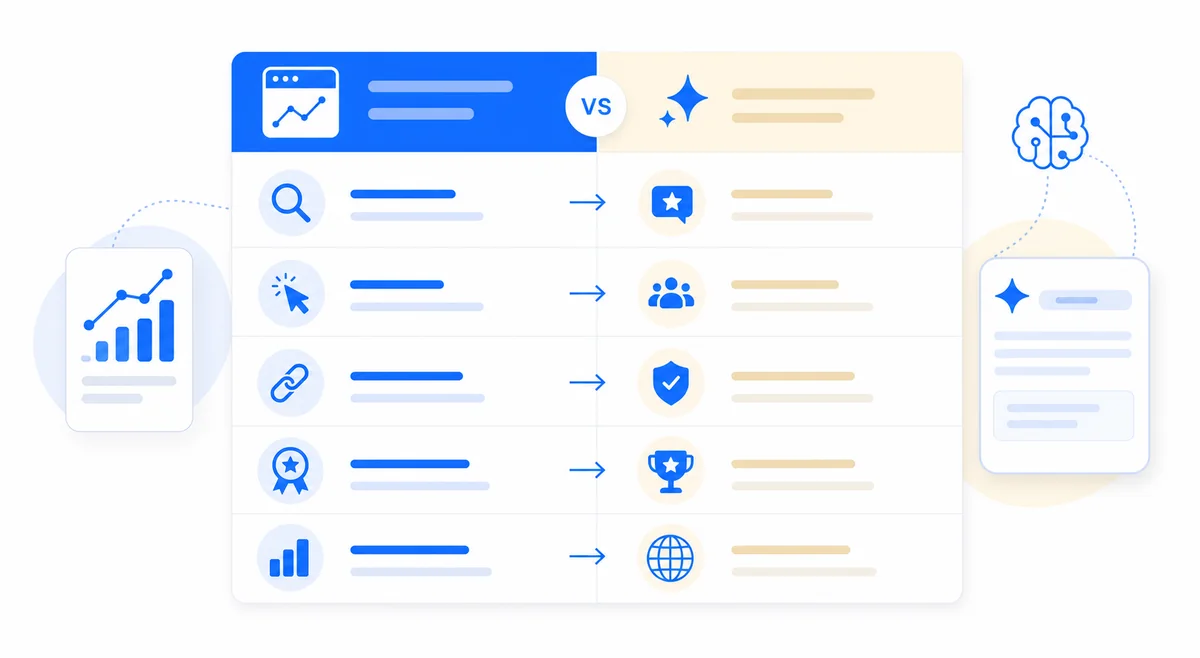
AI search monitoring sits next to Google Search Console and Google Analytics 4. GSC tells you how Google indexed and ranked your pages. GA4 tells you what visitors did. AI search monitoring tells you whether the engines named you at all. A citation rate climbing while GA4 traffic stays flat means the brand is named but the homeowner is calling instead of clicking, which is good news because a call from ChatGPT closes at a higher rate than a click. The best ChatGPT SEO tracking tool for a contractor plugs into this existing loop.
Google AI Overview grew fastest in 2025 and now shows on a majority of commercial queries in the US. The factors that move position in it: LocalBusiness schema, Q&A blocks, accurate GBP data, and source diversity. The pages we restructured around Q&A blocks moved from average position 3.4 to 1.9 inside 90 days on Or's account, and that shift shows in the report before it shows in booked calls.
February 2025 baseline: 11 of 34 prompts named Or in at least one engine. April 2026: 27 of 34. ChatGPT-attributed booked calls last quarter: 11 confirmed, up from 2 the prior year. Hallucination flags caught in March 2026: 2, both fixed by updating directory listings. The competitor with 253 Google reviews sits higher on some Google rank positions but loses bookings because Or is now named first on 22 of 34 ChatGPT prompts. The full blueprint lives on our local SEO case study page.
The same loop runs across other niches. Momo at America's Chimney Sweep in California climbed from 4 of 22 chimney prompts to 14, after one run caught the model claiming he serviced a city outside his radius and we fixed two directory profiles. Alex at Ace Locksmith SF moved from 6 of 28 San Francisco prompts to 19, with Perplexity share climbing fastest once we built three directory listings that engine weights. Tomer at Pine Garage Doors in Denver runs the commercial-tilt version of the same report. Different trades, same discipline.
Profound covers ChatGPT, Perplexity, Gemini, and Claude at enterprise pricing only. Otterly.ai starts at $89 a month with sensible dashboards but shallow Perplexity coverage and no hallucination check. Knowatoa mines public AI queries to build the initial prompt list. Our internal runner is a Python script and a Google Sheet that hits all four engines, scores citations, and flags hallucinations against a ground-truth file. None of these tools paid for the mention.
The House Call Method runs in four phases. Audit (two weeks): every page, GBP, directory profile, schema, and a baseline citation rate. Fix (days 14 to 60): GBP mistakes, schema, service page rewrites, toxic citation cleanup. Build (from day 30): service pages, city pages, niche directory listings, EEAT signals. Track: runs on the first of every month. The full four-phase breakdown is on our AI optimization and GEO process page.
Monitoring is included in every retainer. A fix loop without tracking is guesswork. Tracking without a fix loop is just a chart you look at once and forget.
| Package | Monthly price | Prompts tracked | Engines covered | Hallucination check |
|---|---|---|---|---|
| Starter | $750/mo | 20 | ChatGPT, Gemini | Manual review |
| Pro | $1,500/mo | 35 | ChatGPT, Gemini, Perplexity, Google AI Overview | Automated, ground-truth file |
| Custom | From $2,500/mo | 50+ | All four engines plus voice-mode pilot | Automated plus quarterly source audits |
Full breakdown on the tier comparison. What makes a specialist agency different from a generic shop is covered on the founder-led model page.
We pull 10 prompts for your niche and city, run them through all four engines, and email you the answers within 48 hours. No call required. Pricing comes after, only if the numbers prove the gap is real and fixable. Book your free SEO consultation and we will run a baseline this week.
Homeowners increasingly ask ChatGPT or Gemini for a contractor recommendation before they Google one. Or's Denver garage door brand logged 11 ChatGPT-attributed calls last quarter, up from 2 the prior year. If your brand is not named when the AI engines answer a service question, the lead goes to whoever is.
Measure six numbers every month: citation rate, citation rank, source link inclusion, factual accuracy, query coverage by engine, and change over time. The headline KPIs are citation rate, AI Overview position, and the branded versus non-branded split.
AI search tracking is sending a fixed prompt list to the major AI answer engines on a recurring schedule, capturing the model's answer, and scoring whether your brand was named, where, with what source links, and how accurately. A one-off screenshot is not tracking.
Organic click volume on Google has dipped on commercial queries since Google AI Overview expanded in 2025. Phone volume from organic leads has not, because customers who get the answer inside the overview often call the named brand directly without clicking.
Run three reports in parallel: Google Search Console for index coverage and rankings, Google Analytics 4 for session and conversion data, and AI search monitoring for citation share across the four engines. Together they explain why phone volume moves even when click volume stays flat.
Standalone tools range from $89 a month for Otterly.ai to enterprise pricing for Profound. Our retainers bundle monitoring at $750, $1,500, and from $2,500 monthly with no separate tracking fee. Full breakdown on how the plans differ.
The first useful chart is at month two. Meaningful citation share lift shows up between month three and six. Or's account moved from 32 percent to 58 percent in 90 days, then to 79 percent over 10 more months.

I specialize in home services SEO: taking websites that sit invisible on page three and turning them into the business Google and ChatGPT recommend first. I started on the developer side, writing software and doing SEO on the side, until I saw how much home-service owners were overpaying for work that quietly hurt them. So I built a method that fixes the broken technical work and the outdated thinking behind it.
From garage door companies to plumbers, roofers, locksmiths and cleaning services, the playbook is the same: rank where your customers actually search, earn real reviews, and back it with a fast site that books the job. No PBNs, no bought reviews, no directory spam. Only work that survives Google’s next five updates. See exactly how it’s priced on the pricing page.
Free 30-minute strategy call