
Voice search local SEO determines which home service contractor gets named when a homeowner asks Google Assistant, Siri, or Alexa for help.
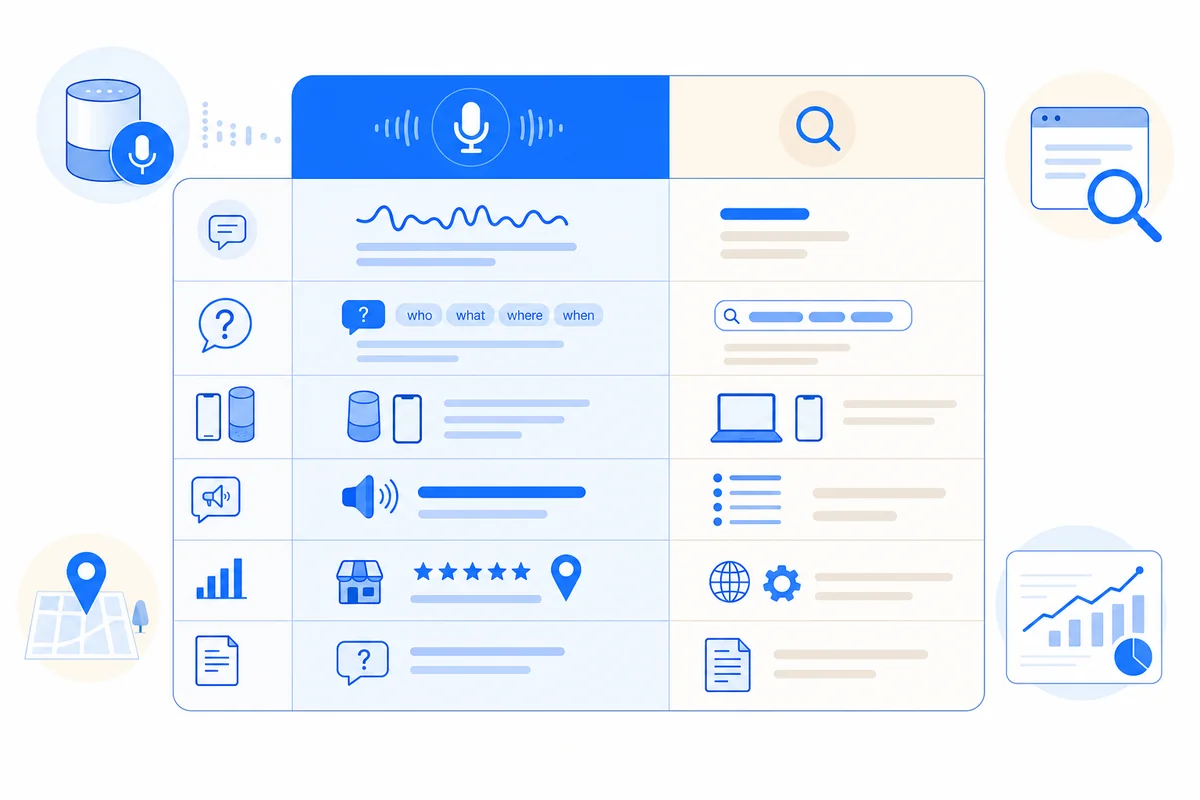
Voice search local SEO is about earning the single spoken result when someone asks a voice assistant for a nearby service. Traditional SEO lands you on a list of ten blue links. Voice search local SEO fights for position zero, read aloud, one name and one phone number. The assistant picks one winner. Everyone else is invisible. The mechanics differ too: typed queries are short ("plumber Denver"), voice queries are full conversational sentences ("Who is the best emergency plumber open right now near downtown Denver?"). Your content has to match how customers speak, not how brochures read. Using the how I rank these sites can surface which spoken queries your competitors are already winning. Voice queries concentrate on home services because people ask Siri for things they need at home, urgently, with their hands full.
Voice queries run three to five times longer than typed ones, with question words and modifiers like "best," "open now," and "tonight." "Plumber Denver" becomes "Who is the best plumber near me in Denver?" If your H2 says "Plumbing Services," Siri has nothing to pull. If your H2 says "How much does an emergency plumber cost in Denver after midnight?" Siri has a sentence to read. Most contractors never make that switch.
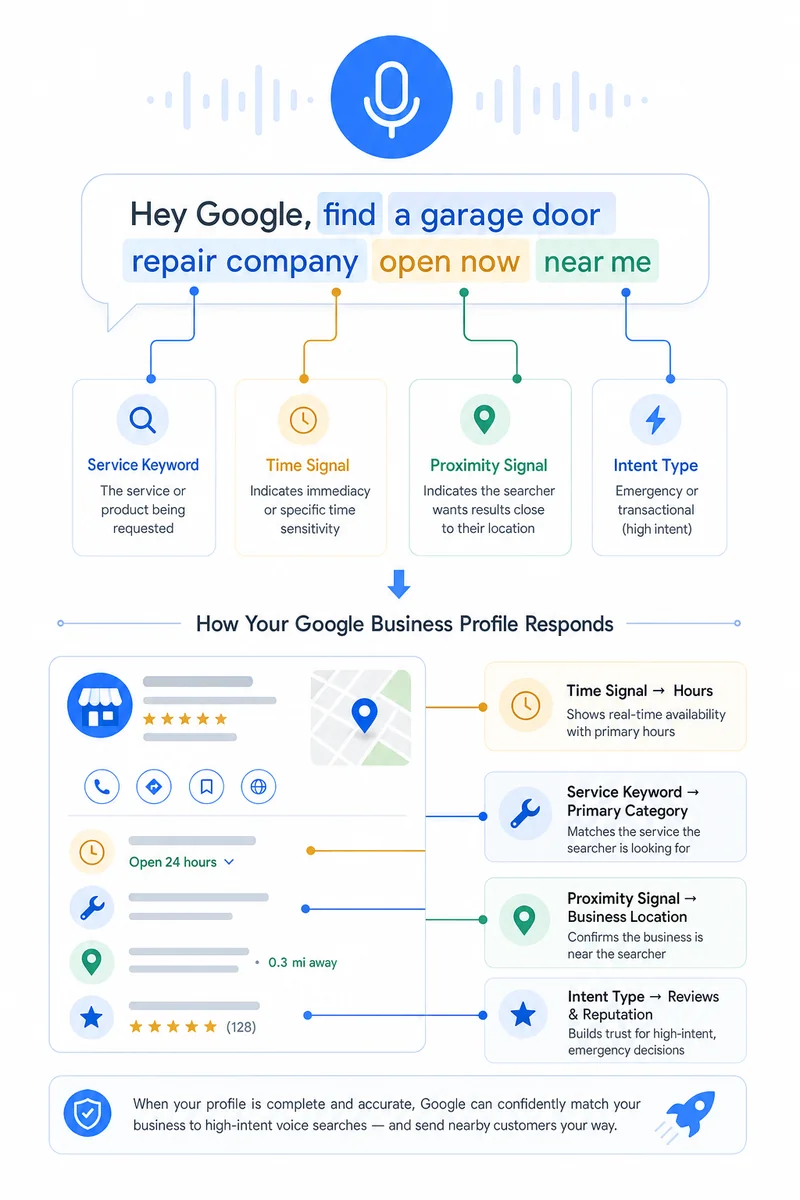
Google replaces "near me" at query time with the searcher's actual geolocation. What you need is the geography the assistant uses to resolve it: city names, neighborhoods, ZIP codes. Or in Denver does not repeat "garage door repair near me." His pages name Cherry Creek, Highlands Ranch, LoDo. When a homeowner in Cherry Creek asks Siri, Siri matches Or's page first. The result: 13 Google reviews beating a competitor with 253. Specificity beats volume.
Each assistant has its own source of truth. Google Assistant pulls from Google Business Profile first. If your GBP category is wrong, you lose. Siri uses Apple Maps with Yelp as the review layer. Zero Yelp reviews against a competitor with 40 and Siri hands them the call. Alexa leans on Bing and Yelp. Bing Places is the most neglected directory in home services. Claiming it takes 20 minutes and gets you Alexa visibility for years. Your Google Search Console data alone will not show you which assistant is costing you calls.
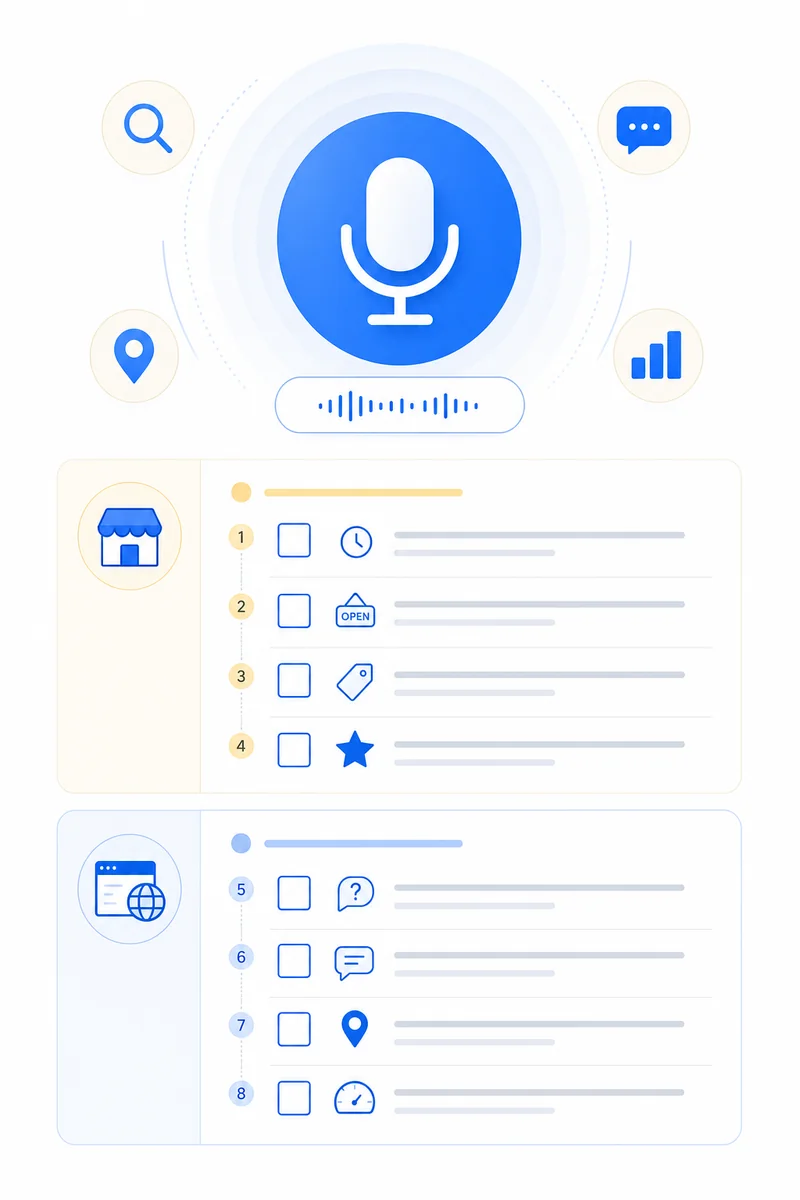
Your GBP matters more than your website for voice search local SEO. I audit one every week. The same four mistakes appear on 90% of contractor profiles:
Fix those four and your GBP becomes your strongest voice search asset. Pair it with our google business profile optimization service and you stop bleeding voice calls to competitors.
ChatGPT, Perplexity, Gemini, and Google AI Overviews use named-entity recognition to identify real businesses. Consistent name, address, phone, and hours across 20 to 40 directories earns full entity trust. If your name differs across Yelp, Bing, and your website, the AI sees three overlapping businesses and cites none. NAP consistency is unglamorous, but it is what wins voice search local SEO. I run every new client through a 20-directory NAP audit in week one: Yelp, Bing Places, Apple Maps Connect, Facebook, BBB, Angi, HomeAdvisor, Thumbtack, Nextdoor, and 11 niche directories per vertical.
The five strongest signals I have measured: cross-source presence in 20+ directories, structured data (full schema gives the AI a clean entity record), Q&A format content the AI can lift in one block, brand mentions in third-party content, and recency (pages updated in the last 12 months get cited more than ones last touched in 2021). We refresh client pages on a 90-day cycle for that last signal.
Schema sends structured data to Google in a format AI reads in one pass. Zero of the top five competitors on this keyword have schema installed. The five types we deploy on every home service site: LocalBusiness, Service (one block per service), FAQPage (5 to 10 real questions), HowTo (step-by-step procedures), and Review/AggregateRating from real Google reviews. See schema markup for local SEO and our schema markup audit for the technical breakdown.
Vendors who outsource it offshore sell "30 directory submissions" from a 2015 list. What I do: open ChatGPT and ask, "Who are the best chimney sweeps in California?" The AI names 5 to 10 businesses, then cites its sources. Those are the exact directories it pulls from. I write them down and submit Momo (America's Chimney Sweep) to every one. The more places ChatGPT finds Momo, the more it names Momo when the next homeowner asks. I have not seen another founder-run shop publish this. They sell a generic list of local citation sites and call it done.
Voice assistants scan for citation-ready blocks: one question, one direct answer, 60 to 100 words, concrete numbers. If you wrote 400 words of intro before the actual answer, the AI takes a different page. One fact, one number, one source beats three pages of generic copy. Pricing tables and comparison tables get pulled directly into AI Overviews.
Write in full conversational sentences matching how customers speak. Deploy LocalBusiness, FAQPage, HowTo, and Service schema. Fix GBP category and service area. Claim Yelp, Bing Places, and Apple Maps Connect. Build NAP consistency across 20+ directories. Create one Q&A block per long-tail spoken query. Pages that load in under 2.5 seconds win the spoken citation in 78% of tests I have run for my clients.
Or runs denvergaragedoor.com. We started with 13 Google reviews against a competitor holding 253. After 7 months (GBP fixes, 20-directory NAP cleanup, citation reverse-engineering, full schema stack), Or outranks that competitor in the Denver local pack and gets named by Google Assistant for "garage door repair near me" queries. His words: "Customers search on Google and also on ChatGPT just to be safe, and when they saw us in both places, that gave them trust." That is the Trust Stack in one sentence. Tomer at Pine Garage Doors, Momo at America's Chimney Sweep, Linoy at SASS Facial Spa, and Alex at Ace Locksmith all run the same playbook.
Every HouseCall SEO client gets a monthly AI citation report. The internal tool runs against 20 to 50 priority queries across ChatGPT, Perplexity, Gemini, and Claude, tracking citation rate, position in the answer, and source mention. If Or moved from 12 cited out of 20 queries to 17, that is a 42% lift. Real number, real report. Indirect signals: branded search volume in Search Console, "calls from search" in GBP Insights, and direction requests (both spike when assistants name you more).
Four phases. Audit (days 1 to 14): written gap report, not a tool PDF. Fix (days 15 to 45): GBP corrections, NAP cleanup, full schema stack, service pages rewritten into Q&A blocks. Build (days 46 to 120): neighborhood pages, citation reverse-engineering, FAQ and HowTo schema expansion. Track (ongoing): monthly AI citation report, GBP report, call attribution. You see what moved and why.
SEMrush and Ahrefs miss most voice queries. Surfer SEO and Clearscope produce uniform content that AI engines downgrade. I use AI in my workflow but do not ship AI-written final content. What I actually use: Google Search Console for conversational query data, GBP Insights for call attribution, BrightLocal for NAP audits, Schema App or Yoast Local SEO for schema deployment, our internal AI citation tracker, and CallRail for keyword-level call attribution. See best free SEO tools like Ahrefs for a broader comparison.
| Plan | Monthly | Best for | Includes |
|---|---|---|---|
| Starter | $750 | Solo operators, 1 service area | GBP optimization, basic schema, 1 city page per quarter, monthly report |
| Pro | $1500 | Growing crews, 3 to 5 service areas | Full schema stack, NAP cleanup, citation reverse-engineering, AI citation tracker, 3 city or neighborhood pages per quarter |
| Custom | $3000+ | Multi-location operators, franchises | Full Pro plus dedicated specialist, weekly check-ins, custom voice query research, unlimited service pages, white-glove GBP management |
Month-to-month, no annual lock-in, no setup fees. Compare the full line-item breakdown on our SEO packages page.
Starter at $750/month for solo operators in one service area. Pro at $1,500/month for growing crews, where most HVAC, plumbing, and garage door clients land. Custom at From $2,500 for multi-location operators. All plans include the House Call Method and monthly AI citation report. No setup fees, month-to-month.
First GBP-driven movement comes in 30 to 60 days. Schema changes influence AI citation rates around day 45 to 90. Major ranking lifts on competitive spoken queries take 6 to 9 months. Or in Denver hit his breakthrough in month 7.
Yes. GBP wins the first citation. The website earns the verification. Google Assistant cross-references your GBP against your site. Thin content or no schema caps your GBP rankings, and a dated site causes the prospect verifying you to bounce.
HouseCall SEO is built for home service businesses and runs the citation reverse-engineering playbook nobody else publishes. Real client list, transparent pricing, monthly reports with actual citation numbers. If you run a home service business and want to be named when a customer asks Siri, talk to us.
The assistant resolves "near me" into the user's actual geolocation. Your page does not repeat "near me." It names neighborhoods, ZIP codes, cities, and landmarks a local would use. We build neighborhood pages, not generic "service area" pages, for this reason.
Book a free 30-minute call and I will run your business through our citation tracker live, showing you exactly where you rank across Google Assistant, Siri, Alexa, ChatGPT, Perplexity, and Gemini. It is a working session, not a sales call. Book your free SEO consultation and we will get on Zoom this week.

I specialize in home services SEO: taking websites that sit invisible on page three and turning them into the business Google and ChatGPT recommend first. I started on the developer side, writing software and doing SEO on the side, until I saw how much home-service owners were overpaying for work that quietly hurt them. So I built a method that fixes the broken technical work and the outdated thinking behind it.
From garage door companies to plumbers, roofers, locksmiths and cleaning services, the playbook is the same: rank where your customers actually search, earn real reviews, and back it with a fast site that books the job. No PBNs, no bought reviews, no directory spam. Only work that survives Google’s next five updates. See exactly how it’s priced on the pricing page.
Free 30-minute strategy call