Short answer: ChatGPT SEO tracking software runs the same list of customer questions through ChatGPT (and usually Perplexity, Gemini and Google AI Overviews) every week or month, saves each answer, and tells you whether your business was named, where in the list, and which source the engine used. For a US home-service business, a starter tool like Otterly.ai or Knowatoa covers the basics. Past a few locations, you need something that also turns the gaps into a fix list.
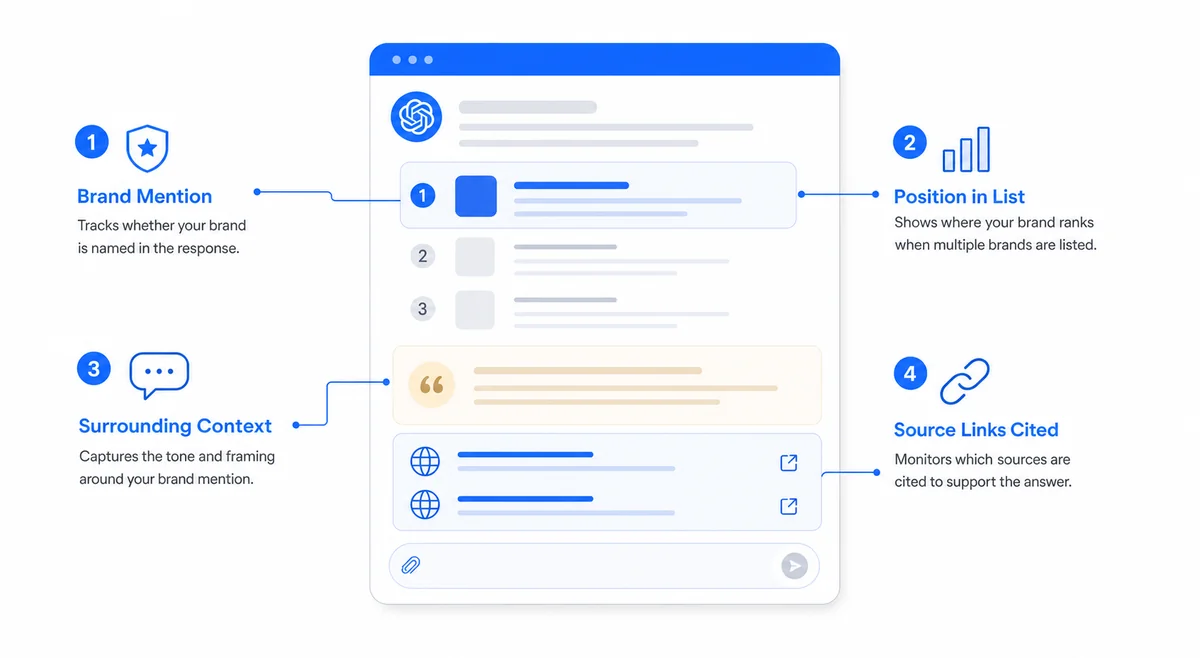
The best ChatGPT SEO tracking software sends a fixed list of prompts to large language model engines on a recurring schedule, captures the full text answer, and records whether your brand was named, ranked, linked, or ignored. Traditional tools measure your position in the Google index against a keyword. AI tracking measures your presence inside a generated answer. If you want the playbook behind the numbers, read how to rank in ChatGPT.
A Google rank tool tells you "position 4 for emergency garage door repair Denver." An AI tracking tool tells you "ChatGPT named your competitor twice and you not at all, but Perplexity cited your site." That second sentence is the operating signal. It is the same signal behind brand visibility in AI search. Our generative engine optimization is built around it; our AI SEO tools for brand visibility in ChatGPT guide covers the signal set behind the comparison below.
ChatGPT, Perplexity, and Gemini blend training data, real-time web retrieval, and a citation layer that surfaces URLs to verify. ChatGPT weights authoritative directories and large publishers, including Wikipedia. Perplexity shows every source under the answer and weights Reddit and niche forums more heavily. Gemini overweights pages eligible for AI Overview. A page at position 8 with weak schema might get cited by Perplexity but skipped by ChatGPT because training-layer trust signals are thin.
Prices are what we paid in 2025 and 2026, not list-page screenshots. All prices are in US dollars for US accounts; check each vendor's pricing page, as plans change often.
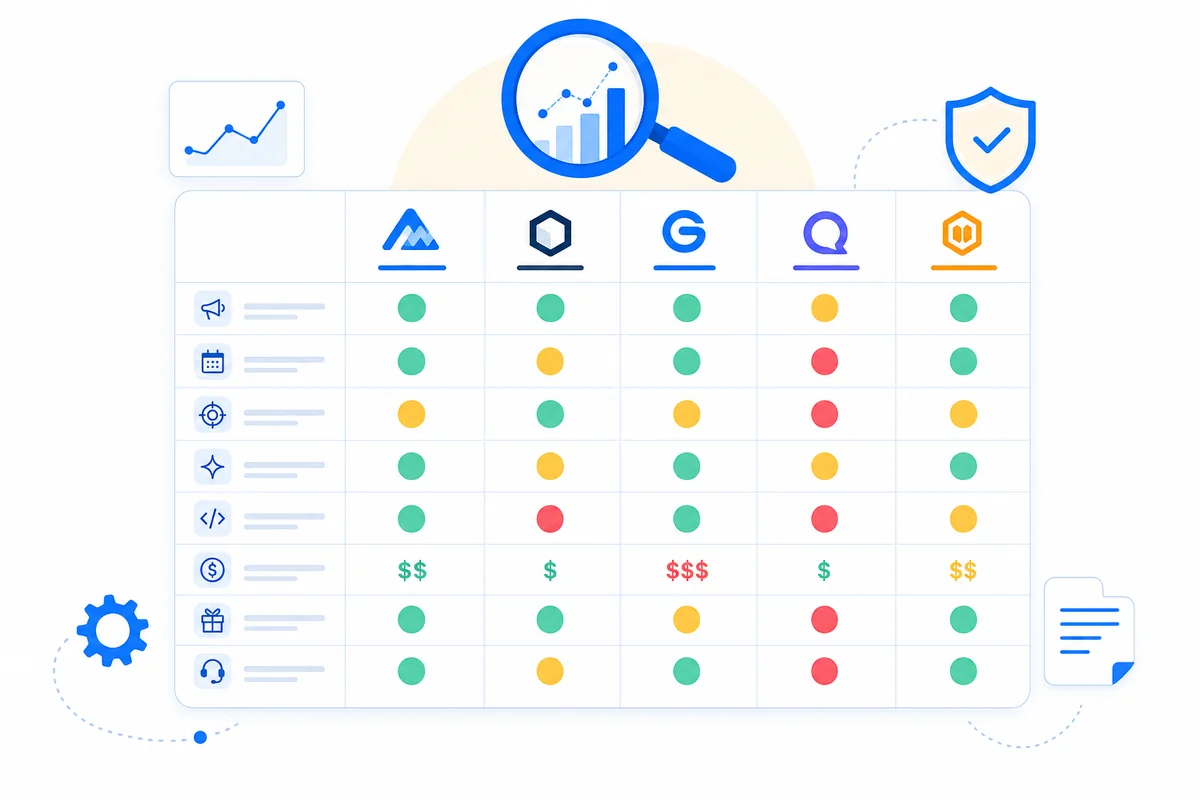
| Platform | Starting price (USD/mo) | Engines covered | Hallucination check | Best for |
|---|---|---|---|---|
| Profound | $899 | ChatGPT, Perplexity, Gemini, Claude, Copilot | No (manual) | Enterprise brands and large agencies |
| Otterly.ai | $29 starter / $189 pro | ChatGPT, Gemini, Google AI Overview | No | Solo SEOs and small in-house teams |
| Knowatoa | $49 | ChatGPT, Perplexity, Claude, Gemini | No | Prompt discovery and SMB tracking |
| Athena HQ | $199 | ChatGPT, Perplexity, Gemini, AI Overview | Partial | Mid-market brands with content teams |
| SE Ranking AI module | $65 add-on | ChatGPT, Gemini, AI Overview | No | Agencies already paying for SE Ranking |
| HouseCall SEO internal runner | Included in retainer ($750+) | ChatGPT, Perplexity, Gemini, AI Overview | Yes (ground-truth file) | Home service brands on retainer |
Otterly.ai's $29 starter caps fast; $189 Pro is the usable tier. SE Ranking's $65 add-on only makes sense if you already pay for their core tracker. Athena HQ is the strongest mid-market pick: wide coverage plus a partial hallucination check from late 2025. For a single garage door shop, Profound is overkill.
Search for these tools and you will see three names for things that do different jobs. Buying the wrong one is the most common mistake I see.
A ChatGPT SEO checker runs a one-time test. You type a prompt or a URL and it tells you, today, whether ChatGPT mentions you. It is useful for a first look and many are free. It cannot show a trend, because it has no history.
A ChatGPT SEO tracker runs a fixed prompt list on a schedule and stores every answer. That history is the point: you see when a competitor started getting named, and whether your fixes moved anything. Otterly.ai, Knowatoa, Athena HQ, Profound and the SE Ranking AI module are all trackers.
Analysis software goes one step further and explains why: which directories, review sites and pages the engine pulled from. That source list is what tells you where to get listed. Most trackers show some of it. My AI search optimization tool comparison covers the rest of the stack. None I tested turned it into a work plan on its own.
Which one to buy: a checker to see if you have a problem, a tracker once you are fixing it, and analysis only if someone will act on it every month.
Buy side: Profound at $899, Otterly.ai Pro at $189, and $200 of analyst time comes to roughly $1,288 a month. Build side: one engineer for three weeks at $9,000, plus $4 per client per month in API costs. Year-one for ten clients: $9,480 to build versus $15,456 to buy. The math only works at scale. For a one-client team, Otterly's $29 plan is right; past four clients it becomes real math.
Schema markup is what you fix when tracking shows AI engines skipping you. We deploy four types on every retainer: LocalBusiness with real radius, services, phone, and review count; FAQPage with exact questions answered in 60 to 100 words; HowTo for technical walkthroughs; Article with real author, dates, and organization entity. Full principle in our why schema markup matters. Use real values: AI engines cross-check directories, and a fabricated radius gets caught.
Q&A blocks where the first sentence states the claim. Stat blocks with one number, a named source, and a sentence of context are directly quotable. Tables comparing options side by side, which AI engines lift verbatim. What they avoid: long paragraphs with no clear claim and hedging language.
Six metrics: citation presence, citation rank among brands named, source link inclusion, factual accuracy against a ground-truth file, query coverage share, and change from the prior month. Cheap tracking tools cover one or two of those. Profound covers four. Athena covers five at partial tier. Our runner covers all six. Pair it with SEO call tracking and you have the full funnel from AI mention to booked call.
Tracking sits inside a four-phase loop. Audit: pull keyword research, add prompt discovery from Knowatoa and customer interviews, run 20 to 50 prompts across four engines. Fix: every gap prompt becomes a ticket for a new service page, citation, schema block, or directory listing. Build: service and neighborhood pages, schema deployment, niche directory outreach; page count grows from twenty to two hundred over a year. Track: the runner fires on the first of every month; ChatGPT's source weighting shifted twice in 2025, and without a monthly run you miss it until call volume drops. Full cycle in our guide to monitoring SEO performance in AI search.
Take a gap prompt where a competitor is named instead of you. Ask ChatGPT and Perplexity to answer it, then ask each: "what sources did you use?" Both list specific directories, review sites, and forums. Register your client in every source named, then re-run next month. On Or's Denver Garage Door account, the first round revealed seven directory sources he was not listed in. After six weeks of registrations his citation count went from 11 of 34 prompts to 19, and ChatGPT now names his 13-review shop over a 253-review competitor. The same play moved Tomer's Pine Garage Doors into Denver answers within months. Full story in our how the 13-review win happened.
Four mistakes block AI citations more than any other. Hiding the address when the business is a Service Area Business configured wrong: the local pack drops you and ChatGPT loses a trust signal. Keyword stuffing the service list: Google penalizes the listing and AI engines downweight it. The wrong primary category: "Plumber" instead of "Emergency Plumber" costs visibility on both. A spam-sounding business name: Google deboosts it and AI engines deprioritize it. Full audit checklist in our Google Business Profile optimization services writeup.
Day one: the runner fires the full prompt list across four engines. Day two: the parser scores citation presence, rank, source links, and accuracy against the ground-truth file. Day three: I write the fix queue. Days four to twenty-eight: the team ships fixes, then the report ships to the client. On Or's April 2026 run, ChatGPT named him in 21 of 34 prompts, Perplexity in 17, Gemini in 12, AI Overview in 9: 27 of 34 with at least one citation, up from 11 fourteen months earlier. The same loop tracks Momo at America's Chimney Sweep and Alex at Ace Locksmith SF, niches where AI engines pull from different directory mixes than garage door. The same work sits inside my SEO for locksmiths and chimney sweep marketing plans. Before you track mentions, it helps to know what earns them, which is what my playbook on getting named by ChatGPT covers.
Most AI SEO agencies sell a dashboard and call it a service. Tracking is the signal that tells the team what to do next: which page to rewrite, which directory to register in, which schema block is missing. If an agency cannot tell you what they did with last month's output, the tracking is theater. More on our ranking boutique companies.
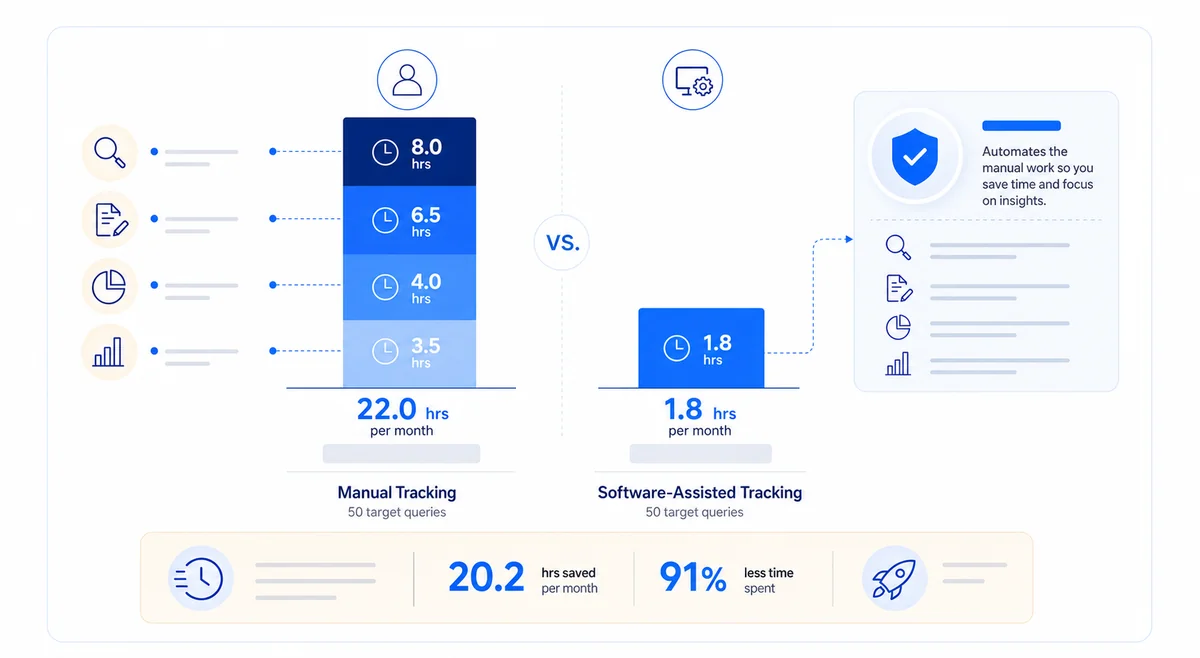
Tracking is included in every plan: quarterly AI-citation tracking on Starter ($750/month), monthly on Pro ($1,500/month), Custom from $2,500/month for multi-location.
Starter fits a single-location contractor. Pro fits a multi-service shop expanding into AI search. Custom fits a franchise or multi-city operator. Full breakdown on the pricing tiers page.
ChatGPT SEO rank tracking software sends conversational prompts to ChatGPT and other AI engines on a recurring schedule, captures the full text answer, and records whether your brand was named, ranked, linked, or ignored. The output is a citation visibility time series, not a keyword position chart. The best tools track four engines, flag hallucinations against a ground-truth file, and feed the gap list into a fix queue.
AI engines intercept a meaningful share of high-intent service queries before a customer opens Google. If your brand is not cited in the AI answer, you lose the lead before the Google session begins. Tracking is the only way to find the prompts where a competitor is named instead of you.
Local home service brands, brand teams tracking share of voice in AI answers, and SEO agencies where Google rank no longer captures full visibility. Single-location contractors gain the most per dollar: short prompt list, fast fix loop.
The baseline run is instant. Real movement takes 30 to 60 days because AI engines refresh source weighting roughly monthly. How fast it moves depends on how many gaps the fix queue closes each month; I do not promise rankings.
Entry-level platforms start at $29 to $49 a month (Otterly.ai starter, Knowatoa). Mid-market runs $189 to $199 (Otterly.ai Pro, Athena HQ). Enterprise runs $899 and up (Profound). HouseCall SEO retainers including tracking plus the full fix loop run $750 and $1,500 a month, with Custom from $2,500.
Before you pay, check whether the platform covers the engines your clients care about, whether the prompt cap fits your volume, and whether it flags hallucinations against a ground-truth file. Solo SEOs want Otterly.ai or Knowatoa. Mid-market brands want Athena HQ. Enterprises want Profound. Agencies past five clients should run the build-versus-buy math.
An agent that runs "find three garage door companies in Denver and call them for quotes" surfaces three brand names. If yours is not one, you lost the lead before the Google session started. Treat AI citation visibility as the primary KPI, Google rank as a downstream effect. Deeper take on the generative engine optimization page.
Pick the platform that fits the operator who reads the output. Solo SEO: a low-friction dashboard (Otterly.ai or Knowatoa). Content team: strong prompt clustering and partial accuracy validation (Athena HQ or Profound). Agency running ten-plus clients: run the build-versus-buy math. The platform that fits the operator is the right answer.
For solo SEOs and small teams, Otterly.ai Pro at $189 a month or Knowatoa at $49 are the practical picks. Agencies already on SE Ranking can add its AI module for $65. Athena HQ at $199 fits mid-market brands with content teams, and Profound at $899 suits enterprise brands. Prices are what we paid; check each vendor's page.
Most trackers only monitor. Athena HQ is built for mid-market brands with content teams, and Profound covers the widest set of engines. For a home service business, the cheaper route is a tracker plus manual citation reverse-engineering, then rewriting the pages the answers skip.
The main options are Profound, Otterly.ai, Knowatoa, Athena HQ and the SE Ranking AI module, compared in the table above with prices and engines covered. Each runs a set of prompts in ChatGPT and other engines on a schedule and records when your brand is named or cited.
I am Lior Daniel, a software developer and SEO specialist with six-plus years of experience, formerly at government and airline-sector organizations, now focused on AI-engine optimization for US home service businesses. Book the audit and we will pull 10 prompts for your niche and city, run them through four engines, mark every prompt where a competitor is cited instead of you, find the directories AI engines pull from that you are not in, and ship the report inside 48 hours. Book the free SEO consultation and we will email back within one business day.
Book a 30-minute call or get the free 24-hour audit.

I specialize in home services SEO: taking websites that sit invisible on page three and turning them into the business Google and ChatGPT recommend first. I started on the developer side, writing software and doing SEO on the side, until I saw how much home-service owners were overpaying for work that quietly hurt them. So I built a method that fixes the broken technical work and the outdated thinking behind it.
From garage door companies to plumbers, roofers, locksmiths and cleaning services, the playbook is the same: rank where your customers actually search, earn real reviews, and back it with a fast site that books the job. No PBNs, no bought reviews, no directory spam. Only work that survives Google’s next five updates. See exactly how it’s priced on the pricing page.
Free 30-minute strategy call