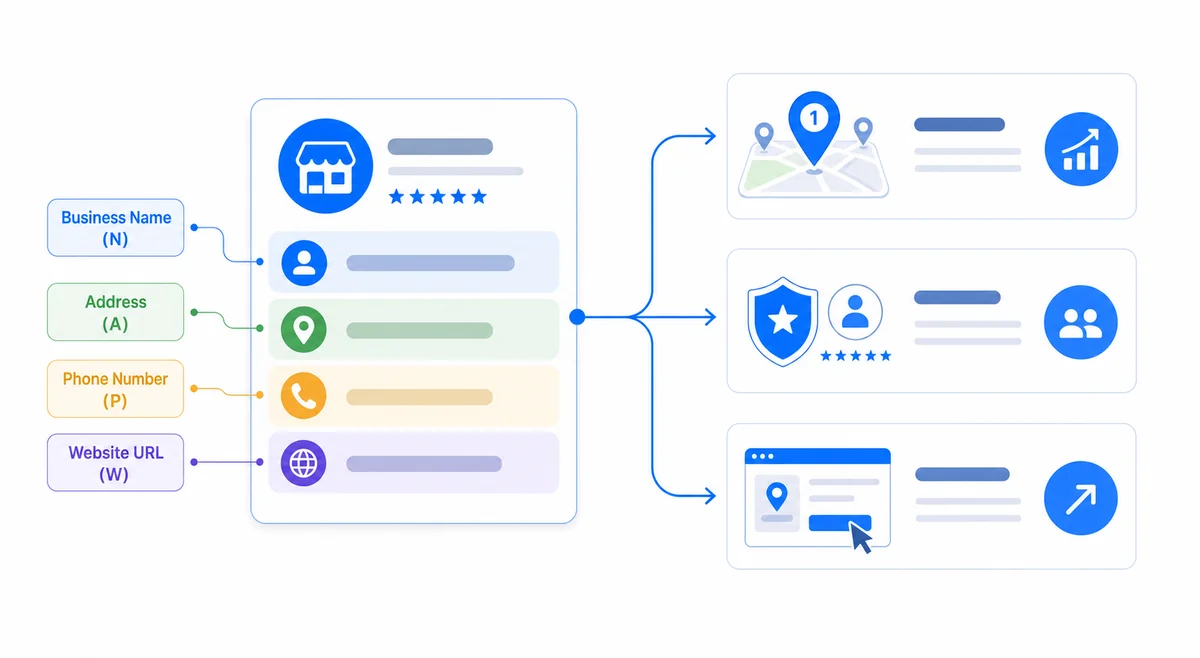
What is citation building? It is the work of getting your business name, address, and phone (NAP) listed on third-party sites that search engines and AI engines trust. Each correct listing votes for you. The contractor with more correct votes gets named, ranked, and called.
A citation building program means 30 to 60 verified listings with identical NAP across general directories, vertical home-service platforms, and niche trade sites the AI engines cite. It is not a one-time submission. Directories merge, get bought, and rot. Homeowners check ChatGPT, then Google, then your GBP, then two reviews, then they call. Inconsistent citations mean the AI skips you. Clean citations across 30+ trusted sources increase the chance AI engines name you in answers.
Shops that run a one-size-fits-all package treat citations like a 2014 checkbox. They submit your business to 50 directories, send a spreadsheet, and call it done. I have audited those reports. Half the directories are dead, a quarter point to wrong addresses, and the contractor pays $400 to $800 for almost no lift. The second failure is niche blindness. A garage door pro needs IDA listings. A locksmith needs ALOA. A chimney sweep needs CSIA and NCSG. Generic packages skip all of these. Local seo for home SEO playbook demands a niche-aware list.
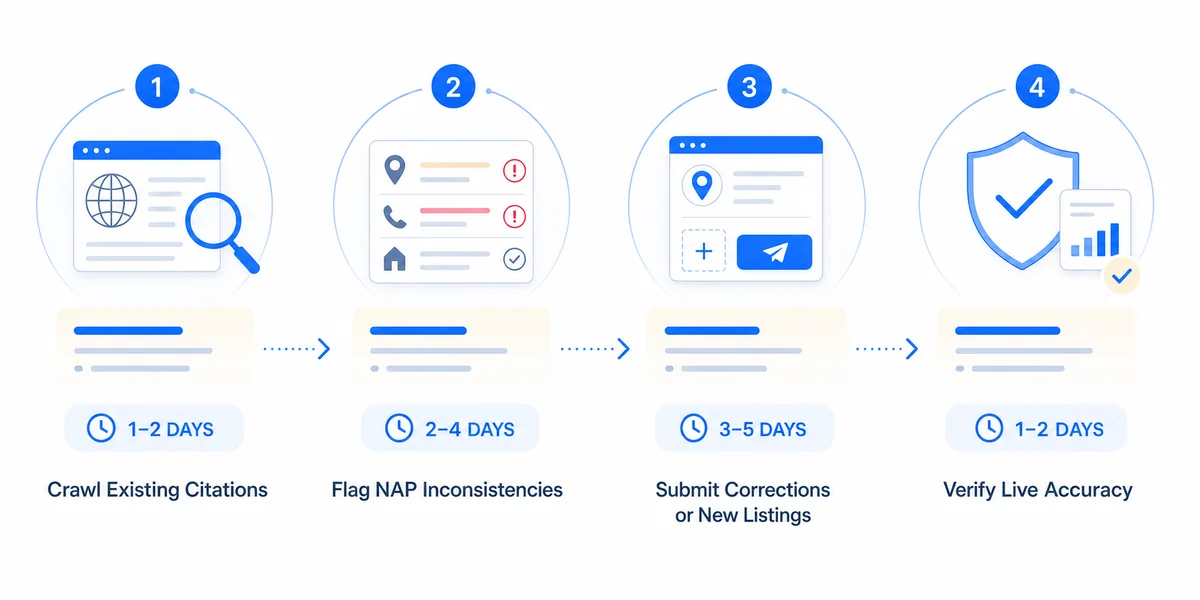
Real citation work runs in four loops: audit, cleanup, new submissions, and AI reverse-engineering. First I lock the source-of-truth NAP. One spelling, one format, one URL, in writing. The audit surfaces 10 to 30 inconsistencies in most accounts. With NAP locked and listings cleaned, I submit to the trusted-source list for your trade. General directories (Yelp, BBB, Angi), map providers (GBP, Bing Places, Apple Maps), vertical platforms (HomeAdvisor, Thumbtack, Houzz), and niche trade sites. The local citation sites list has 50+ sources organized by tier.
The loop competitors who stop at Google skip is AI reverse-engineering. I open ChatGPT, Perplexity, Gemini, and Google AI Mode and run the queries a homeowner would type for your service. Every cited source becomes a registration target. Clients start showing up in AI answers within 6 to 10 weeks. The deeper mechanic lives in our AI citation tracking write-up.
Step 1. Pick a real customer query with city and intent: "best garage door repair Denver" or "locksmith in San Francisco open now."
Step 2. Open ChatGPT with web browsing on. Paste the query, write down every cited source domain.
Step 3. Repeat in Perplexity, Gemini, and Google AI Mode. Run all four and your list will surface 15 to 30 unique domains.
Step 4. Filter for registration-eligible sources. Skip news articles. Keep directories, review platforms, association directories, and chamber-of-commerce sites. Register on every one with source-of-truth NAP, photos, category, and a description with your service and city. Wait 4 to 10 weeks.
I ran this for Or. Queried ChatGPT for "best garage door repair Denver" and found a niche directory I had never registered any client on. Registered him in 45 minutes. Six weeks later, ChatGPT was naming him. He had 13 reviews. The competitor had 253. The directory move closed the gap.
General (10): Google Business Profile, Yelp, BBB, Bing Places, Apple Maps, Yellow Pages, MapQuest, Foursquare, Facebook Business, Nextdoor.
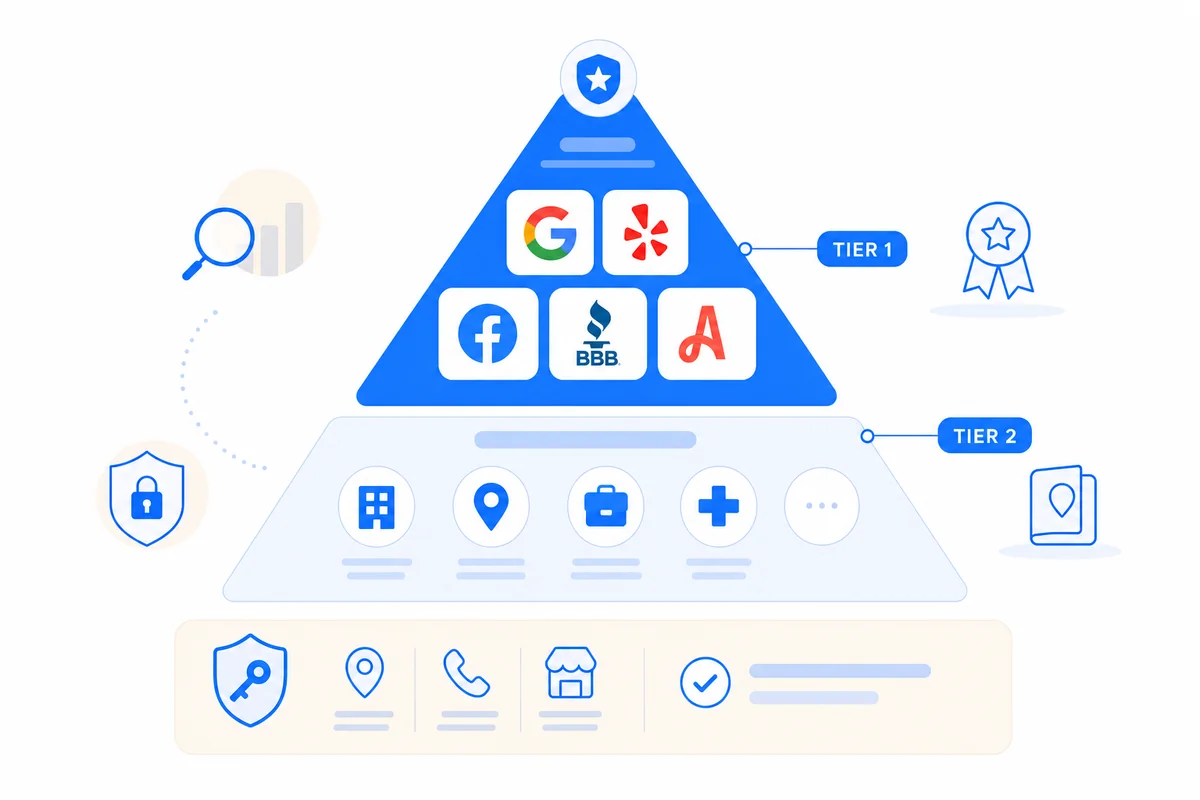
Vertical platforms (10): Angi, HomeAdvisor, Thumbtack, Houzz, Porch, BuildZoom, HomeGuide, Networx, Pro Referral, Trustpilot.
Map and voice (7): Waze, Here WeGo, TomTom Places, OpenStreetMap, Superpages, Manta, EZlocal.
Review and reputation (3): Sitejabber, ConsumerAffairs, Reddit city subreddits and r/HomeImprovement.
Niche by trade: Garage door: IDA Accredited Dealer. Locksmith: ALOA directory. Chimney: CSIA, NCSG, NFI directories. HVAC: ACCA, NATE, manufacturer dealer pages. Plumbing: PHCC, state plumbing board. Roofing: NRCA, GAF Master Elite. Electrician: IBEW, NECA. Pest control: NPMA, QualityPro. Restoration: IICRC, RIA. Tree service: ISA Certified Arborist, TCIA.
Local and regional: Local Chamber of Commerce, local news business directories, state industry licensing boards.
Business name and phone need exact-string match across every listing. City, state, and ZIP must match exactly. Street format (Street vs St, Suite vs Ste) Google normalizes, so minor variations are fine. What fragments your citation graph is mixing website URL formats, misspelling the city name, or using the legal suffix inconsistently. The standard SEO shop focuses on description rewrites and skips the NAP audit. That is backward. The NAP consistency and local SEO write-up has the deeper breakdown.
I publish pricing because every top-ranking result for "what is citation building" hides it.
No setup fees. Month to month, cancel anytime. Our affordable SEO packages page has the full feature matrix.
Or runs a garage door business in Denver. Eleven general directories, zero niche, NAP drift across three platforms. His competitor had 253 Google reviews. Or had 13. I ran the AI reverse-engineering loop and found a niche directory ChatGPT was citing. Registered Or in 45 minutes. Six weeks later, ChatGPT started naming him. Call volume tripled inside the quarter. Site: denvergaragedoor.com. Full story: our local SEO case study.
Tomer runs Pine Garage Doors in Denver. His prior marketer submitted to 38 directories with call-tracking lines never standardized. Google saw five separate entities. I locked the source-of-truth NAP in week one. Map pack ranking on his two highest-intent keywords moved from page two to top three inside the cleanup window.
Momo runs America's Chimney Sweep in California. ChatGPT and Perplexity were not naming him for chimney sweep queries. The engines cited CSIA and NCSG member directories. His prior agency skipped both. I registered him on each plus three regional chimney trade boards. Within 9 weeks Momo appeared in AI answers for the queries he targeted.
BrightLocal and Whitespark both run fixed directory lists curated per city. Useful for audits. Neither runs AI reverse-engineering to find the directories ChatGPT cited for your niche yesterday. Yext pushes NAP to 70 to 100 directories through a dashboard. Stop paying and listings revert. I run direct submissions because citations belong to you. Vendors selling a set-it-and-forget-it package submit to 30 directories in month one and never look again. No audits. No AI loop.
The classic citation playbook was built for Google Maps. That still works. But ChatGPT, Perplexity, Gemini, and Google AI Mode pull from a wider pool. AI engines cite niche directories Google ignores: CSIA, ALOA, IDA. Thin traffic but high trust. They also cite Reddit city subreddit threads. And they re-crawl faster, so a correct citation can appear in AI answers inside 4 to 8 weeks. The Google Maps list and the AI engine list overlap about 60 percent. That remaining 40 percent is the gap between a 2014 program and a 2026 program. The longer read on AI-first citation strategy covers this in depth.
| Competitor | What they cover | What they miss |
|---|---|---|
| BrightLocal | 990 words, general directory advice | No AI reverse-engineering, no per-trade niche list |
| YouTube (top result) | 32 words of metadata | No content |
| Hibu | 2,689 words | Two H2s, no case study |
| PowerDigital | 14 words | No content |
| Citation Builder Pro | 3,136 words | Pitches the agency rather than explaining the topic |
None of the five explain the AI loop, publish a per-trade niche list, or include a real case study with names and numbers. That gap is what this page fills.
I am Lior Daniel, founder of HouseCall SEO. Software developer with 6+ years of SEO work. Before SEO, I worked at government and airline-sector organizations, where I learned to debug systems that don't forgive sloppy data. I run every audit myself.
Getting your business NAP listed on third-party sites that search engines and AI engines trust. A correct 2026 program covers 30 to 60 verified listings across general, vertical, niche, and local directories.
Aim for 30 to 60. Start with 10 general directories (GBP, Yelp, BBB, Bing Places, Apple Maps). Add 10 vertical platforms (Angi, HomeAdvisor, Thumbtack, Houzz). Layer 10 to 20 niche directories and 5 to 10 local sources. Past 60 you hit diminishing returns.
Local citations are public mentions of your business NAP on trusted third-party sites. Google's local pack and AI engines both use citation consistency as a verification layer. A business with 30+ correct citations outranks one with 5 even when reviews and on-page are otherwise similar.
They sell submissions to a fixed list, same for every customer. I run that general and vertical layer, then add the AI reverse-engineering loop no fixed-list provider covers. That loop is how my Denver client got named in ChatGPT on 13 reviews against a 253-review competitor.
HouseCall SEO Starter is $750/mo, Pro is $1,500/mo, Custom is from $2,500/mo. A standalone one-time submission with no audit and no AI loop runs $300 to $800 and delivers minimal lift.
Map pack lifts from a clean audit show up between 30 and 60 days. AI citation share lifts show up between 6 and 10 weeks per directory added. Full maturity takes 4 to 8 months. The full SEO timeline has the wider breakdown.
Name and phone need exact-string match. City, state, and ZIP need exact match. Street format is normalized by Google and AI parsers. Lock name, phone, city, state, ZIP, and website URL. Minor street format variations matter far less.
No. Use the service-area setting on GBP and mirror it on every directory that supports it. Publishing a home address creates safety problems and confuses local algorithms that look for commercial properties.
A citation is a NAP mention, with or without a link. A backlink is a clickable link from another site to yours. For local SEO, citations matter more. For organic non-local SEO, backlinks matter more.
Every contractor gets a free written audit before any contract. I cover citation graph health, NAP drift, AI citation footprint, and top competitor citation gaps. Takes 2 to 3 hours. Book through a free 30-minute call. No popups. I reply within 24 hours.

I specialize in home services SEO: taking websites that sit invisible on page three and turning them into the business Google and ChatGPT recommend first. I started on the developer side, writing software and doing SEO on the side, until I saw how much home-service owners were overpaying for work that quietly hurt them. So I built a method that fixes the broken technical work and the outdated thinking behind it.
From garage door companies to plumbers, roofers, locksmiths and cleaning services, the playbook is the same: rank where your customers actually search, earn real reviews, and back it with a fast site that books the job. No PBNs, no bought reviews, no directory spam. Only work that survives Google’s next five updates. See exactly how it’s priced on the pricing page.
Free 30-minute strategy call