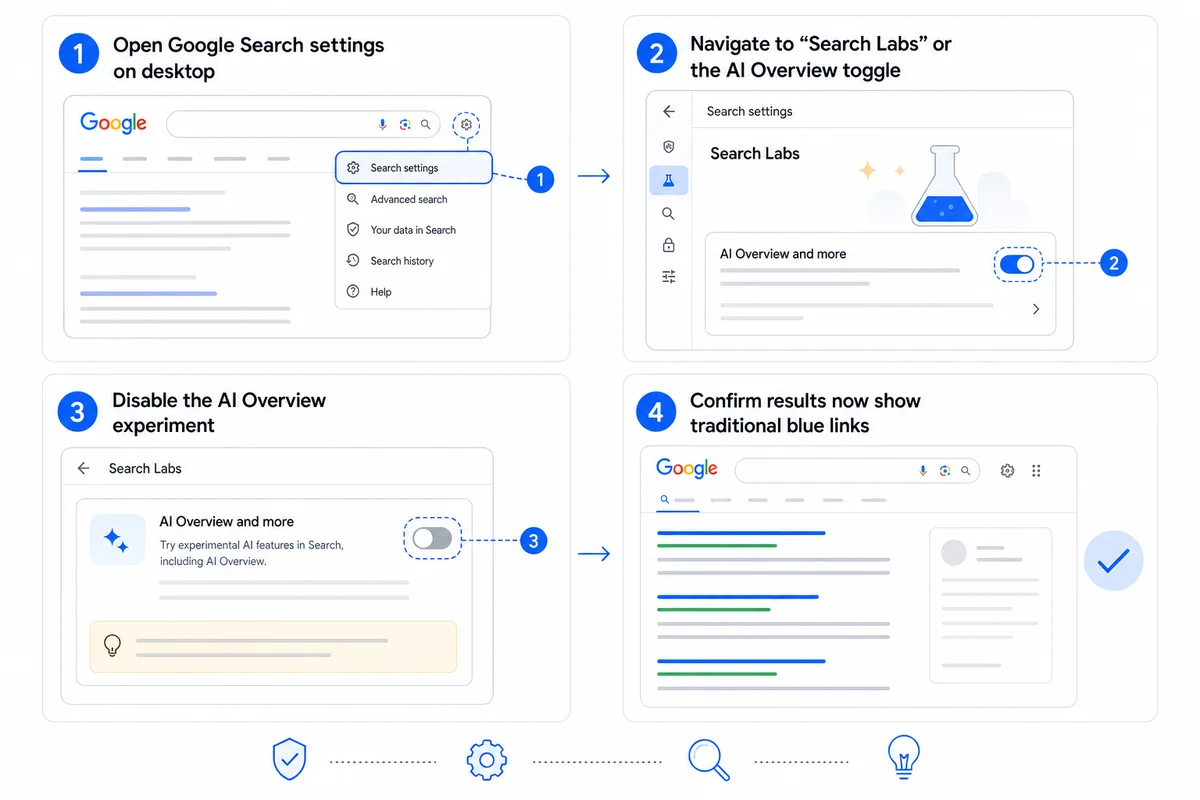
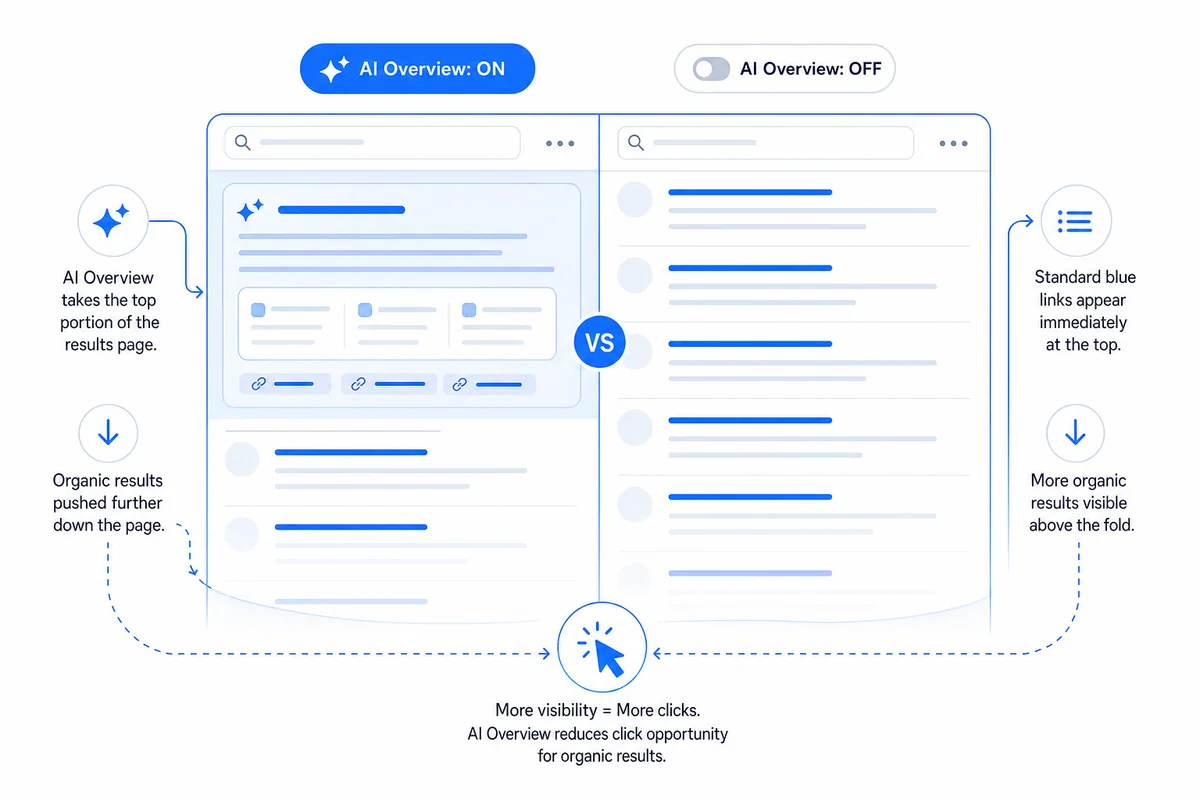
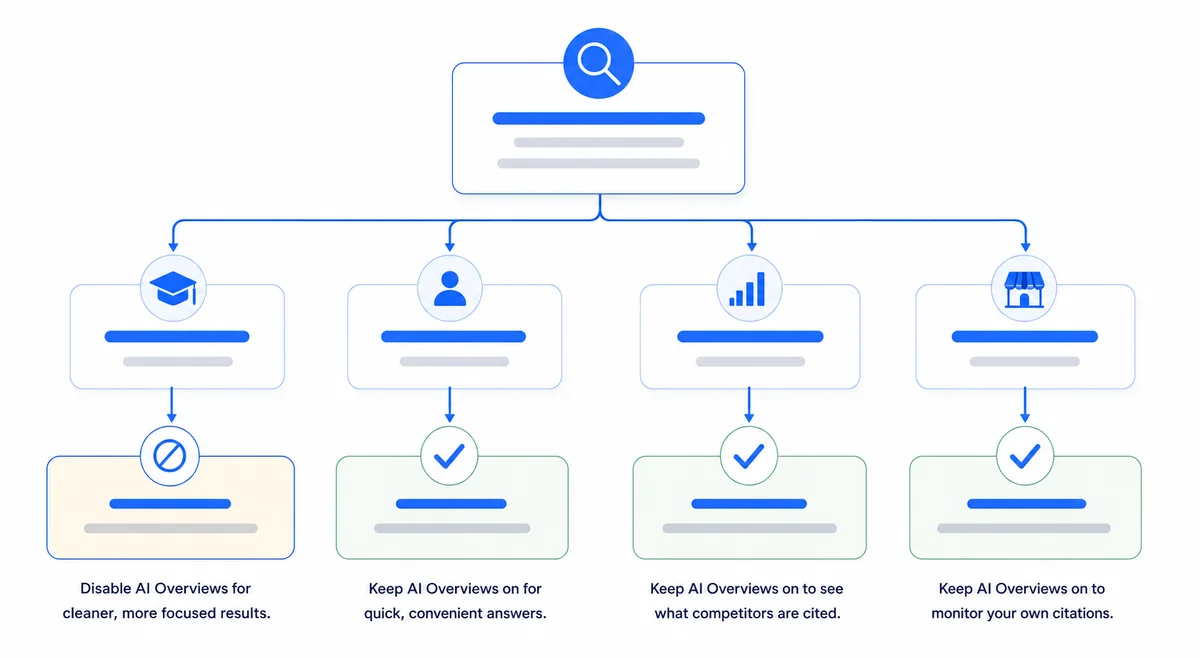
Searching for how to turn off Google AI Overview -AI is a rational first move. Click-through rates on organic links below the AI box dropped sharply in 2025: Pew Research Center reported that AI summaries changed click behavior on roughly 18% of search sessions. But the fix does not exist on your side of the screen. The personal Search Labs toggle only changes what you see. Your customer still sees the box. The one legitimate use for the toggle: auditing the clean SERP without the AI box interfering. For revenue, that hour is better spent on the ranking playbook.
Google AI Overview is a generative-AI summary at the top of search results on roughly 40% of US queries. The box has four parts: the answer paragraph, citation chips, right-rail source links, and follow-up question suggestions. Competitors who stop at Google chase only the source list. The chip placements and follow-up suggestions are softer targets almost no local competitor is fighting for yet. The model is a Gemini variant tuned for search, preferring structured, declarative, fact-dense passages. You cannot reverse-engineer it, but you can write content it prefers.
From fourteen months of testing across home service queries in Denver, San Francisco, and Sarasota, I can name the signals that compound. The page has to rank in the top 10, positions 1 to 4 get cited far more often than 5 to 10. It needs a 60 to 100 word passage that directly answers the user's question near the top. It must be entity-rich: real city names, service names, brand names, addresses. It must be fresh, content updated in the past 12 months beats identical 2022 copy. Finally, the brand needs third-party entity presence: niche directories, Reddit threads, YouTube transcripts. The model triangulates trust from the open web before picking a citation. That same foundation powers the AI tools for Google Business Profile optimization 2026 work we run for every retainer client.
If you only fix one thing on a page, fix the answer paragraph. The model lifts short, self-contained answer blocks out of longer articles. The pattern: state the topic, name the location or audience, give one specific number, name a real entity, end with a forward-looking sentence. Keep it 60 to 100 words. Avoid lists, paragraphs read more cleanly for this slot.
A working example from a page we wrote for Or at denvergaragedoor.com: "Garage door spring repair in Denver typically costs $180 to $360 depending on torsion versus extension type. Or at Denver Garage Door has replaced more than 1,400 springs since 2019, with same-day service in zip codes 80202 through 80249. Most repairs take 45 to 75 minutes. Homeowners should not attempt the swap, springs store enough torque to break a wrist." The model pulled that paragraph twice in three months for Denver garage door spring queries.
The move that put Or in ChatGPT's Denver answers within three months costs nothing but time. Ask ChatGPT, Perplexity, and Google AI Overview the exact queries your customers use. Note which directories each engine cites as sources. Register your business on every one of those directories with consistent NAP, real photos, and service descriptions. The more places an AI engine finds your brand as a trusted answer, the more likely it recommends you. The model leans toward consistent citation footprint, not review count. Or has 13 Google reviews and 47 niche directory listings. His displaced competitor had 253 reviews and fewer listings. This is the GEO move almost no local competitor in any city is running yet.
Your Google Business Profile is the foundation the AI engines triangulate against. Four mistakes cut AI visibility for home service businesses. First, hiding your address when you could verify a physical location, AI engines trust address-verified profiles more. Second, stuffing the services list with keyword variants: "garage door repair Aurora Colorado same-day" as a service name. Google ignores it and AI engines inherit that skepticism. Third, wrong primary category, "Garage Door Repair Service" beats "Handyman" because the right category sets entity context. Fourth, a business name that reads like a spam keyword string. Entity coherence starts with your name matching every mention of you on the web. Fixing these is Phase 1. A GBP that passes the trust check becomes the entity anchor AI engines build their answers around.
Every retainer includes a monthly runner that fires 20 to 50 priority queries through Google, ChatGPT, Gemini, and Perplexity. For each query we log whether the AI Overview triggered, which sources the model pulled, and whether the brand name appeared in the answer paragraph. The best Google AI Overview tracking tools for this are Profound and Otterly.ai, paired with our internal Google runner. Clients get the sheet by the third of the month. Over twelve months Or's AI Overview citation rate went from 0 of 34 queries to 14 of 34. Each gap becomes a fix ticket, tracking is the input to the next round of work, not a report you file away.
Or runs a small garage door shop in Denver. In February 2025 he ranked position 4 for "garage door spring repair Denver" but the AI Overview named two competitors. By August 2025 the AI Overview cited his page and named Denver Garage Door as a recommended provider in the answer paragraph.
Three things changed: a 78-word answer paragraph with specific price ranges and zip codes, FAQPage schema with seven real customer questions, and 11 new niche directory citations plus three Reddit mentions where Or answered real homeowner questions. No new major backlinks. No paid ads. Or's review count is 13. The competitor we displaced has 253. The AI engine does not weight review count the way the Local Pack does. It weights entity coherence and answer-format quality. Read the deeper writeup inside the how Or beat the 253-review competitor.
Every retainer runs through the House Call Method: Audit, Fix, Build, Track. Phase 1 logs whether AI Overview triggers for each priority query and which sources it cites, baseline sheet for 20 to 50 queries. Phase 2 rewrites target pages with a 60 to 100 word answer paragraph, builds FAQPage and HowTo schema, verifies LocalBusiness schema matches the live NAP. Phase 3 builds 30 to 60 niche directory citations per city, optimizes GBP, seeds Reddit and YouTube with real brand mentions, 60 to 120 days to compound. Phase 4: monthly tracking, each gap a fix ticket.
The shift is real but smaller than most headlines suggest. Traditional SEO still drives the foundation: indexing, schema, page speed, backlinks, local citations. AI Overview adds three things on top: the lift-friendly answer paragraph, entity coherence, and the citation feedback loop. A page broken on the traditional layer will not get cited. A page solid there plus those three additions gets cited at roughly 4 to 8 times the rate of a competitor that only did traditional work. Full side-by-side: my full breakdown.
AI Overview optimization runs inside every retainer, content, schema, and citations are the same work regardless of which channel you're optimizing for.
| Package | Monthly price | AI Overview pages | Schema coverage | Tracking cadence |
|---|---|---|---|---|
| Starter | $750/mo | 1 priority page rewritten | FAQPage on hero page | Monthly, 20 queries |
| Pro | $1500/mo | 2 to 3 priority pages rewritten | FAQPage + HowTo + LocalBusiness | Monthly, 35 queries |
| Custom | $3000+/mo | 5+ priority pages plus new pages | Full schema stack across the site | Monthly, 50+ queries plus weekly during launches |
The usual agency says "call for pricing." Mine is on the page because the work is concrete. Full breakdown: our SEO pricing and packages.
Sign into your Google account, click the Search Labs flask icon, and toggle off "AI Overviews." That change applies to your account only. Your customers still see the box. Useful for auditing the clean SERP, not useful for revenue.
Yes. Or runs a Denver garage door shop with 13 Google reviews and currently appears in Google AI Overview on 14 of 34 tracked Denver queries. We rewrote his service pages with 60 to 100 word answer paragraphs, shipped FAQPage and HowTo schema, and built 47 niche directory citations over nine months. Structure and entity coherence won, not review count.
Ask for a real AI Overview tracking report from a current client, brand name redacted. It should list priority queries, AI Overview state month over month, and a 30-day fix queue. No artifact means reporting theater. Also ask for one published page: no real client names, no numbers, no city anchors mean the entity layer is empty.
Between 30 and 90 days after the page is rewritten, schema shipped, and entity work started. Competitive queries take six months or more. Fastest win we recorded: 17 days. Slowest: 11 months. Expect a curve, not a switch.
It hurts the brands that ignore it. If your competitor lands in the AI Overview answer paragraph and you do not, you lose roughly half the click traffic on that query in 2026. Click-share reshapes toward whoever the model cites. Sitting out is not a neutral move.
No. Schema is necessary, not sufficient. Every page we have landed in Google AI Overview had FAQPage or HowTo schema, but many pages with identical schema never got cited because the answer paragraph was weak or the entity layer was thin. Treat schema as one of seven required signals, the other six are organic position, answer-paragraph quality, entity density, third-party citations, freshness, and topical authority.
Google AI Overview is the summary box at the top of standard Google search, powered by a Gemini variant tuned for search. Gemini is the standalone chatbot. ChatGPT is OpenAI's separate engine. The three pull from overlapping but distinct source sets. A home service brand needs to appear in all three because customers cross-check. For a side-by-side, read the How this works breakdown.
I am Lior Daniel, founder of HouseCall SEO: software developer, 6+ years in SEO, IDF veteran with past work in government and airline-sector organizations. Every client gets a hands-on program, not a rotating contact who barely knows their account. If you want to know where your brand stands inside Google AI Overview, the fastest path is a free audit: 10 priority queries for your city and service, a log of the brands currently named in the answer paragraph, delivered within 48 hours. Book it at Book your free AI visibility audit and we will pull the baseline this week.

I specialize in home services SEO: taking websites that sit invisible on page three and turning them into the business Google and ChatGPT recommend first. I started on the developer side, writing software and doing SEO on the side, until I saw how much home-service owners were overpaying for work that quietly hurt them. So I built a method that fixes the broken technical work and the outdated thinking behind it.
From garage door companies to plumbers, roofers, locksmiths and cleaning services, the playbook is the same: rank where your customers actually search, earn real reviews, and back it with a fast site that books the job. No PBNs, no bought reviews, no directory spam. Only work that survives Google’s next five updates. See exactly how it’s priced on the pricing page.
Free 30-minute strategy call