
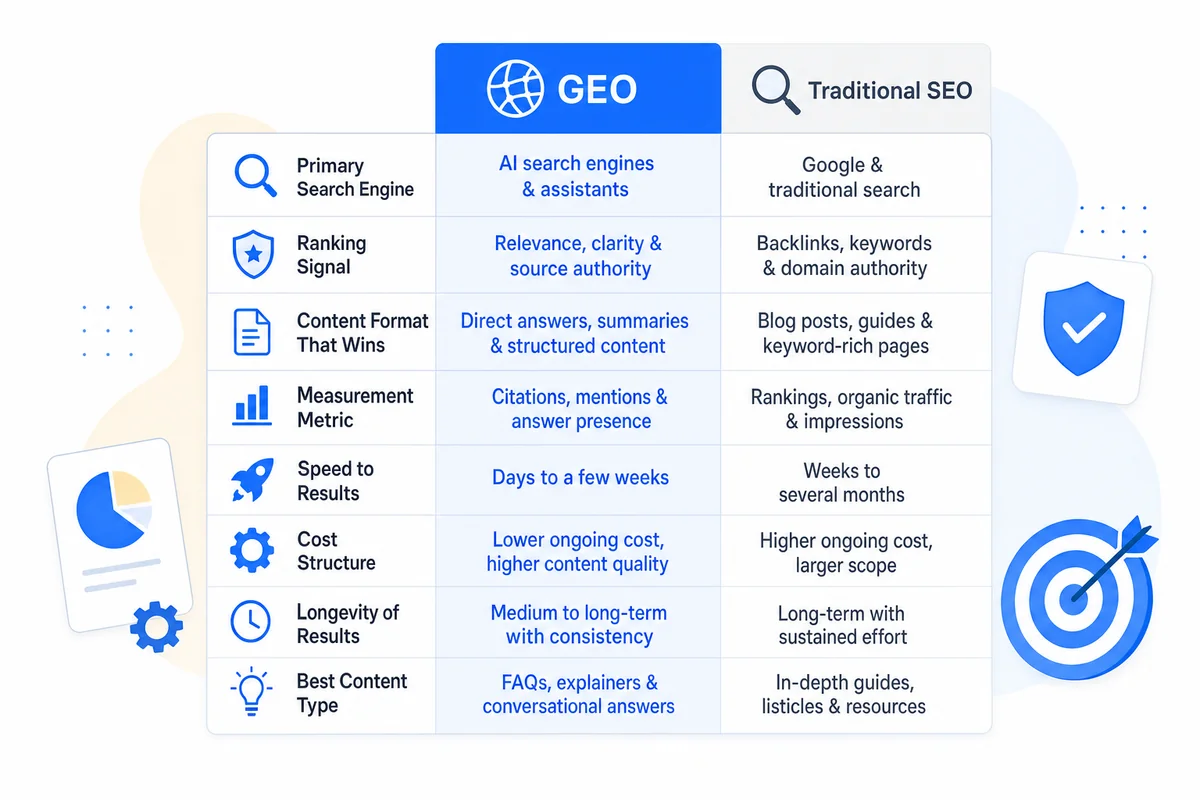
Generative engine optimization vs traditional SEO compares optimizing for AI engines that write answers (ChatGPT, Gemini, Perplexity, Google AI Overview) against optimizing for the classic ten blue links on Google. Traditional SEO wins when your page ranks high enough for a customer to click through. GEO wins when an AI engine names your brand inside the answer it generates. Both share the same on-page and trust core: depth, schema markup, freshness, credible backlinks. They diverge on retrieval (GEO pulls heavily from directories, Reddit, YouTube, and Q&A blocks) and measurement (GEO tracks citation share, not SERP position). See how GBP feeds both channels with the right AI tools for Google Business Profile optimization.
| Signal | Traditional SEO weight | GEO weight |
|---|---|---|
| Keyword in title tag | Very high | Medium |
| Backlinks from authority domains | Very high | High (trust weighting) |
| Click-through rate from SERP | Very high | Not measured |
| Schema markup (FAQ, HowTo, LocalBusiness) | Medium | Very high |
| Directory citations (Yelp, BBB, Angi, niche) | Medium for local pack | Very high (primary retrieval source) |
| Reddit and forum mentions | Low | Very high |
| Q&A blocks with one focused answer | Helpful | Critical (engines quote the paragraph directly) |
| Google Business Profile completeness | Very high for local pack | High (engines verify against GBP) |
| SERP position 1-3 | The whole game | Not the same game |
| Citation share across 50 prompts | Not measured | The whole game |
The GEO column is not a subset of SEO. They share an on-page core but split on retrieval sources and measurement metrics.
ChatGPT, Gemini, and Perplexity do not crawl the web fresh for every query. They run a live retrieval pass against a proprietary index, pick four to ten top sources, and synthesize an answer. For local service queries, sources are weighted by domain reputation, recency, directory authority, and clean structured data. A business listed across five trusted directories shows up in AI answers roughly four to five times more often than one listed in a single directory. Google AI Overview pulls from the top 10 organic results and re-ranks by structured-answer eligibility, so traditional SEO position and GEO citation are linked at the AIO layer but decoupled inside ChatGPT and Perplexity.
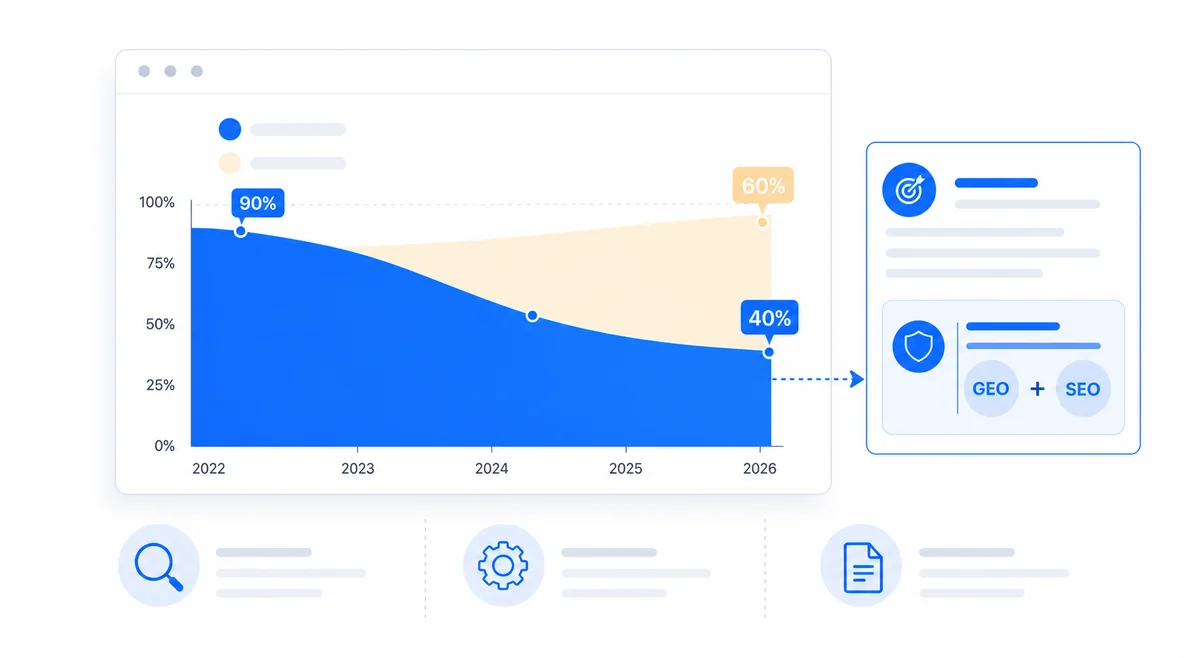
Google still drives the majority of home service search volume. ChatGPT and Perplexity combined are now the second-largest entry point for commercial intent queries in the US. Customers do not pick one engine and stop: they ask ChatGPT, see three names, then Google two of them to verify. Tomer at Pine Garage Doors ran 18 months of pure traditional SEO and zero AI-GEO: top-3 Google position, 4% ChatGPT citation share, flat bookings. After 90 days of GEO work alongside the SEO retainer, citation share moved to 31% and bookings rose 22%. The Google position never moved.
Customers do not trust one search engine alone. They verify ChatGPT recommendations on Google and Google results on ChatGPT. When they see your brand in both, the conversion rate moves three to five times higher than a single-engine win. Or: "Customers love to search on Google and also on ChatGPT just to be safe. A lot of times they saw us in both places, and that gave them trust." Site is denvergaragedoor.com. Or's old SEO agency charged him $4 for every $1 he now pays me.
Schema is the single most common GEO weakness we find today. Every one of the top five pages ranking for this query in 2026 has zero schema markup. We deploy Organization, LocalBusiness with service radius, FAQPage (one Question, one Answer, no nested lists inside), HowTo, BreadcrumbList, Article with author byline and last-updated date, and Service per offer with price band and area served. Citation numbers move within 30 to 60 days. What makes schema get cited versus ignored is clean Answer text: 60 to 100 words, one paragraph, a specific number or named source. Multi-paragraph essays with nested lists get rewritten and your name drops out.
Three content patterns get cited most. A Q&A block: one H3 question, a 60 to 100 word answer that opens with the direct answer and adds supporting detail in the next two sentences. A stat block: one paragraph, one number, one named source ("Or's Denver garage door shop grew ChatGPT citation share from 19% to 63% over 14 months"). A comparison table: AIO scrapes table rows verbatim for ready-made scaffolding. Every page we write has all three.
We run a 50-prompt, four-engine scoring system on the first of every month for every retainer client. Output is a citation share percentage per engine, charted month over month, with a gap list of prompts where a competitor was named instead. Engines tracked: ChatGPT, Gemini, Perplexity, and Google AI Overview. Dimensions scored: citation presence, citation rank, source link, factual accuracy, query share, and month-over-month change. Both the GEO chart and the SEO position chart land in one monthly report by the third of each month.
Ask ChatGPT, Perplexity, and Gemini which directories they cite for your niche and city. Register the client on every one named. For Or in Denver, cited sources included BBB, Yelp, Angi, HomeAdvisor, two niche garage door directories, and three Denver-specific home service portals. Citation share moved from 19% to 31% within 60 days. The same move works in any trade: we ran it for Momo at America's Chimney Sweep and Alex at Ace Locksmith SF on their niche portals. Most shops skip this because they focus on rankings, not on which sources the AI pulls from.
Four mistakes we see on almost every new client. Hiding the address: AI engines verify against GBP and skip brands that have no verified address tied to a service area. Spammy service lists: 47 keyword-stuffed services signals gaming; trim to what the dispatcher runs. Wrong primary category: the single biggest local pack signal, mirrored by AI engines. A spam-sounding business name: engines avoid quoting brands that look like keyword stuffing.
We use SEMrush and Ahrefs for keyword and backlink data, Google Search Console for indexing, and ChatGPT, Gemini, Perplexity, and AIO for the manual prompt runs. We cross-check Otterly.ai and Profound.ai but do not depend on either. We skip Surfer SEO and Clearscope because optimizing competitors against the same template erases differentiation. Jasper and Copy.ai produce uniform output that loses source weighting. SEMrush keyword volume lags AI search by about 18 months, so our prompt list comes from real customer language.
| Tier | Monthly | What runs | Best for |
|---|---|---|---|
| Starter | $750 | Monthly tracking (50 prompts, 4 engines), schema stack, GBP optimization, 2 new pages per month, citation reverse-engineering, monthly report | Solo operator, 1 city, 1 service line |
| Pro | $1500 | Starter plus 4 new pages monthly, neighborhood and city pages, internal mesh rebuild, full keyword research with AI queries, monthly fix queue | Multi-city, multi-service, 5 to 20 employees |
| Custom | $3000+ | Pro plus dedicated content writer, link building, advanced citation work across 50-plus directories, custom dashboard, weekly check-ins | Multi-location, regional or national footprint, 20-plus employees |
Most home service clients land at $1500. Multi-location brands push into Custom. See our full SEO packages page for details.
SEO puts your page in the Google results; a customer clicks through. GEO gets your brand named inside the AI answer; the customer never needs to click. SEO measures position. GEO measures citation share. They share an on-page and trust core but diverge on retrieval sources and measurement. In 2026 you need both because customers verify one engine against the other before they call.
SEO is search engine optimization: ranking pages on Google and Bing so a customer clicks through. GEO is generative engine optimization: getting cited inside AI-generated answers from ChatGPT, Gemini, Perplexity, and Google AI Overview. SEO produces a blue link. GEO produces a brand mention inside the answer the AI hands the customer. Both retrieval mechanisms differ enough to need their own playbooks, even though they share an on-page core.
No. Google still drives most home service search volume, AI Overview pulls from the top 10 organic SERP, and customers verify AI answers on Google before they call. The share of clicks is shifting as AI engines intercept commercial intent queries that used to flow to organic links. Running both from the same monthly queue is more efficient than separate retainers.
Retainers run from $750 to $3000-plus monthly. Starter covers the GEO and SEO baseline for a single-city operator: schema stack, GBP optimization, two new pages a month, monthly tracking, citation reverse-engineering. Pro adds neighborhood and city pages, four new pages monthly, and full keyword research. Custom covers multi-location brands with dedicated content and link building.
GEO moves faster. Schema and citation work compound within 30 to 60 days. Traditional SEO position changes show up between month three and month six. Or's curve ran 14 months from 19% citation share to 63%, with the steepest gains in months three through eight. Full Trust Stack closure (cited in AI and ranked on Google) typically lands between month six and month nine.
The right agency runs both layers on every retainer and can show you a previous month's report before you sign. They should name the directories they registered clients on in the last 90 days, the prompt list they use for the monthly run, and the schema patterns they deploy. If they cannot answer those three questions, the GEO work exists only in a pitch deck. See our lean specialist model for fit.
They align on content depth, schema markup, trust signals, freshness, and E-E-A-T (Google's Experience, Expertise, Authoritativeness, and Trustworthiness framework). They diverge on retrieval (GEO pulls from Reddit, YouTube, and niche directories the classic Google SERP underweights) and measurement (GEO charts citation share, SEO charts position). GEO over-rewards Q&A blocks and tables engines can quote verbatim; SEO rewards depth and internal linking more uniformly. Run them together.
I run the audit myself: citation share across ChatGPT, Gemini, Perplexity, and Google AI Overview across a 50-prompt list built around your niche and city. Free with any retainer signup, $497 standalone, delivered within five business days. Book a free SEO consultation and I will send the baseline this week.

I specialize in home services SEO: taking websites that sit invisible on page three and turning them into the business Google and ChatGPT recommend first. I started on the developer side, writing software and doing SEO on the side, until I saw how much home-service owners were overpaying for work that quietly hurt them. So I built a method that fixes the broken technical work and the outdated thinking behind it.
From garage door companies to plumbers, roofers, locksmiths and cleaning services, the playbook is the same: rank where your customers actually search, earn real reviews, and back it with a fast site that books the job. No PBNs, no bought reviews, no directory spam. Only work that survives Google’s next five updates. See exactly how it’s priced on the pricing page.
Free 30-minute strategy call