
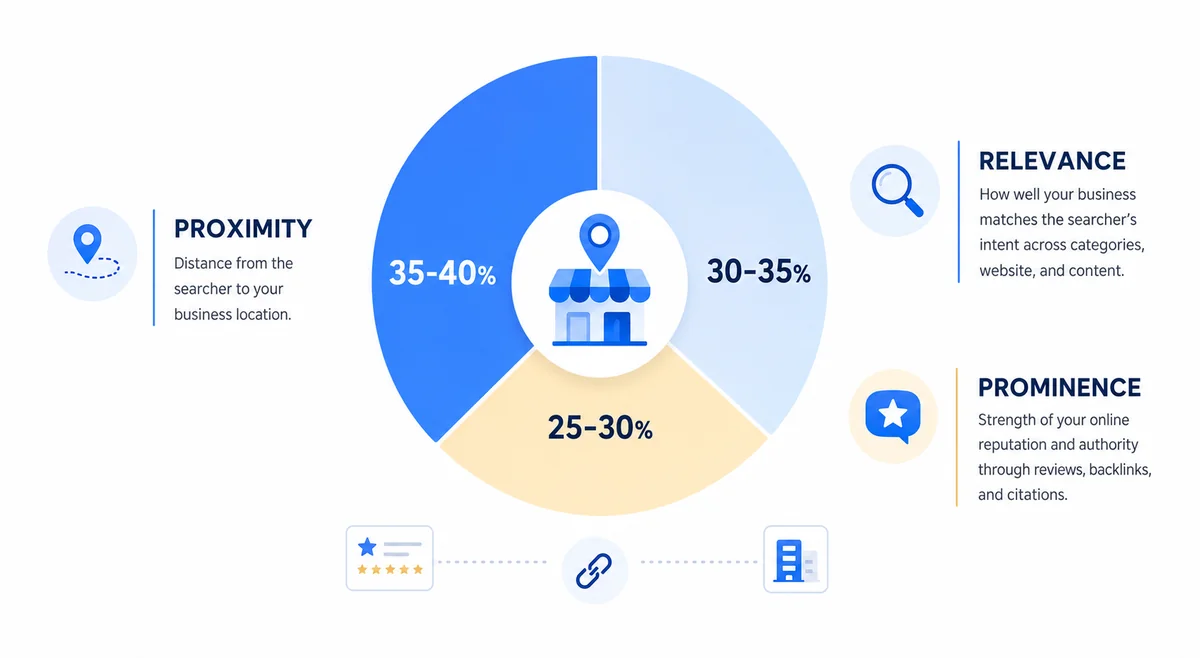
Local pack rankings are the three Google Business Profile listings in the map block at the top of local-intent searches. Google ranks them on proximity (distance from searcher to business), relevance (how closely the profile and website match the query), and prominence (trust from reviews, citations, and links). Review count alone does not win. A 13-review listing beats 253 reviews when proximity is tight and the website carries topical authority. Most clients see their first ranking movement in 7 to 14 weeks after fixing the core signals.
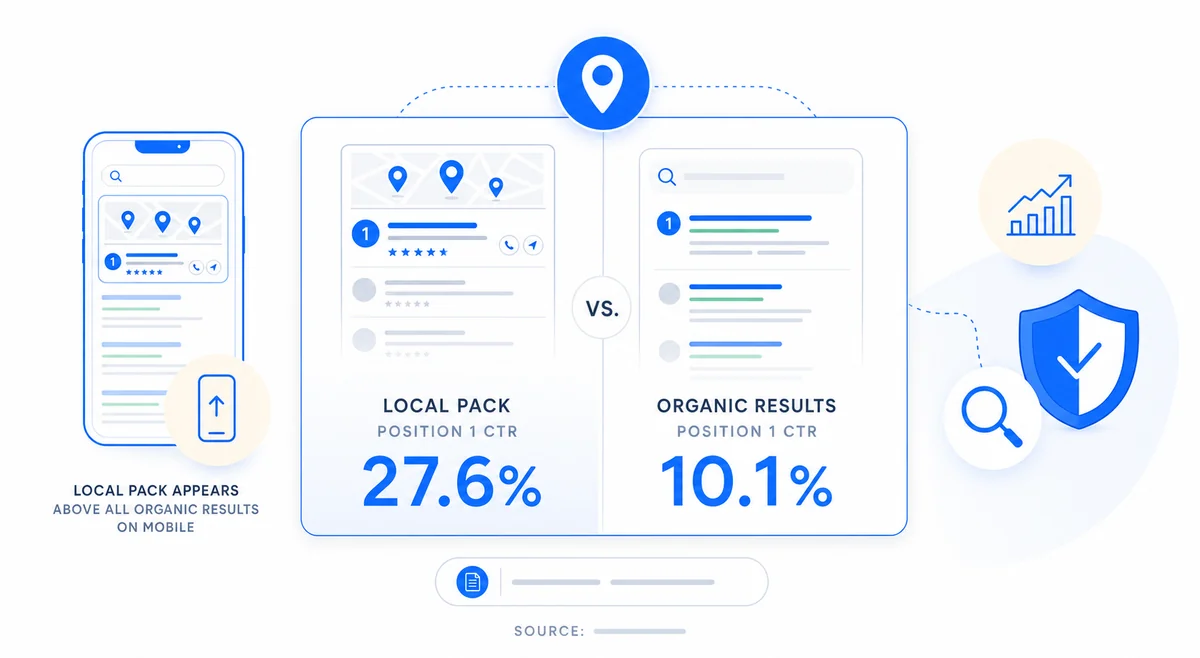
The local pack pulls from Google Business Profile, not organic web indexes, so getting your Google business profile categories SEO playbook right is the first relevance lever most contractors miss. Across my clients the pack absorbs 40 to 65% of clicks on local-intent queries. My client Or at denvergaragedoor.com gets roughly 70% of his monthly leads from it; Tomer at pinegaragedoors.com tracks 60% of his bookings to local pack visibility across his service area; Momo at americaschimneysweep.com gets 78% of his pre-season inspections from one pack position. For contractors the local pack is the channel, not one among several.
Google publishes only three factors, weighted unevenly. Proximity is the distance from searcher to profile pin, the heaviest factor on commercial queries; a business 1.2 miles away often outranks one 4.5 miles away, and the same query from two ZIP codes 8 miles apart returns different packs. Relevance is how closely the profile matches the query, read from the primary category, secondary categories, services list, and entity links; a wrong primary category sinks it, like a locksmith on "Service Establishment" losing to any "Locksmith" nearby. Prominence is the trust Google reads from reviews, velocity, links, citations, and NAP consistency; a 50-review business with steady velocity and a strong site beats a 300-review business with stale reviews and weak NAP.
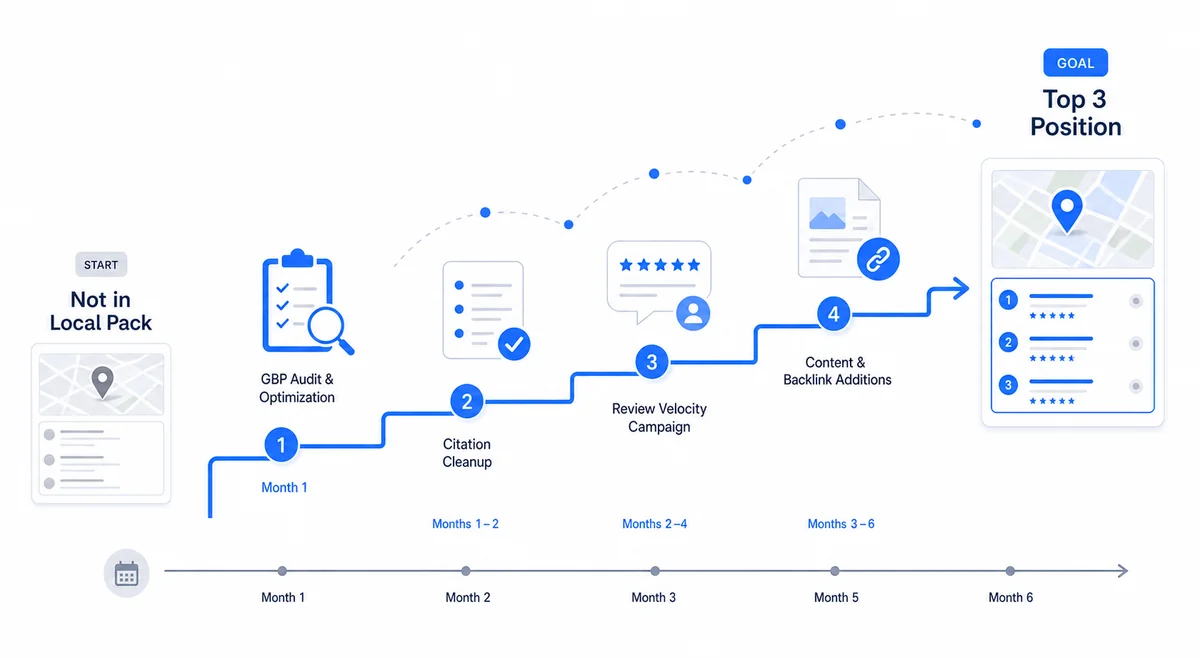
The sequence I run with every new client. The order matters; skipping step 2 to chase step 5 is the most common DIY mistake.
The full sequence moves positions in 60 to 120 days; category fixes lift in 7 to 21 days. Momo at America's Chimney Sweep jumped from position 8 to 2 in 7 weeks on a category fix alone.
| Tool | Category | Price range | Best use case |
|---|---|---|---|
| Local Falcon | Grid rank tracker | $25 to $200/mo | Visualizing pack position across the service area as a heatmap |
| BrightLocal | All-in-one local SEO suite | $39 to $130/mo | Citation building, review tracking, and grid tracking in one dashboard |
| GMB Everywhere | GBP audit extension | Free plus paid tier | Reverse engineering competitor categories and services |
| Google Business Profile Manager | Free Google product | $0 | The only place to make actual edits to the profile |
The highest-ROI tool for a small operator is Local Falcon, under $150 a month. My team layers profile audit tools we use on top to audit categories and entity signals faster than any single dashboard.
The mistakes I see most when auditing a profile. The first few are afternoon fixes; the rest take weeks to unwind.
Or runs denvergaragedoor.com in Denver. When we started he had 13 reviews; his main competitor had 253 and ranked first for "garage door repair Denver." But that competitor sat on the wholesale "Garage Door Supplier" category, ran a single-page brochure with a 4.8-second mobile LCP, and carried three phone formats in his NAP. He won on reviews and proximity; his relevance and link authority were soft.
We rebuilt Or's site with a page per service, LCP under 2 seconds, and 7 suburb pages, fixed his primary category to "Garage Door Repair Service," added 8 secondary categories, filled the services panel, and cleaned the NAP across 30 citations. Within 11 weeks he moved from invisible to position 2 on the Denver query and position 1 on three suburbs. Six months in, his visibility covered 80% of the metro while the competitor sat frozen at 253.
| Dimension | Local pack | Organic SERP |
|---|---|---|
| Share of clicks on local queries | 40 to 65% | 5 to 20% across top 3 organic |
| Primary ranking signals | Proximity, relevance, prominence | Content depth, links, technical SEO |
| Asset that ranks | Google Business Profile | A specific URL on the website |
| Time to first lift | 2 to 12 weeks for category fixes | 3 to 9 months for new content |
| Lead intent | Very high, mostly ready-to-buy | Mixed research and ready-to-buy |
The pack wins on click share, speed, and lead intent; organic wins on defensibility. For most contractors, running both at the same time pays off faster than choosing one.
Local SEO is the broader practice of ranking across local results: the pack, organic, Maps, and voice. The SERP is the full page Google returns, made of ads, the local pack, organic links, and People Also Ask. Map pack SEO is ranking inside the 3-pack specifically; reviews are the ratings that feed prominence. The three signals work together: a clean profile feeds the pack, the pack drives clicks to the site, and citation consistency supports both. Adding structured data for map visibility reinforces relevance, and none of the top 5 competitors we analyzed had any.
| Tier | Price range | What's included | Realistic outcome |
|---|---|---|---|
| DIY | $0 cash, 15 to 25 hrs/mo | Owner runs profile, citations, reviews, content edits | Works in low-competition markets if disciplined |
| Low-tier agency | $300 to $600/mo | Mass GBP posts, automated citations, monthly report | Minimal movement, often net-negative |
| HouseCall SEO Starter | $750/mo | GBP optimization, monthly content, NAP cleanup, review flow | First movement 8 to 14 weeks, full lift in 6 months |
| HouseCall SEO Pro | $1,500/mo | Starter plus weekly content, link building, grid tracking, strategy call | Top 3 in most markets within 4 to 8 months |
| Custom | From $2,500/mo | Multi-location, paid media, content team, dedicated lead | Strong for chains, overkill for single locations |
The sweet spot for a single-location contractor is $750 to $1,500 a month; below that you pay for automated tools that hurt more than they help, above $2,000 for overhead, not deliverable. See how the tiers compare for the exact breakdown.
Price is half the decision; who actually touches the profile is the other half. Here is how the four real paths to a pack position compare on the factors that actually move rankings.
| Approach | Who does the work | Strength | Where it breaks |
|---|---|---|---|
| DIY | The owner, nights and weekends | Free, and nobody knows the business better | Category and NAP fixes get half-done; 15 to 25 hours a month the owner does not have |
| Cheap freelancer ($150 to $400/mo) | One offshore generalist juggling 40 accounts | Cheap, ticks boxes on a report | Mass citation spam and keyword-stuffed names that get the profile suspended, not ranked |
| Big agency ($3,000+/mo) | An assigned account manager behind a dashboard | Process, reporting, multi-location scale | You pay for overhead and pretty SEMrush charts, not for the category fix that actually moves the pack |
| Boutique founder-led (HouseCall SEO) | The person who diagnosed the profile | Relevance fixed before reviews are sold; AI-search optimization included | One operator means limited slots, so it is not built for 50-location chains |
A suspension plus months of lost ranking recovery makes the cheap freelancer the most expensive path in practice. DIY works in a quiet market if the owner is disciplined. For most contractors the choice is a big agency's process against a boutique's attention, and on a single profile attention wins.
Chasing review count is the most common distraction I see in local SEO. I have watched contractors spend $1,000 a month on review platforms while their primary category sat wrong; the category fix would have moved ranking in two weeks, the platform moved nothing. The 2019 playbook is dying, and the new edge is AI search: showing up when ChatGPT, Perplexity, or Google's AI Overview recommends a service. AI-engine referrals to my clients grew from near-zero in early 2024 to 8 to 15% of leads by mid-2026. The source of truth is not a SEMrush dashboard but a grid tracker and the call log, the only metric that connects directly to revenue.
The Google local pack is the boxed map result showing three businesses with names, ratings, and addresses at the top of a local search, also called the 3-pack or map pack. It pulls listings from Google Business Profile and ranks them on proximity, relevance, and prominence. For contractors it absorbs 40 to 65% of clicks on local-intent queries.
Google reads local intent from the query text, the user's location, and the historical click pattern. "Plumber Sacramento" has explicit intent; "garage door spring replacement" has implicit intent. Location comes from IP, GPS, and browser signals, so the same query from two ZIP codes 8 miles apart can return different packs.
The pack ranks Google Business Profiles on proximity, relevance, and prominence; organic ranks web pages on content depth, links, and technical SEO. A business can rank first organically yet never appear in the pack if its profile signals are weak. Proximity is dominant for the pack yet irrelevant to organic.
The market spreads from $0 DIY to $3,000+ a month, with the affordable sweet spot for a single location at $750 to $1,500. HouseCall SEO Starter at $750 covers one location; Pro at $1,500 adds weekly content, link building, and grid tracking.
Look for one that fixes relevance before it sells review acquisition, names real clients with live URLs you can verify, and is run by the person doing the work. Agencies that include AI search optimization are outperforming those still on the 2019 playbook. See the lean specialist model.
If your google map pack ranking is stuck, the next move is not more reviews or citations. It is finding the weak signal suppressing your position: a wrong primary category, a service area set too wide, or one NAP mismatch dragging down the prominence blend. Book a free SEO consultation to get started. I will pull your profile live, run a grid scan, name the top 3 suppressors, and give you a realistic timeline. That is it.

I specialize in home services SEO: taking websites that sit invisible on page three and turning them into the business Google and ChatGPT recommend first. I started on the developer side, writing software and doing SEO on the side, until I saw how much home-service owners were overpaying for work that quietly hurt them. So I built a method that fixes the broken technical work and the outdated thinking behind it.
From garage door companies to plumbers, roofers, locksmiths and cleaning services, the playbook is the same: rank where your customers actually search, earn real reviews, and back it with a fast site that books the job. No PBNs, no bought reviews, no directory spam. Only work that survives Google’s next five updates. See exactly how it’s priced on the pricing page.
Free 30-minute strategy call