Keyword research for organic SEO is the process of finding the terms your customers type into Google, Bing, and AI engines, grouping them into topical clusters, and mapping each cluster to one page. Done right, you stop guessing and start ranking. The initial pass takes 12 to 20 hours. Ranking results land in 90 to 180 days for low-competition local terms and 6 to 12 months for competitive ones. AI-engine citations often appear in 30 to 60 days because those engines re-crawl faster than Google.
It is the act of discovering, scoring, and organizing the queries that drive non-paid traffic. The "organic" part separates it from paid search, where you bid. The "research" part separates it from guessing. Organic search still drives a large share of website traffic, and a growing share of questions now start in an AI engine. That shift is why I built HouseCall SEO around AI-engine optimization, not classic Google SEO alone.
The old playbook of repeating a keyword 14 times on a thin page gets ignored by Google's helpful-content systems and earns no ChatGPT citation. I have audited home-service sites where the owner paid $2,000 a month to a prior agency, received 80 blog articles, and ranked for zero commercial terms. Every one had skipped this step.
List every service, product, brand, and neighborhood you serve. For Or at Denver Garage Door, that was 41 services, 8 brands, and 39 neighborhoods. Skip it and your research chases what tools suggest instead of what you sell.
Drop each seed into SEMrush Keyword Magic Tool. Filter by country, keyword difficulty under 30 for new sites, and volume over 10 a month. For a 41-service client, that returns 800 to 1,500 keywords. SEMrush is strong on US commercial intent, weak on AI-engine queries.
Run the same seeds through Ahrefs Keywords Explorer with the Matching Terms and Questions filters. Ahrefs surfaces question-based queries better. I cross-reference both because SEMrush over-reports local volume and Ahrefs under-reports it. For the long-tail side of this work, Ahrefs wins.
This is the step page-one competitors skip. Open ChatGPT with browsing on, type your seed plus "what are people asking about this," repeat in Perplexity and Claude, save every question. These queries run 8 to 12 words and never appear in SEMrush or Ahrefs. I treat brand visibility in AI search engines as a parallel track, not a replacement.
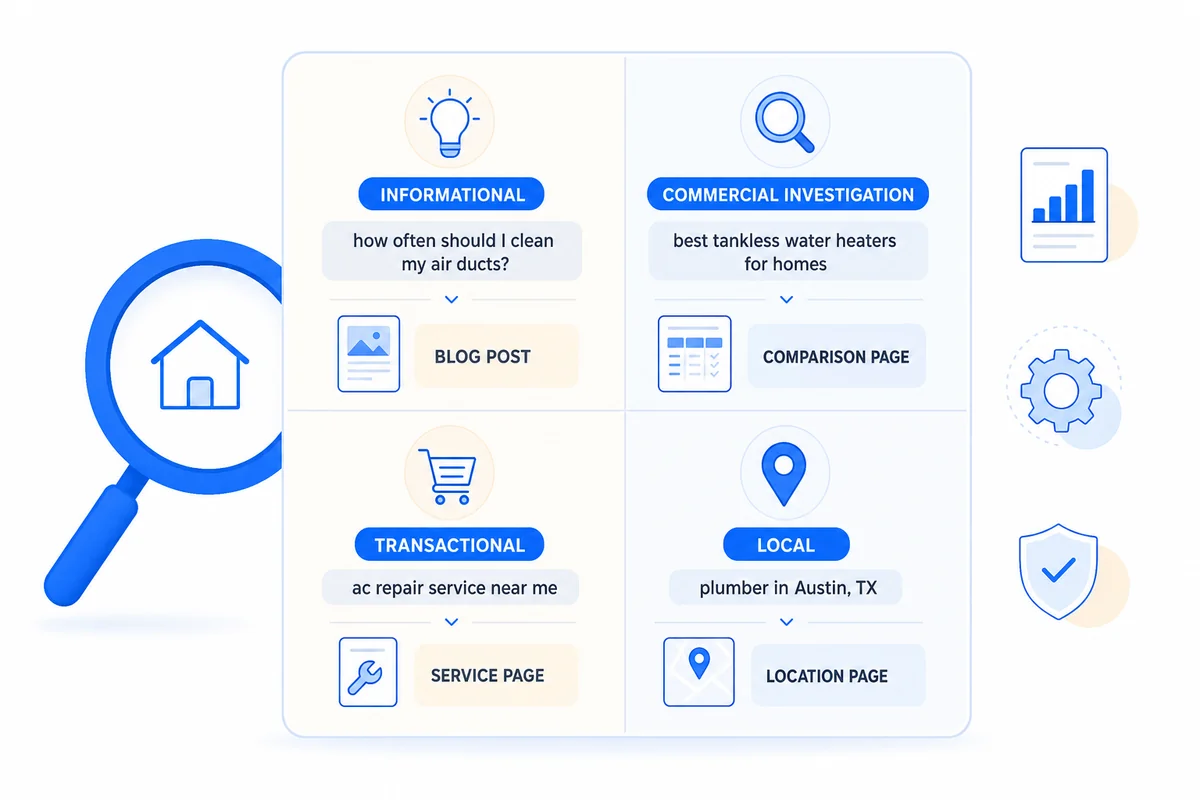
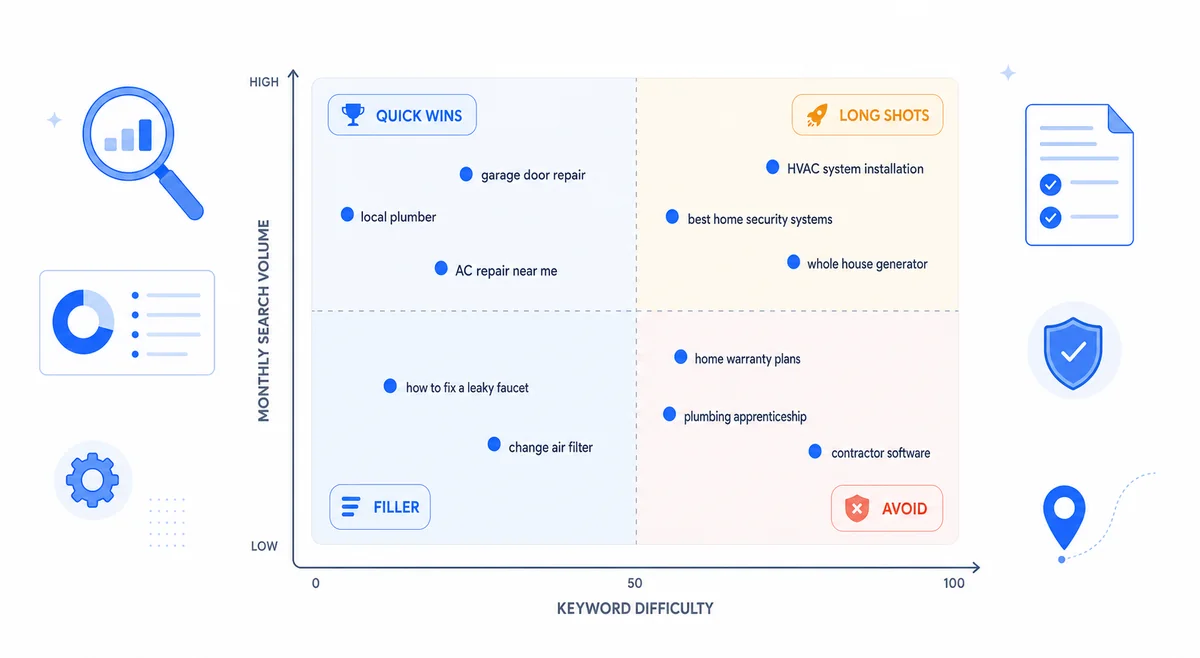
Assign intent, take the higher volume estimate of the two tools, use Ahrefs KD for difficulty, and add an AI-engine relevance score of 0, 1, or 2. My top-priority sort: transactional intent, volume over 50, KD under 25, AI-engine relevance 1 or 2.
If two keywords share at least 6 of the same top-10 Google results, they belong on one page. "Garage door repair" and "garage door installation" sound like one theme but share fewer than 2 results, so they are different pages. Clustering by theme causes cannibalization.
Assign one cluster to each page. No page for a cluster, create one. No cluster for a page, cut or redirect it. For Or, this exposed 7 unindexed pages with no internal links. We killed 3, merged 2, and rewrote 2; two rewrites ranked top 3 within 90 days. The mapping took 4 hours.
Before any content is written, a brief comes first: primary keyword, secondary keywords, AI-engine queries to answer, must-cover H2s, internal links, and intent. Our SEO content writing service uses the same template. No off-the-shelf tool covers AI-engine queries the way I need, so I built my own. That brief is where my content plan starts.
Once pages publish, I track Google SERPs and AI engines. For AI, I run each query 3 times a week across ChatGPT, Perplexity, Claude, and Google AI Overviews, and report a citation rate. Or's citation rate in ChatGPT for "garage door repair Denver" climbed from 0% in month 1 to 78% in month 11. That predicts revenue better than rank alone.
Here is the stack I use, what each is good for, and where each falls short. I am not affiliated with any of them. Prices reflect 2026 list rates.
| Tool | Best for | Weakness | Monthly price |
|---|---|---|---|
| SEMrush Keyword Magic | US commercial keywords, local volume | Inflated volume, no AI-engine data | $140 to $500 |
| Ahrefs Keywords Explorer | Question keywords, long-tail, KD accuracy | Smaller local volume coverage | $129 to $449 |
| Google Keyword Planner | Free baseline, ad-side volume | Bucketed volume ranges | Free with Ads account |
| ChatGPT Plus | AI-engine queries, conversational intent | No volume data, manual extraction | $20 |
| Perplexity Pro | Citation-source mapping, AI queries | Limited keyword export | $20 |
| Keyword Insights | Cluster grouping by SERP overlap | Per-project pricing adds up | $58 to $299 |
| Google Search Console | Real query data from your own site | Only shows queries you already rank for | Free |
I run SEMrush, Ahrefs, ChatGPT Plus, Perplexity Pro, and Google Search Console as the core stack, about $320 a month. For Starter clients, I absorb that into the retainer. The my approach to this covers the budget alternatives.
Or runs Denver Garage Door. When I took the site, the biggest local competitor had 253 Google reviews; Or had 13. I ran the 9-step workflow: 41 services and 39 neighborhoods produced 1,247 keyword candidates, and ChatGPT and Perplexity surfaced 184 conversational queries the tools missed. After scoring and clustering, we had 117 clusters, mapped 53 to existing pages, killed 7 dead pages, and built 64 new pages over 8 months.
Within 11 months, Or ranked top 3 for "garage door repair Denver" and number 1 in ChatGPT for "best garage door company in Denver." The reason is content depth backed by the cluster map, not the review count. The competitor had 17 thin pages chasing one keyword; Or had 64, each answering a question the competitor never touched. That is what I document on the garage door repair SEO.
The pattern repeats with Tomer at Pine Garage Doors in Denver (organic leads tripled in 9 months), Momo at America's Chimney Sweep in California (31 reviews beat shops with 180-plus), and Alex at Ace Locksmith SF. I run mine through HouseCall SEO, built around AI-engine integration at step 4.
People ask if keyword research is even the right starting point. Some agencies sell content marketing with no research, some sell SEO but mean link-building, some sell AI optimization alone. Here is how each compares for a home-service business.
| Approach | What you get | What you miss | Best for |
|---|---|---|---|
| Keyword research first | Page-level targeting, intent match, cluster authority | Brand storytelling for non-search audiences | Home-service local search |
| Content marketing first | Brand voice, audience trust, shares | Search-traffic predictability | D2C brands with social audiences |
| Link-building first | Domain authority, referring domains | On-page intent match, AI-engine eligibility | Already-ranked sites pushing higher |
| AI-engine optimization only | ChatGPT and Perplexity citations | Classic Google rankings that still drive most leads | Brands with mature SEO already |
| Paid search instead | Immediate traffic, full intent control | Stops the day you stop paying | Short-term lead bursts |
For a home-service business under $5,000 a month in spend, organic keyword research returns the most per dollar. Each of the alternatives above assumes you already know what your customers search.
In my audits, SEMrush and Ahrefs volume estimates over-report by 30 to 70% on US local terms and show nothing from ChatGPT or Perplexity. I watched a client target a keyword SEMrush reported at 1,300 searches a month, rank position 2, and pull 41 clicks. Real volume was around 110. Build a strategy on tool data alone and your forecast will be off by an order of magnitude.
SurferSEO and Clearscope average the top 10 results and tell you to match them. The output reads like every other page in the top 10, and AI engines refuse to cite it. Or's Denver pages break those rules on purpose. The unique sections and named-client stories the tools would strip are what make the pages citeable.
AI writing tools do not work for the content step. Keyword research can use AI as input; the writing cannot. AI-written pages read generic and earn no citations. I use AI to brainstorm, outline, and edit, never to write the finished page. Tools and AI are inputs to your judgment, not replacements for it.
| Package | Monthly fee | What is included |
|---|---|---|
| Starter | $750 | Keyword research, 5 backlinks, 2 articles or 1 service page, GBP optimization, monthly report, quarterly AI-citation tracking |
| Pro (most popular) | $1,500 | Keyword research, 15 backlinks, 6 articles plus 4 service-area pages, GBP bi-monthly audit, monthly AI-citation tracking, competitor reverse-engineering, Slack and biweekly calls |
| Custom | from $2,500 | Multi-location, city pages at scale, weekly strategy calls |
There is no separate research fee, no setup fee, and no 12-month lock-in. Other vendors charge $2,500 to $5,000 for the initial research alone, then $2,000 a month for ongoing work. I bundled it because separating research from execution is how mediocre work happens. See what each package includes beyond keyword research, or read our published pricing.
Reading a workflow is not the same as having someone run it on your site. If you would rather not learn SEMrush, ChatGPT prompts, and SERP-overlap clustering, that is the entire reason HouseCall SEO exists. I personally take every discovery call, no SDRs. We pull your domain into SEMrush and Ahrefs live on the call and you walk away with at least three keyword opportunities even if you never sign up. Book at a no-pitch site review.
SEO stands for search engine optimization, making a website rank higher in unpaid search results. For a home-service business it covers four areas: technical SEO (a crawlable, fast site), on-page SEO (pages that match buyer intent), local SEO (Google Maps and the Local Pack), and AI-engine SEO (citations in ChatGPT, Perplexity, and Google AI Overviews). Organic keyword research is the foundation that ties all four together.
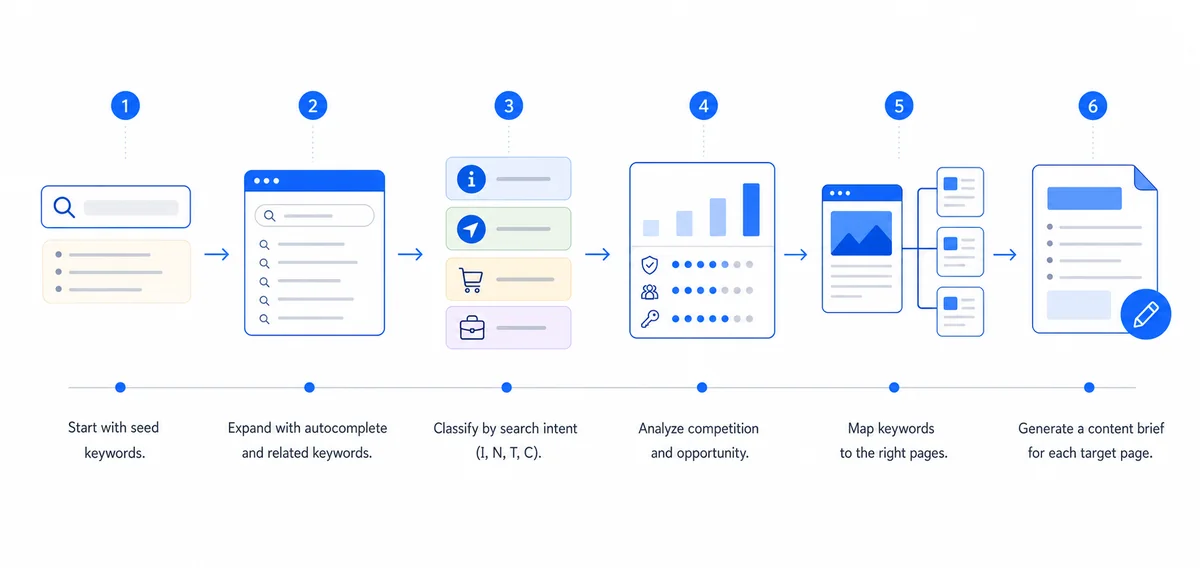
Run the 9-step workflow: build seed keywords from your service menu, expand in SEMrush, expand in Ahrefs, pull queries from ChatGPT and Perplexity, score by intent and difficulty, cluster by SERP overlap, map clusters to URLs, write a brief per page, and track rankings in Google and AI engines. Allocate 12 to 20 hours for the initial pass, then 4 hours per quarter for refresh.
Prioritize on four dimensions in order: intent fit (buyer ready to spend), ranking feasibility (KD below what your domain can win in 6 to 12 months), business value (top-3 ranking grows leads, not just traffic), and AI-engine relevance (the query shows up in ChatGPT and Perplexity). Transactional intent plus KD under 25 plus AI-engine relevance 1 or 2 is my top-tier filter.
Standalone one-time engagements run $1,500 to $5,000 with a senior SEO. At HouseCall SEO it is bundled into every plan: Starter at $750 a month, Pro at $1,500 a month, and Custom from $2,500 a month for multi-location businesses. No contract. Research without execution is a deliverable on a shelf, not a result.
It depends on your niche and service area. HouseCall SEO is built for US home-service businesses: plumbing, garage door, HVAC, locksmith, chimney sweep, roofing, and med-spa. What separates us is the AI-engine query step at step 4. Most local SEO agencies do not include it. If your business sits outside home-service, find an agency with proven wins in your specific vertical. Niche depth beats agency size every time.
I am Lior Daniel, founder of HouseCall SEO. I take every discovery call personally, no sales team between you and the work. We run the 9-step keyword research workflow live on your domain in 30 minutes, and you leave with real opportunities whether or not you hire us. Book a 30-minute call and pick a time that works.

I specialize in home services SEO: taking websites that sit invisible on page three and turning them into the business Google and ChatGPT recommend first. I started on the developer side, writing software and doing SEO on the side, until I saw how much home-service owners were overpaying for work that quietly hurt them. So I built a method that fixes the broken technical work and the outdated thinking behind it.
From garage door companies to plumbers, roofers, locksmiths and cleaning services, the playbook is the same: rank where your customers actually search, earn real reviews, and back it with a fast site that books the job. No PBNs, no bought reviews, no directory spam. Only work that survives Google’s next five updates. See exactly how it’s priced on the pricing page.
Free 30-minute strategy call