
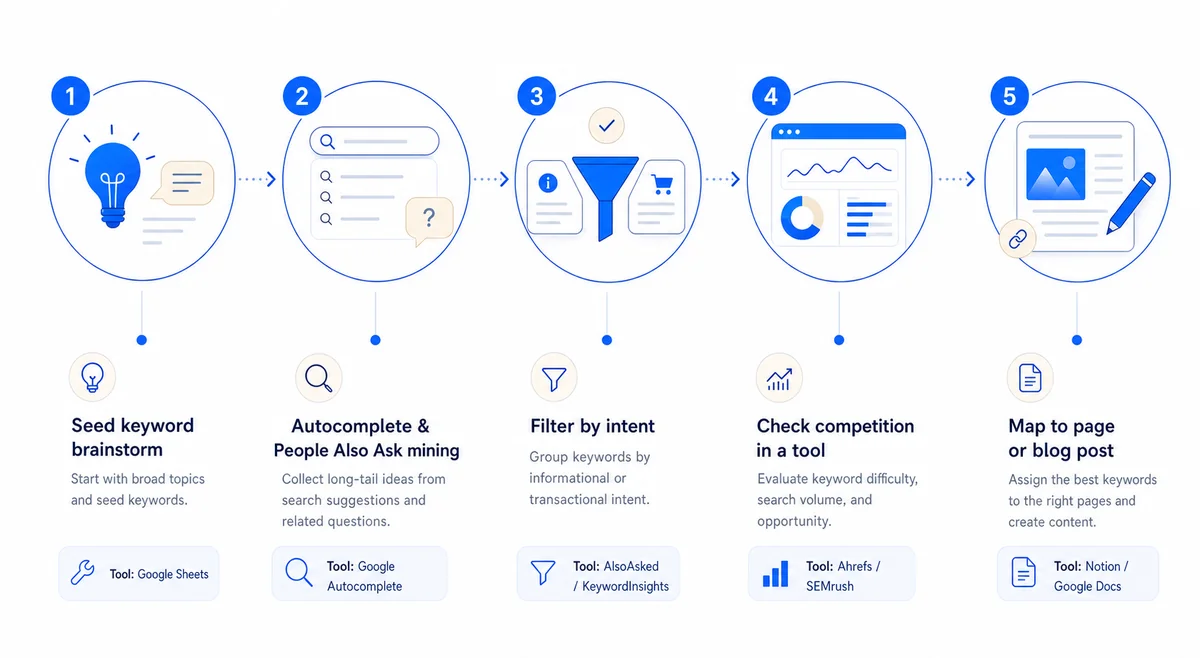
Here is how to find long tail keywords for SEO: run five sources in one pass. Prompt ChatGPT with your seed keyword plus "list 50 long tail queries a frustrated buyer would type before calling." Run AlsoAsked to map question chains. Mine Reddit threads for exact customer phrases. Sweep Google AutoSuggest A through Z. Then validate volume in SEMrush or Ahrefs. Five sources, one list, 200 to 500 raw candidates ready for filtering. For niche examples, see my guide to plumbing SEO keywords.
A long-tail keyword is a search query with low volume, high specificity, and clear intent. Usually 4+ words, under 1,000 monthly searches, converting 2.5x better than head terms. Ahrefs data shows 92% of all queries get 10 or fewer monthly searches. That is the long tail. One page per topic ranks for the head term plus dozens of long-tail variants. Long tail is where revenue hides.
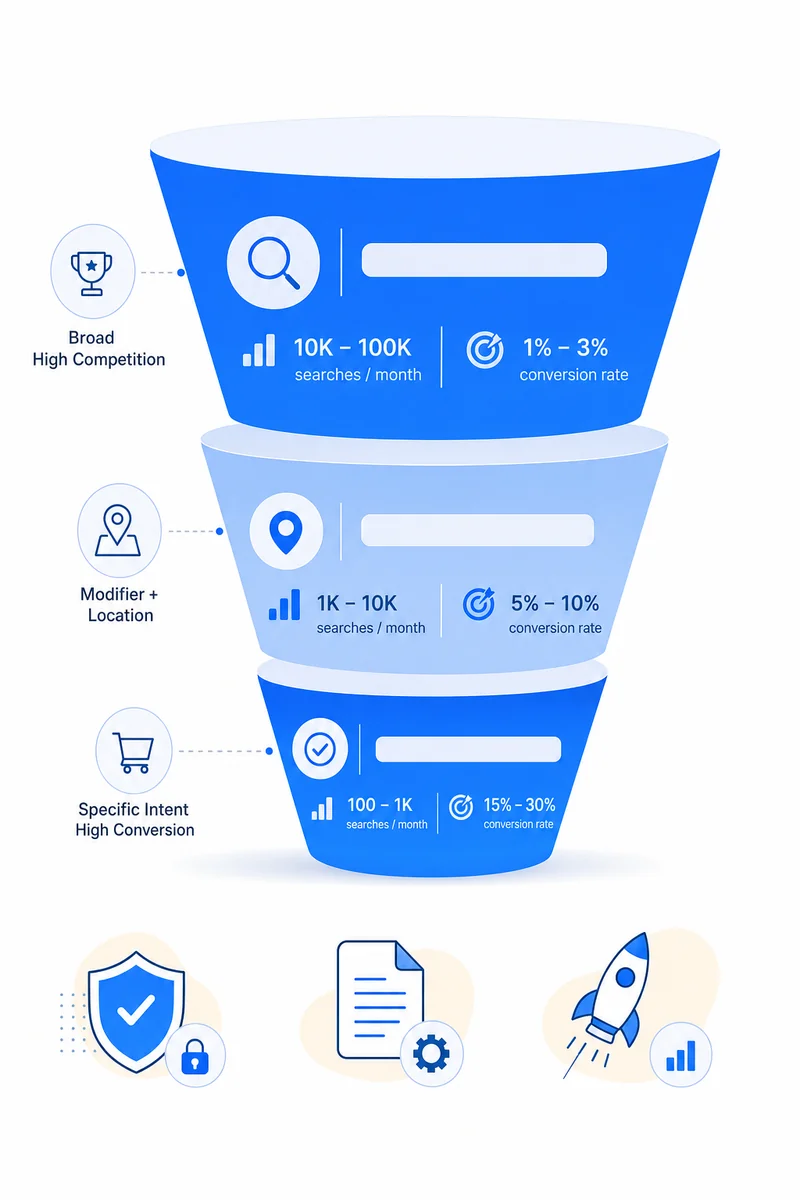
The name comes from the search demand curve. A small cluster of head terms sits at the top with high volume. The curve drops sharply, then stretches into a long, flat tail of millions of low-volume queries that holds the majority of all searches when summed. Chris Anderson coined "long tail" in a 2004 Wired article on internet retail. SEOs borrowed the term for the same curve shape in keyword data.
Long-tail keywords convert better and cost less to rank, and together they drive more total traffic than head terms. Conversion rates run 4-12% versus 1-2% for head terms. Keyword difficulty drops with specificity. One page ranks for hundreds of variants simultaneously. For a contractor on a $750 monthly SEO budget, long-tail pays back inside 6 months. Head terms on a small budget rank nothing.
This is the exact order I run for every new client. One working day yields 200 to 500 raw candidates.
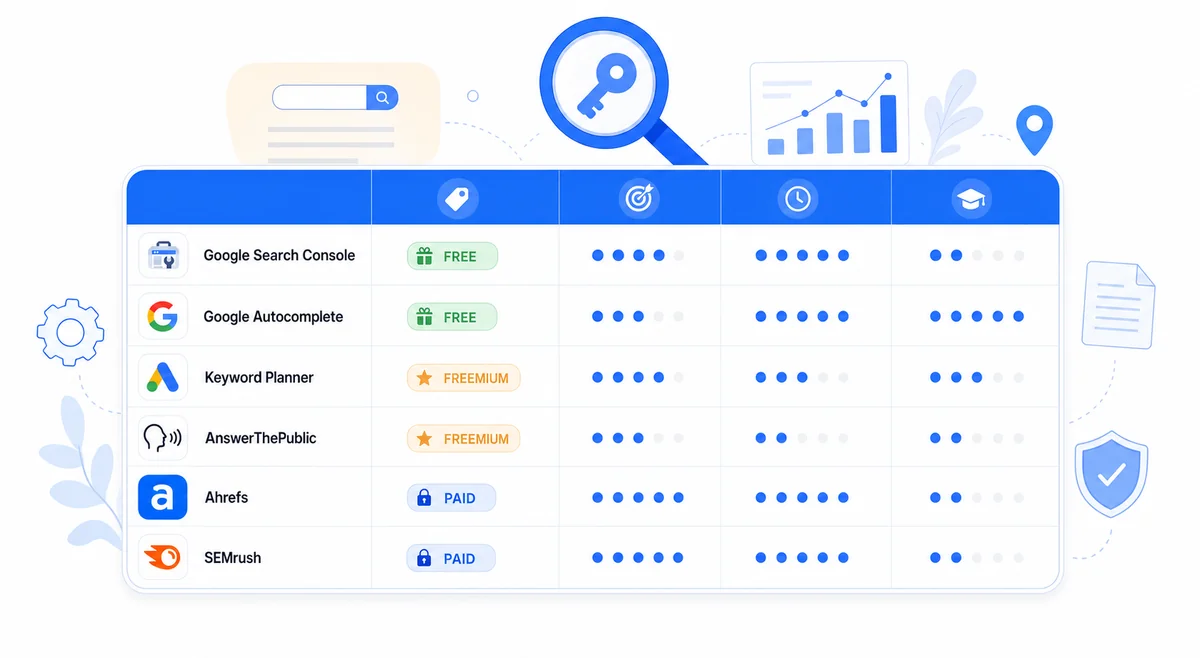
| Tool | Use case | Price (2026) | Why I use it |
|---|---|---|---|
| ChatGPT (Plus) | Buyer-language brainstorming | $20/mo | Generates queries SEMrush never shows. AI search overlap. |
| AlsoAsked | PAA question trees | Free (3/day) or $15/mo | Shows second and third-layer branches in one view. |
| AnswerThePublic | Question and preposition patterns | Free (3/day) or $9/mo | Surfaces vs, for, and near patterns most tools miss. |
| Real customer language, model numbers | Free | Highest signal. Real frustration in real words. | |
| Google AutoSuggest | A-to-Z query sweep | Free | Live within 90 days. Straight from Google. |
| SEMrush or Ahrefs | Volume and KD validation | $129-199/mo | Filters raw candidates to terms with measurable demand. |
| Google Search Console | Already-ranking discovery | Free | Shows impressions with no clicks. Full long-tail picture on your own site. |
I have audited 80+ home service sites. The same four mistakes appear on almost every one.
Confusing low volume with low value. "Garage door spring broken near Mile High Stadium" gets 30 searches, KD of 4, closes at 8%. Skip it and you lose the easiest call in your market.
Stuffing 200 keywords onto one page. One pillar covers one topic plus 20 to 50 variants sharing search intent. Different intent means different pages. Plumbers who cram "emergency plumber Denver" and "is it worth replacing my water heater" on the same page rank for nothing.
Relying only on SEMrush or Ahrefs. Those tools miss Reddit-sourced phrases and the entire ChatGPT query universe. That 30% gap is where competitors have not looked.
Ignoring intent groups. Mix informational and transactional long-tail on one page and bounce rate spikes, dwell time drops, Google demotes the page.
January 2026, Or's site at denvergaragedoor.com. Seed: "garage door spring repair." The 5-source pass produced 53 candidates. After SEMrush validation, 47 survived. ChatGPT returned "garage door spring snapped won't open." AlsoAsked gave 8 nodes under 3+ parent branches. AutoSuggest found "garage door spring replacement Denver near Cherry Creek," KD of 3.
Page launched February 2026. By April it ranked for 32 of those 47 variants on page 1, 11 in the top 3, and generated 13 spring repair calls from organic traffic alone. This workflow runs inside the HouseCall SEO AI-search stack, layering ChatGPT mining with citation reverse-engineering.
| Category | Volume per query | KD range | Conversion rate | Time to rank | Best for |
|---|---|---|---|---|---|
| Head terms | 10,000+ | 50-90 | 1-2% | 12-24 months | Large sites, $5k+ monthly budget |
| Mid-tail | 500-5,000 | 25-50 | 2-4% | 6-12 months | Service area dominance |
| Long-tail (4+ words) | 10-500 | 0-25 | 4-12% | 60-180 days | Most small home service businesses |
| Branded | Variable | Low | 15-30% | 30-90 days | Reputation defense, direct navigation |
For a Starter plan contractor at $750 per month, 80% of effort goes to long-tail. Head terms come after long-tail wins build domain authority.
A true long-tail keyword has three properties: low monthly volume under 1,000, high specificity at 4+ meaningful words, and clear intent. "Why does my Genie 2055 garage door opener flash 5 times then stop" qualifies. "Plumber Denver Colorado USA service area" does not. Misread the mix and your content plan fills with junk. This is the step most SEOs skip, and why their keyword lists never turn into ranking pages. Get the keyword mix right and the rest of the content strategy falls into place.
Long-tail discovery is one stage of keyword research, not the whole job. The full pipeline: seed selection, head term mapping, mid-tail expansion, long-tail mining, intent clustering, page mapping. Skip seed selection and you end up with 500 candidates and no content plan. Pick the 3-5 services that drive real revenue first. Each gets a pillar page plus 10 to 20 long-tail support pages.
Home service buyers move through 4 stages before they call: symptom search ("garage door making grinding noise"), diagnosis ("garage door cable came off drum what to do"), solution search ("how much does cable repair cost in Denver"), trust search ("best garage door repair Cherry Creek"). Long-tail research feeds all 4 stages.
ChatGPT used wrong returns generic junk. The way to get there is by roleplaying as the customer: "Pretend you are a homeowner whose water heater just started leaking on a Sunday night. Type the next 15 things you would search." No keyword database has quantified those queries yet. The same model generating them also fields them in production.
Run "best plumber in Denver" in ChatGPT and note which sources it cites: Yelp, Angi, BBB, HomeAdvisor. That is your local citations list for 2026. I cover the full reverse-engineering technique on the the citation building guide page.
The highest-converting long-tail queries contain a model number: "LiftMaster 8500W not closing," "Kohler Cimarron toilet keeps running." These convert at 12 to 18%. SEMrush underweights them because they spread across thousands of model variants. Reddit and ChatGPT surface them.
Mining takes 20 hours. Pillar pages take 60 to 80 hours to write at depth. How the plans compare has the full breakdown.
Long-tail keywords are search queries with low individual volume, high specificity, and clear intent. Usually 4+ words, under 500 monthly searches each. Examples: "garage door spring repair cost Denver," "locksmith for Medeco locks San Francisco." Combined across hundreds of variants, they drive the majority of search traffic and convert at 2-3x the rate of head terms.
The name comes from the search demand curve. A small cluster of head terms sits at the top. The curve drops sharply and stretches into a long, flat tail of millions of low-volume queries. Chris Anderson coined "long tail" in a 2004 Wired article on internet retail, and the SEO industry adopted it for the same curve shape in keyword data.
Build one pillar page per topic cluster covering the head term and 20 to 50 long-tail variants that share the same search intent. Use H2s for sub-topics, H3s for specific questions. Place a quick answer near the top for AI Overview eligibility. Add specific numbers and a named client example.
Same 5-source workflow, but filter strictly for commercial and transactional intent. Add Google Ads Keyword Planner for CPC data. Target CPC over $5, volume 30 to 500 monthly. Long-tail PPC runs 40-60% lower CPC than head terms with 2-3x higher conversion rates.
Google Search Console is the baseline. Its Performance report shows every query your site gets impressions for, including thousands of variants you never explicitly targeted. SEMrush and Ahrefs track position over time but strip queries under 50 monthly volume. GSC is the only complete source. For timeline expectations, see when rankings typically move.
You have the workflow. The mining takes one working day. Turning the keyword list into ranking pages takes 60 to 80 hours per pillar. I am Lior Daniel. I do both inside every monthly retainer. Book a free SEO consultation and I will run the 5-source workflow live on your top 3 services, hand you 50+ long-tail candidates and a written content plan, no charge and no obligation.

I specialize in home services SEO: taking websites that sit invisible on page three and turning them into the business Google and ChatGPT recommend first. I started on the developer side, writing software and doing SEO on the side, until I saw how much home-service owners were overpaying for work that quietly hurt them. So I built a method that fixes the broken technical work and the outdated thinking behind it.
From garage door companies to plumbers, roofers, locksmiths and cleaning services, the playbook is the same: rank where your customers actually search, earn real reviews, and back it with a fast site that books the job. No PBNs, no bought reviews, no directory spam. Only work that survives Google’s next five updates. See exactly how it’s priced on the pricing page.
Free 30-minute strategy call