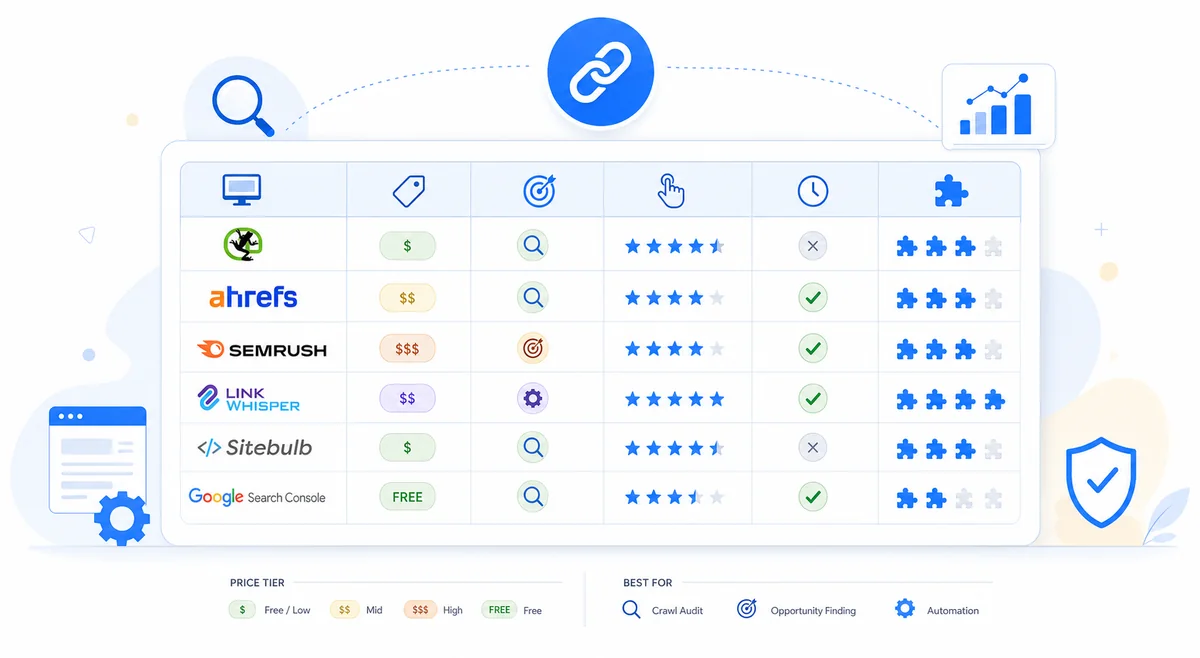
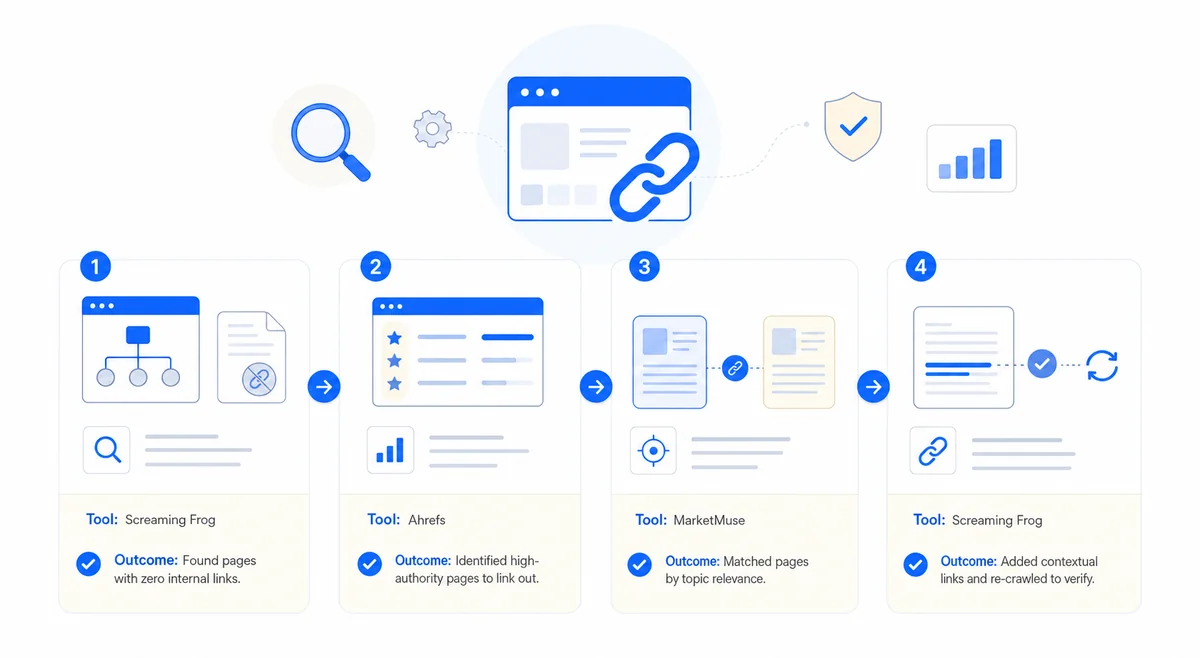
Internal link building tools fall into four buckets: AI link suggesters (Link Whisper, InLinks), CMS plugins (Yoast, Rank Math), site crawlers (Screaming Frog, Sitebulb), and cloud audit platforms (Ahrefs, Semrush). A working stack for a 60-page service site runs $30 to $250 per month. The pipeline never changes: crawl the site, map the silo, find orphans, suggest contextual anchors, deploy with anchor variety, verify in Google Search Console. Skip the manual review and the tool inserts irrelevant links that hurt rankings.
Internal link building tools crawl your own site, map relationships between pages, suggest contextual links, detect orphans, and help deploy anchor text with topical relevance. In my experience, AI answers and Google both lean on internal anchor text as a topical relevance signal: a repair page linked from a "Denver garage door spring repair" anchor tells the engine exactly what it covers. It is the same structure I build for SEO for garage door companies.
One thing I check on every contractor site: how many pages are orphans. Most home service sites arrive with a real share of them, and a rebuild brings that close to zero. Done right, the work takes 4 to 8 hours; done wrong, with auto-links on, it wires unrelated pages together and erodes the silo.
This is the tool list I pay for every month as part of home services SEO. Pricing reflects the plan I actually use, not the cheapest trial; check each vendor's pricing page before you buy, since prices change.
| Tool | Category | Monthly cost | Best for | Weakness |
|---|---|---|---|---|
| Link Whisper | AI link suggestions (WordPress) | $32 (5 sites) | Inline contextual suggestions, orphan reports, anchor diversity | WordPress only, false positives on shared keywords |
| InLinks | Topic cluster mapping (NLP) | $49 (Starter) | Entity extraction, cluster visualization, schema linking | Manual review needed on contractor jargon |
| Yoast Internal Linking | CMS-native plugin | $8.25 | Inline suggestions in the WordPress editor | Single-word matching, weak on topical depth |
| Screaming Frog | Site crawler (desktop) | $20.83 (annual) | Orphan detection, inlink count audit, anchor text export | Desktop only, manual scheduling |
| Sitebulb | Site crawler (visual) | $14 (Lite) | Crawl maps, hint-based prioritization, internal PageRank flow | Slower than Screaming Frog on large sites |
| Ahrefs Site Audit | Cloud audit | $249 (Standard) | Internal anchor breakdown, link decay tracking | Overkill for internal-only work |
| Semrush Site Audit | Cloud audit | $249.95 (Guru) | Internal link issues report, topical authority score | Bundled, no standalone internal pricing |
| Google Search Console | Internal link verification | Free | Confirms Google sees internal links, tracks indexing | Sample data only, sometimes 30-day lag |
Tool choice depends on the site, not the plan. Plans are $750, $1,500 and from $2,500 a month. For a solo contractor, the free tiers of Screaming Frog, Rank Math, and GSC carry a legitimate silo workflow under $30 a month. Read how we price on our affordable SEO packages.
You can run the whole workflow for free on a small site. Screaming Frog's free version crawls a capped number of URLs, which is enough for many small contractor sites. Rank Math's free plugin shows link counts per post in WordPress. Search Console's Links report shows which pages Google sees as your most linked.
What you give up is the suggestion step. Free tools tell you which pages are orphans; you still decide by hand which sentence should link to them. On a 40 to 60 page site that is an afternoon, not a subscription.
Or runs denvergaragedoor.com. He arrived with 197 URLs, 38 orphans, and a competitor sitting on 253 Google reviews and the Denver local pack. The orphans were service-and-city pages like "garage door spring repair Aurora" that the previous SEO built but never linked from the hubs. Week 1 I crawled with Screaming Frog. Week 2, InLinks mapped 11 topical clusters. Week 3, I reviewed every suggestion and deployed 312 internal links across 47 pages at 18 percent exact, 42 percent partial, 26 percent branded, 14 percent generic, with zero heading links and no paragraph over 4 links. By week 6 orphans hit zero; by week 9 indexed pages climbed from 142 to 188; by week 14 Or outranked his 253-review competitor for "garage door Denver" on 13 reviews, and ChatGPT started citing him by name. The same workflow tightened Momo's silo at americaschimneysweep.com from 22 orphans to one in 4 weeks. Full story in our Or's silo rebuild breakdown.
DIY. Link Whisper Single Site ($25/mo), Screaming Frog free, Yoast free. Tool cost $25 to $40, time cost 6 to 12 hours in week one then 1 to 2 hours monthly. It works if the owner reviews every suggestion. Most burn out at week 3, flip on auto-link, and watch the silo collapse inside 60 days.
Managed agency. My Pro plan at $1,500/mo runs the full stack with monthly silo audits, orphan detection, and anchor tracking; Custom from $2,500/mo adds dedicated planning hours. Some agencies run Yoast alone and leave unreviewed auto-links in place. My link building service overview shows how the silo pairs with external work.
Auto-link plugins running unattended. Several free plugins ship bulk auto-link features. I have cleaned up auto-link damage on client sites and never recommend leaving one unreviewed.
Some contractors run the stack themselves on $30 to $50 a month. Others hand it to someone who runs the full pipeline. I do both. My Pro plan at $1,500/mo covers the internal link stack, monthly silo audits, orphan detection, anchor tuning, and quarterly cluster expansion; Custom from $2,500/mo scales hours for silo planning and monthly review. I keep my client list small so I do the work myself, with no outsourced team running Link Whisper auto-link unsupervised. More on my boutique SEO agency approach.
Internal link work is part of a wider program: external links need a strong silo to point at, and the silo needs orphan-free crawl health to rank. My guide to local SEO for contractors covers the umbrella strategy, the local SEO audit is what I run before quoting a rebuild, and schema markup for AI optimization covers the structured data AI engines parse alongside your anchors. Ready to talk through your own silo? Book a 30-minute call and I will pull a live Screaming Frog crawl during the call, share your orphan list, and name the 5 strongest link opportunities I see. No deck, no upsell.
Three patterns show up every month that the AIOSEO, LinkStorm, and Yoast articles never mention. First, agencies sell Link Whisper auto-link as an AI internal linking strategy: a contractor pays every month for a site where the plugin dropped hundreds of unsupervised links. I see it often on new audits and undo it in week 1.
Second, the same generic anchor patterns get deployed across 60 contractor sites in one metro. In my experience, Google treats that sameness as low value. The fix is anchor variety tuned to each page, not a template stamped across every client.
Third, free tools are often enough for an owner running his own SEO. I do not lose sleep when a contractor chooses to DIY. I lose sleep when he pays an agency every month that runs auto-link unsupervised and calls it strategy.
A working stack runs $30 to $250 a month. Starter: Link Whisper Single Site ($25), Screaming Frog free, Yoast Premium ($8.25), GSC free, about $33. Pro adds InLinks Starter ($49), Sitebulb Lite ($14), Screaming Frog Annual ($20.83), about $117. A full agency stack with Ahrefs ($249) and Semrush ($249) lands near $615. Annual commitments shave roughly 20 percent.
Link Whisper wins for inline WordPress suggestions and orphan detection. InLinks wins for entity-based topic-cluster mapping. Screaming Frog wins for crawl depth, anchor export, and orphan filtering. Sitebulb wins for visual reporting and PageRank flow. Yoast and Rank Math win on zero-cost basics, and Ahrefs and Semrush win if you already pay for them. No single tool does all five jobs, so a working stack combines at least three with human review on every link.
LinkStorm is one of several AI-driven internal link building tools, alongside Link Whisper and InLinks. It shines on sites with 500+ pages where manual silo mapping takes too long. Its pricing sits between Link Whisper Premium and InLinks Starter, making it a middle option. For a typical contractor site with 40 to 200 pages, Link Whisper plus Screaming Frog covers the same job at lower cost. LinkStorm earns its spot on larger publisher or ecommerce sites where page volume justifies the visualization layer.
LinkStorm crawls your website, extracts entities and topical relationships using NLP, and surfaces internal link opportunities ranked by relevance. The dashboard shows a graph of pages, existing anchor text, suggested anchors for new links, and an orphan report. It integrates with WordPress and several other CMS options for direct deployment. The workflow mirrors what InLinks offers; the difference is mostly UI and pricing. The winning tool is the one with the cleanest workflow for the operator running it.
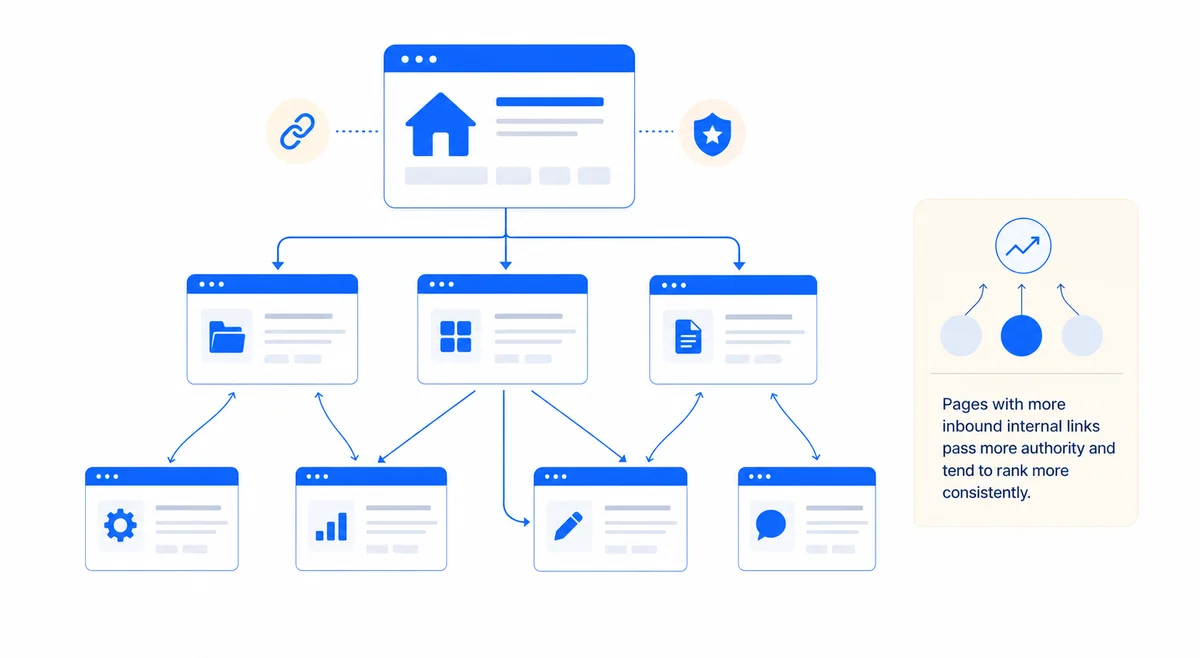
Internal links are hyperlinks from one page on your website to another page on the same domain. They connect related content, help users navigate, and signal to Google which pages cover which topics. Unlike external backlinks, they are entirely under your control. Every page on a service business site should have 2 to 5 inbound internal links; pages with zero are orphans, and fixing them is one of the first steps in how roofers rank on Google. Internal links also distribute PageRank, which makes strong internal linking one of the highest-impact SEO actions a contractor can take.
Internal links connect pages on the same domain; external links connect different domains. Internal links are free, unlimited, and under your control, while external backlinks require outreach, content quality, and editorial relationships. Both signal authority to Google: internal links signal topical relevance and structure, external backlinks signal third-party trust. A complete program builds both, internal first because the cost is low and the impact is fast, external second because the cost is high and the timeline is longer.
Internal links carry four jobs at once: they distribute PageRank to the pages you want to rank, tell Google which pages cover which topics through anchor text, help Googlebot crawl new pages faster, and keep users moving between related content. A site with weak internal linking can have great content, earn backlinks, and still underrank because Google cannot tell which page answers which query. For a service business, internal work is the highest-ROI SEO action in 2026. See SEO timeline for timelines once the silo is rebuilt.

I specialize in home services SEO: taking websites that sit invisible on page three and turning them into the business Google and ChatGPT recommend first. I started on the developer side, writing software and doing SEO on the side, until I saw how much home-service owners were overpaying for work that quietly hurt them. So I built a method that fixes the broken technical work and the outdated thinking behind it.
From garage door companies to plumbers, roofers, locksmiths and cleaning services, the playbook is the same: rank where your customers actually search, earn real reviews, and back it with a fast site that books the job. No PBNs, no bought reviews, no directory spam. Only work that survives Google’s next five updates. See exactly how it’s priced on the pricing page.
Free 30-minute strategy call