
Knowing how to measure brand visibility in ChatGPT starts with a clear definition: it is the rate at which the model names your business when a customer asks a question you want to win. It is not impressions or SERP position. It is binary per prompt (named or not), ranked when multiple brands appear, and time-stamped so the trend across months is visible. The number worth tracking is citation share: the percentage of your priority prompts where ChatGPT names you.
Or runs Denver Garage Door, a garage door SEO client, against a 253-review competitor. When 27 of his 34 tracked prompts named him, that was 79% citation share. A year earlier it was 32%. Every point of growth mapped to ChatGPT-attributed calls weeks later.
An AI visibility audit is a one-time baseline that captures how often a brand appears across ChatGPT, Gemini, Perplexity, and Google AI Overview for a fixed prompt list. In generative engine optimization work it is the starting point, and it produces three artifacts: a citation share percentage per engine, a prompt-by-prompt answer table, and a gap list where a competitor was named instead. Without a baseline, every later chart is uncalibrated.
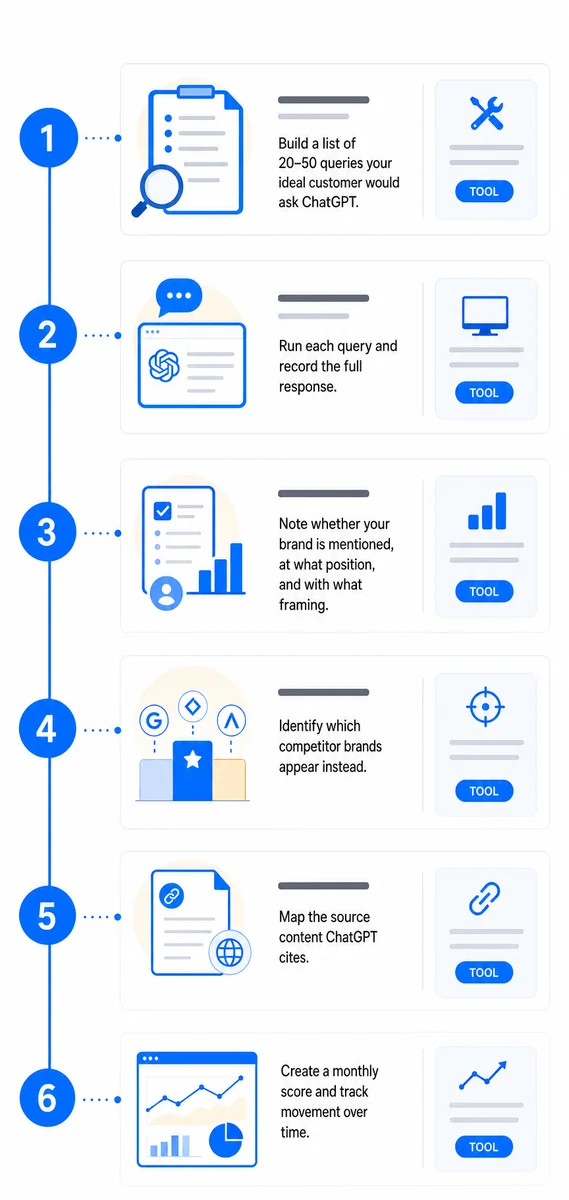
For local service queries, ChatGPT leans on live retrieval: directories, review sites, Reddit threads and your own site when its schema is clean. A brand named consistently across several of those sources gets cited more often than one named in a single place. The full breakdown of how each engine picks sources is in my guide to generative engine optimization.
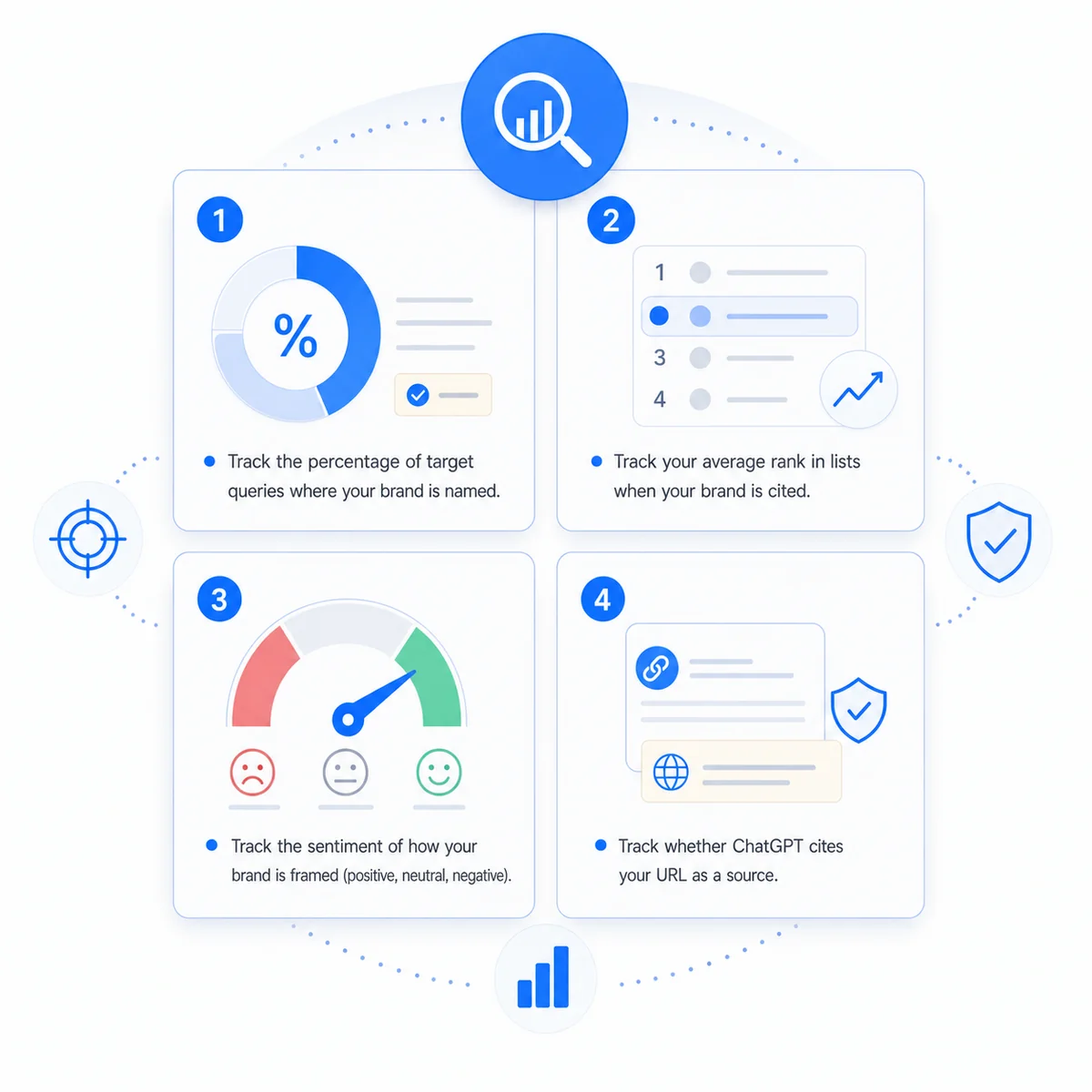
Three signals interact: training data, live retrieval at query time, and source trust weighting. For local queries, fresh retrieved sources decide the answer. ChatGPT weights repetition across trusted sources, so the more places it finds your brand mentioned consistently, the higher the probability it names you. Building that citation footprint is the practical work behind improving brand citations in ChatGPT. The full playbook is our guide on growing your citation share across AI engines.
Fifty prompts, four engines, monthly cadence, six scoring dimensions, one flat dataset per client. Build the prompt list from four sources: 20 prompts from high-intent keyword research rewritten as natural questions, 15 from real customer language (the phrases a dispatcher hears on the phone), 10 from AI-query tools that mine what people ask about your niche, and 5 from competitor traps where a rival dominates. Run the same list through all four engines on the first of every month, and inside ChatGPT run each prompt three times: base model, search, and browse.
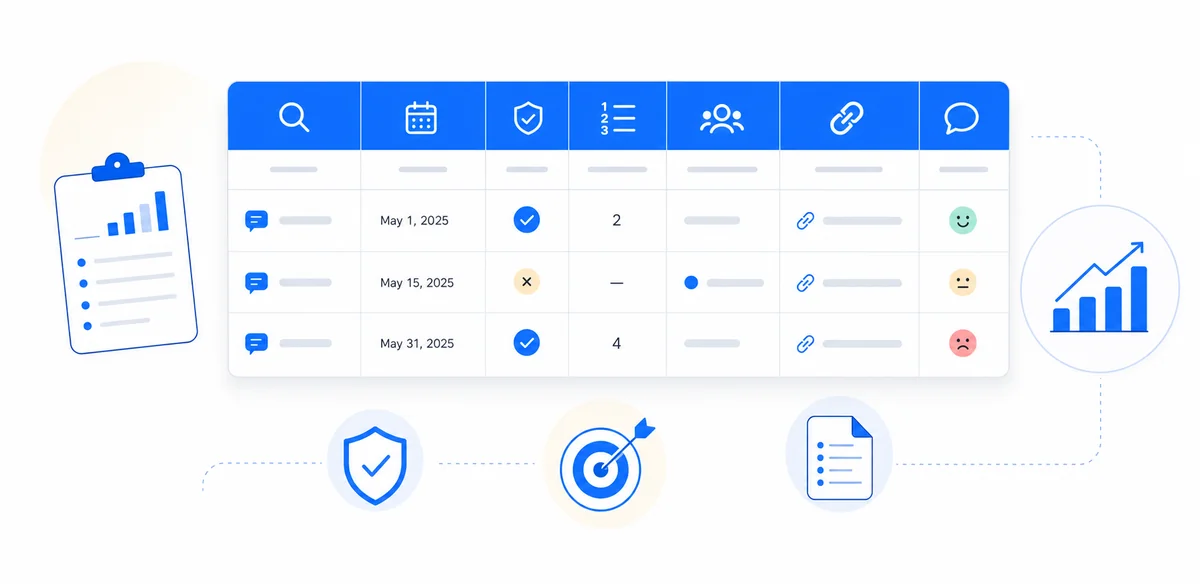
Capture the full answer text, not a summary, in a dated spreadsheet row. Automated parsers miss nuance, like a brand named conditionally versus unconditionally. Score each answer on six dimensions: citation presence (named or not), rank (first, second, later), source link (site, GBP, Yelp, none), factual accuracy (hallucination flag), citation share across 50 prompts, and month-over-month delta. Run the list on the same date every month. Fixed cadence isolates your work from engine-side changes.
This technique separates AI-GEO from generic SEO. Pick a prompt where a competitor is named instead of your client. Run it in ChatGPT search and Perplexity, save every source link both engines cite, then group by type: directories, niche listings, Reddit threads, YouTube videos, local blogs. For each source that mentioned a competitor, get your client listed on that same source. Build the Yelp profile, register the niche directory, write a genuine Reddit answer.
When we ran this for Or across 9 gap prompts in summer 2025, 6 of them started naming him within 60 days. The remaining 3 needed a second cycle. We spent nothing on ads. The cost was 14 directory profiles and one well-crafted Reddit comment. The engines show exactly which sources they trust. Build your citation footprint there.
Three formats get lifted most often: Q&A blocks with one question per heading and a short direct answer, stat blocks with one specific number per sentence, and comparison tables. When you measure, note which of these formats the cited pages use. The schema side is covered in the generative engine optimization guide.
Beyond schema, the structure of your prose decides whether an engine can lift it. Lead each section with a concise definitional answer in the first sentence, so the engine can quote it whole. Break processes into structured lists, because a numbered step is easier to extract than a buried clause. Keep entity clarity high: name the city, the service, the brand, and the number explicitly instead of relying on "we" and "it." Engines pull what they can parse cleanly, so the page that states one fact per sentence beats the page that hedges three claims into one.
Profound runs prompts across ChatGPT, Perplexity, Gemini, and Claude with clean dashboards, but enterprise pricing near $3,000 a month is overkill for a single-shop contractor. Otterly.ai is the closest starter tool at $89 to $300 a month; ChatGPT and Gemini coverage is solid, Perplexity is shallow, and hallucination checks are not built in. Knowatoa helps discover which prompts people ask in your niche, so we use it to build the initial 50-prompt list. Semrush's AI toolkit integrates with keyword data but feels bolted on. After a year of paid trials, I built a Python runner on a cron that hits four engines, scores six dimensions, and writes to a shared spreadsheet. The best tool for tracking brand visibility in ChatGPT is the one a human runs and reads every month. See the full comparison at best ChatGPT SEO tracking tool.
Four mistakes I see every week. Hiding the address when not needed: a service area business set wrong loses signal in both the local pack and AIO. Keyword-stuffed service lists: Google ignores them and AI engines cannot parse them, so five clean service names beat 40 spammed ones. Wrong primary category: "Plumber" instead of "Emergency Plumber" misses query match. A spammy business name like "Best Cheap 24/7 Emergency Plumber Denver LLC" gets filtered by Google and rarely appears in AI citations. A clean, brandable name is one of the strongest GBP signals available.
On the first of the month the runner fires the 50-prompt list across four engines and writes the answers to the shared sheet. On the second, a human reads every answer and flags accuracy errors against the ground-truth file per client. On the third, the report goes out: executive summary, engine breakdown, prompt table, win list, gap list, and next-month fix plan. The rest of the month is shipping fixes: building citations, writing pages, adding schema, pitching niche directories. Without a fix queue, the tracking data goes nowhere.
| Month | ChatGPT share | Gemini share | Perplexity share | AIO share | Combined |
|---|---|---|---|---|---|
| Feb 2025 (baseline) | 32% | 21% | 15% | 9% | 19% |
| May 2025 | 44% | 29% | 26% | 15% | 29% |
| Aug 2025 | 56% | 38% | 41% | 21% | 39% |
| Nov 2025 | 68% | 50% | 53% | 32% | 51% |
| Feb 2026 | 74% | 56% | 62% | 41% | 58% |
| Apr 2026 | 79% | 59% | 68% | 47% | 63% |
Combined share moved from 19% to 63% over 14 months. Or also booked 11 ChatGPT-attributed calls in Q1 2026, up from 2 in Q1 2025. Homeowners called saying "ChatGPT told me to call you." The chart predicted the calls three months ahead. We run the same loop for Tomer at Pine Garage Doors, Momo at America's Chimney Sweep, and Alex at Ace Locksmith SF, and you can verify each one. Full story in the operator turnaround story.
| What gets tracked | Generic SEO | HouseCall SEO |
|---|---|---|
| Google rank position | Yes | Yes |
| ChatGPT citation share | No | Yes, monthly |
| Gemini + Perplexity share | No | Yes, monthly |
| AIO citation share | Rarely | Yes, monthly |
| Hallucination check | No | Yes, ground-truth verified |
| Fix loop tied to tracking | No | Yes, monthly tickets |
| ChatGPT base vs search vs browse | No | Yes |
AI tracking is included in every package. Tracking without a fix loop is a chart, not a service.
| Package | Monthly price | Prompts tracked | Engines | ChatGPT modes |
|---|---|---|---|---|
| Starter | $750/mo | 20 | ChatGPT, Gemini | Search only |
| Pro | $1,500/mo | 35 | ChatGPT, Gemini, Perplexity, AIO | Search + base model |
| Custom | From $2,500/mo | 50+ | All four + Claude pilot | Search + base + browse |
Month-to-month, no lock-in, no PBNs, no fake reviews. Full breakdown of each tier on the SEO packages page.
I will run a free 10-prompt baseline for your niche and city across all four engines, emailed within 48 hours. No call required, no upsell. If you want the full program, book a 30-minute call or request your free AI visibility consultation and we start this week.
It means running a fixed prompt list through ChatGPT, Gemini, Perplexity, and Google AI Overview monthly, capturing full answer text, and scoring whether your brand was named, where it ranked, whether a source link pointed to your site, and whether the facts were accurate. The output is a citation share percentage that forecasts ChatGPT-attributed calls.
Standalone tools range from $89 a month for Otterly.ai to $3,000+ for Profound's enterprise tier. Our retainers bundle tracking into the program at $750, $1,500, and from $2,500 monthly with no separate tracking fee. Measurement is only useful when paired with a team that fixes what it reveals.
The first useful trend appears at month two. Meaningful movement in citation share typically shows between month three and month six, depending on how much content, citation, and schema work ships in the first 90 days. Or's combined share moved from 19% to 39% in six months, then to 63% over the next eight. The curve compounds like organic search, but faster.
Build a 20-prompt list for your niche and city. Run each prompt in ChatGPT search and Perplexity. Log whether you were named, your rank when multiple brands appeared, and which source the engine cited. Run the same list next month. The delta is your trend. That manual method costs nothing and runs on the same logic as the paid methodology at scale.
The best tool is the one a human runs and reads every month; software that sits unread tracks nothing. The right agency shows you a prior month's report before you sign, names the source types it registered clients on in the last 90 days, and bundles tracking with the fix work. I am Lior Daniel, and I run the SEO directly for every client at HouseCall SEO, no account manager between you and the work.

I specialize in home services SEO: taking websites that sit invisible on page three and turning them into the business Google and ChatGPT recommend first. I started on the developer side, writing software and doing SEO on the side, until I saw how much home-service owners were overpaying for work that quietly hurt them. So I built a method that fixes the broken technical work and the outdated thinking behind it.
From garage door companies to plumbers, roofers, locksmiths and cleaning services, the playbook is the same: rank where your customers actually search, earn real reviews, and back it with a fast site that books the job. No PBNs, no bought reviews, no directory spam. Only work that survives Google’s next five updates. See exactly how it’s priced on the pricing page.
Free 30-minute strategy call