
Med spa website design is the practice of building sites for medical spas so the site ranks in Google, gets cited by ChatGPT and Perplexity, and turns mobile visitors into booked appointments. A real med spa website design treats each treatment (Botox, fillers, microneedling, peels, laser hair removal, HydraFacial) as its own ranking page, not a bloated services page where each gets 80 words and a stock photo. The same model drives our custom contractor web design work.
Shops that sell one package to every trade treat a med spa like a salon: one homepage, one services page, one contact page, and the site ranks only for its brand name. Four leaks cause it. Missing treatment pages leak 14 high-intent queries a month. Mobile speed bounces a 9 PM phone visitor at 3 seconds. A slow third-party booking page cuts the tap. And no real photos or provider bio loses a buyer risking her face. Specialized seo for med spa closes all four at the architecture level.
Linoy runs SASS Facial Spa in Sarasota, an Israeli immigrant who built her spa from scratch. Her first site, on Squarespace, looked clean on her MacBook and crawled on her clients' iPhones. Three failures killed her mobile traffic: Largest Contentful Paint over 5 seconds with a 1.2 MB hero image, Cumulative Layout Shift at 0.21 from an injected booking widget shoving the CTA down mid-tap, and blocked lazy-loading that forced every gallery photo to load on first paint.
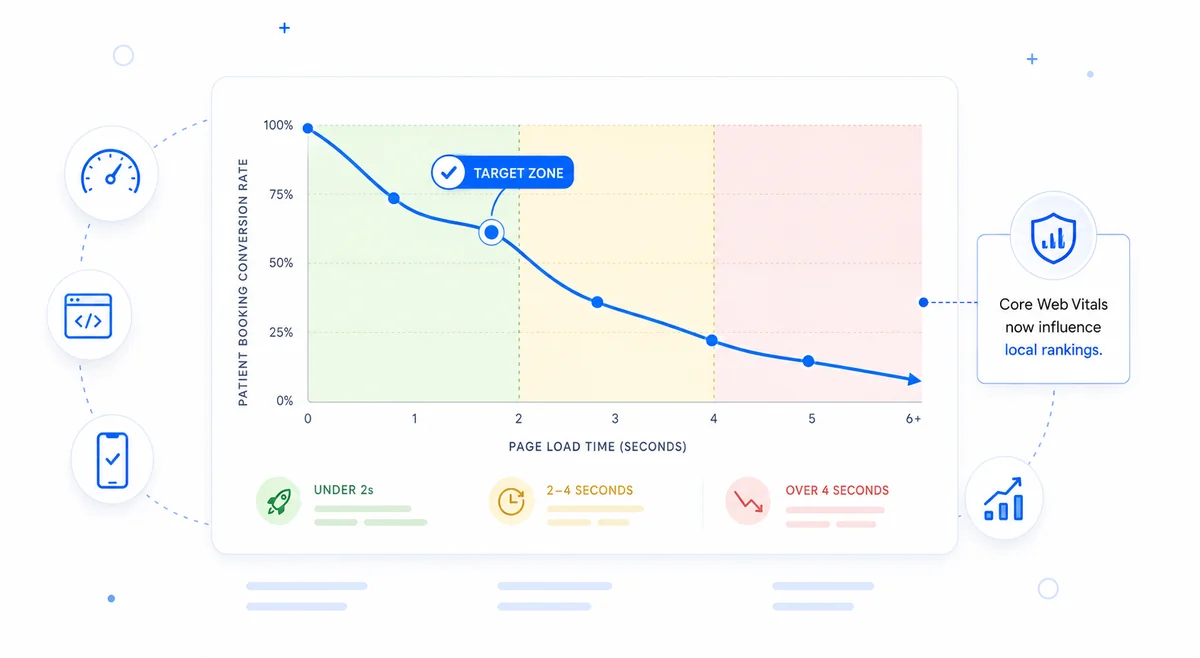
The rebuild took 3 weeks: semantic HTML and CSS, deployed on a CDN. Mobile LCP fell to 1.4 seconds, CLS to 0.00, and INP under 100 ms with a native HTML booking form. The site loaded almost 4 seconds faster at the same prices. The gap was speed, not design.
Med spa SEO sits where YMYL content rules meet local pack signals. Google reads injectables and lasers as health content, so the site earns trust before rankings.
| Ranking factor | Why it matters | What we target |
|---|---|---|
| Mobile LCP | Over 80 percent of searches are on a phone | Under 1.6 seconds on a mid-tier Android |
| CLS and INP | Widgets and slow taps push or stall the booking | 0.00 CLS, under 100 ms INP |
| Treatment page depth | One page per treatment beats a stacked list | 15 to 30 treatment pages per location |
| Provider E-E-A-T | Injectables are YMYL; the author must be credentialed | Provider bio, license, cert on every page |
| Real before-and-after photos | Stock photos erode conversion and AI trust | Original photos with model release, WebP |
| Booking integration | Friction with Vagaro or Mindbody sinks bookings | Native handoff under 200 ms |
Treatment menu architecture is the biggest gap in med spa sites we audit. Each treatment has its own intent and price band, so one page cannot serve 15 intents. We give each its own URL across five hubs (injectables, skin, laser, body, wellness), and each sub-page covers what it is, who it is for, pricing, downtime, a gallery, a FAQ stack, and its own booking button.
This wins AI search too. ChatGPT and Perplexity quote pages that answer one question at a time, so a focused "HydraFacial in Sarasota" page gets cited when a buyer asks if it is worth it.
Vagaro, Mindbody, and Boulevard dominate the market, each with its own speed profile. The wrong integration adds 2 seconds to your booking page and costs you a third of conversions.
| Booking system | Fastest method | Speed cost of the heavy option |
|---|---|---|
| Vagaro | Hosted handoff link (0 ms) | Inline widget adds 600 to 900 ms |
| Mindbody | Branded web link | Full SDK embed adds 1.2 to 1.8 sec |
| Boulevard | Hosted booking page | API embed is heavy |
| Acuity | Direct link (0 ms) | Iframe adds 500 to 800 ms |
The pattern we ship every time: each booking button is a direct link with the treatment pre-selected through a URL parameter. Tap Book on the lip filler page, land inside Vagaro with lip filler chosen, no widget weight.
Med spa sites are image-heavy, the top reason they fail Core Web Vitals. Linoy's old homepage held 22 photos averaging 480 KB each. Our three rules: a WebP version of every photo, cutting weight 25 to 35 percent; srcset sizing at 480, 768, and 1280 px; and native loading="lazy" below the fold. Her new homepage hits 320 KB with the same gallery.
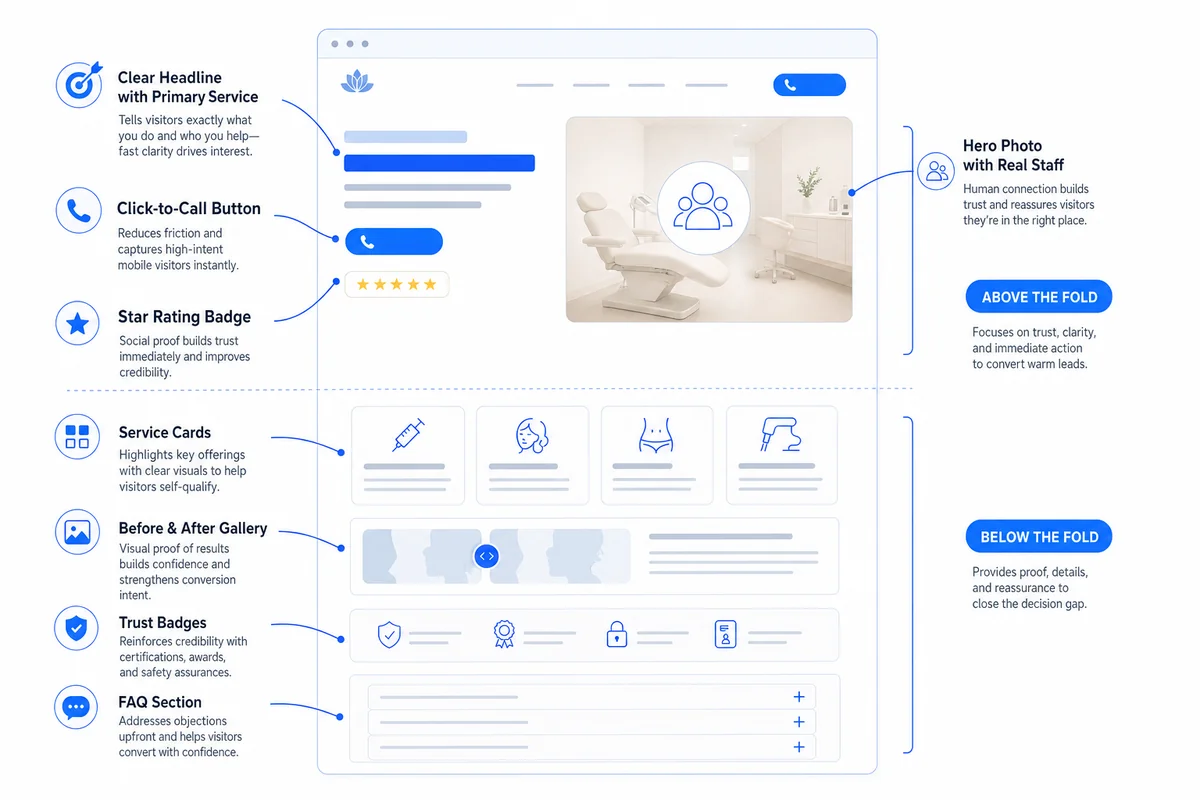
The buyer is a woman aged 25 to 55, browsing in the evening, comparing nearby spas. A site that loads in 6 seconds is invisible; one at 1.5 seconds gets the booking. Every build starts with a sticky "Book Now" header, the phone number beside it, trust signals above the fold, and a native 3-field form instead of a 6-field widget that breaks on iOS Safari.
The build runs in 4 phases, the same shape on every site, tuned here for YMYL trust, treatment-menu architecture, and the booking handoff.
Day one is the discovery call. We map your treatment menu, provider credentials, booking system, GBP, and local-pack competitors, then reverse-engineer the top 5 ranking spas. The audit we run first is the long-form version.
We design the sitemap before touching a pixel: homepage on the brand, five treatment hubs with sub-pages, city pages, and provider bios, every URL mapped to a search query first. Our my approach to this drives that mapping.
The build runs in sprints, hero block through booking handoff. Each page passes a Core Web Vitals check before merge and carries its keyword, a Q and A block AI engines can quote, and a booking button above the fold.
At launch we turn on Search Console, GA4, and booking analytics, then track index status, click growth, booking rate, and AI citation status weekly. If a page is not pulling its weight at 60 days, we rewrite the content, not the design.
Linoy at SASS Facial Spa ran a Squarespace site at 4.2 second mobile LCP, 0.21 CLS, and an 11 MB homepage, ranking only for her brand name. Post-rebuild: 1.4 second LCP, 0.00 CLS, INP under 100 ms, and a 320 KB homepage, with treatment pages for HydraFacial, microneedling, peels, and lip filler ranking on long-tail Sarasota queries inside 60 days.
The pattern carries across niches. Or at denvergaragedoor.com went from 7 indexed pages to 22, and his 13-review site now beats a 253-review competitor. Momo at americaschimneysweep.com hit LCP under 1.6 seconds on the same speed work. A fast multi-page architecture consistently outranks a one-page services list.
Four pains separate this niche from a salon. Intent is treatment-specific, so only treatment-menu architecture fits. Google rates injectables on author credentials no salon template carries. A salon survives a 6-field form; a med spa does not. And stock photos get flagged by AI search and by buyers, so only real photos pass both the trust test and Core Web Vitals.
No competitor in the top 5 for med spa website design shows pricing. We do. If Starter is over reach, the affordable SEO page covers the budget-tier framework.
| Package | Price | What you get |
|---|---|---|
| Starter Site | $750/mo or $4,500 one-time | Homepage plus 2 treatment hubs, 1 city, 6 to 10 pages, Core Web Vitals optimized, booking handoff |
| Pro Site | $1,500/mo or $9,000 one-time | All 5 hubs, top 12 treatment sub-pages, 3 cities, provider bios, gallery system, WebP pipeline, call tracking, GBP, 18 to 30 pages |
| Custom Build | From $2,500/mo | Multi-location, 25 to 30 treatment sub-pages, programmatic city pages, Mindbody or Boulevard API embed, CRM, quarterly content |
Most clients start on Pro. Our retainer tiers overview covers ongoing options after launch, and the med spa SEO covers the retainer scope.
The only conversion that matters is a booking. Put the booking button first, the phone number beside it, and credentials in view: that is the full stack above the fold. A buyer who waits 4 seconds abandons at twice the rate of one who waits 1.5, so mobile LCP is the conversion ceiling.
Med spa buyers ask ChatGPT, Perplexity, and AI Overviews for picks before they open the blue links. We use citation reverse-engineering: run those queries, watch which directories the engines pull from, and register every client there. The full version sits in the AI and GEO ranking playbook, with the Ai citations SEO.
The top ranking pages share five gaps: no pricing, no verifiable Core Web Vitals targets, no named med spa client, no treatment-menu architecture, and no booking handoff. We close all five and back them with real client URLs. The same med spa seo services playbook is on the table for any engagement.
The fastest way to learn if your site is the problem is a free audit. We pull your mobile Core Web Vitals, indexation, top 10 missing treatment keywords, booking-system speed, and AI citation status. Output is a one-page brief with the 4 findings that matter most.
Send your details through the contact page and I will take it from there.
Med spa buyers decide in under 90 seconds, almost always on a phone. Design controls the first impression, the trust signals, and the booking-handoff speed. A slow services-list site loses to a fast treatment-page rival.
A specialist knows the YMYL trust rules for injectables, the Vagaro and Mindbody integration patterns, the Core Web Vitals thresholds that decide mobile bookings, and the treatment-menu architecture that ranks every peel and filler. A generic designer ships a theme that fails all four, and flat bookings follow.
It treats each treatment like a product page: price band, social proof, gallery, and a one-tap booking button. Conversion jumps from the 1 to 2 percent services-page average to the 6 to 9 percent we hit on rebuilds.
Every treatment on its own URL, sub-2 second mobile LCP, a sub-200 ms booking handoff, real WebP photos, provider credential blocks, citation reverse-engineering, and public pricing. Skip any one of them and it shows up in your booking rate.
Starter is $750 a month or $4,500 one-time, Pro is $1,500 a month or $9,000 one-time, and Custom Builds start at $2,500 a month for multi-location spas.
Index status improves in 7 to 14 days and CTR shifts in 2 to 4 weeks. Local pack movement on treatment terms takes 60 to 120 days, and AI citations appear in 60 to 90 days.
The best med spa seo company builds treatment-menu architecture, ships sub-2 second mobile LCP, integrates Vagaro or Mindbody with a sub-200 ms handoff, and shows pricing publicly. HouseCall SEO is that niche-focused option: the playbook is proven on Linoy's site and I run the work directly. For e-commerce or SaaS, hire a vertical specialist.
Tired of a site that bounces visitors at 3 seconds and ranks for nothing but your brand name? I am Lior Daniel, founder of HouseCall SEO, and I rebuilt Linoy's SASS Facial Spa site myself. The same playbook is ready for your practice. Book a free SEO consultation and we will scope the rebuild on the call.
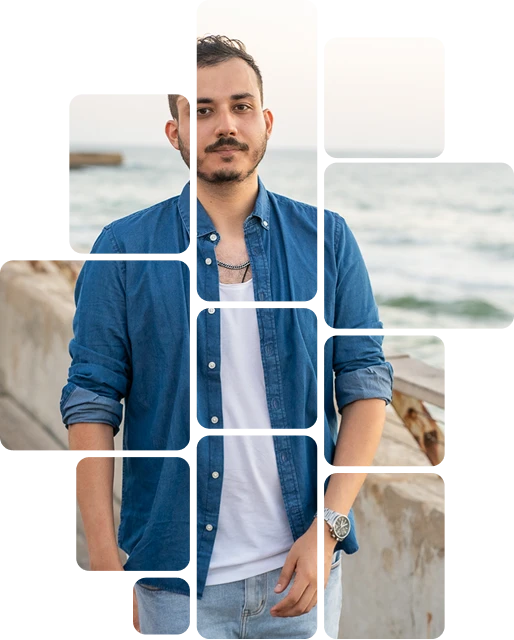
I specialize in home services SEO: taking websites that sit invisible on page three and turning them into the business Google and ChatGPT recommend first. I started on the developer side, writing software and doing SEO on the side, until I saw how much home-service owners were overpaying for work that quietly hurt them. So I built a method that fixes the broken technical work and the outdated thinking behind it.
From garage door companies to plumbers, roofers, locksmiths and cleaning services, the playbook is the same: rank where your customers actually search, earn real reviews, and back it with a fast site that books the job. No PBNs, no bought reviews, no directory spam. Only work that survives Google’s next five updates. See exactly how it’s priced on the pricing page.
Free 30-minute strategy call