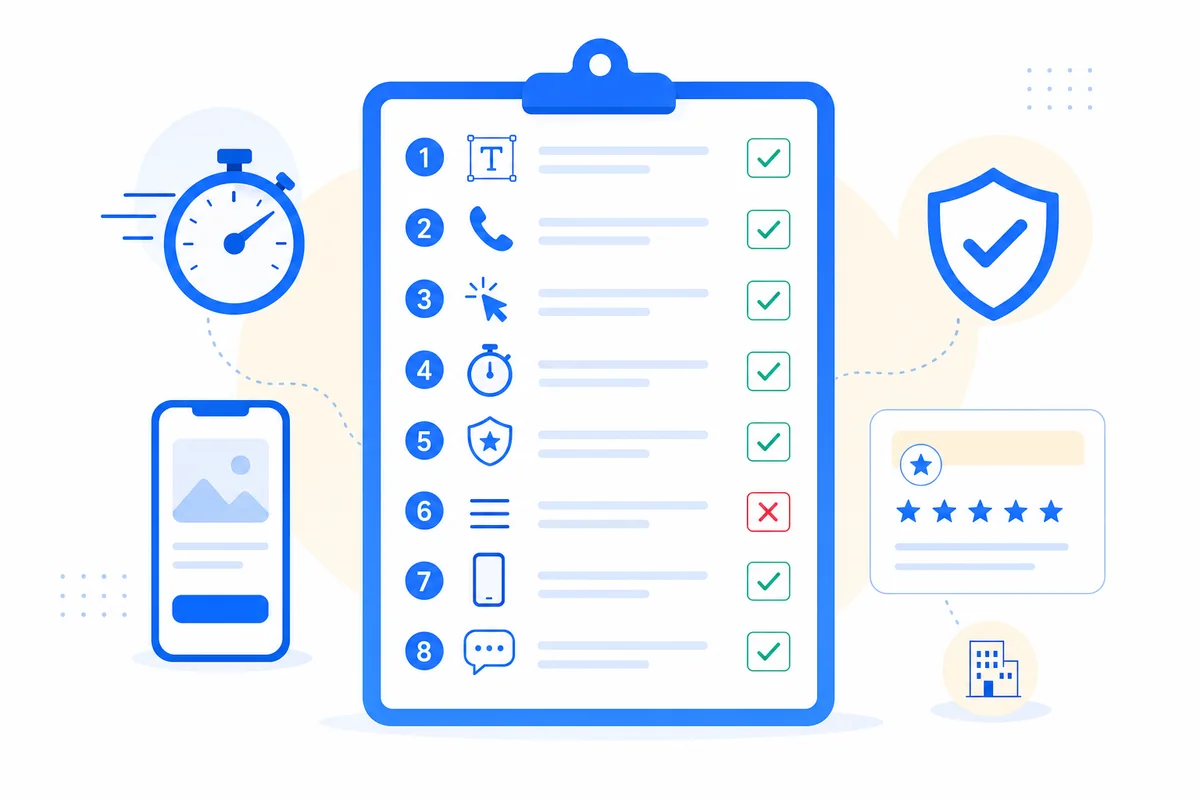
A home service landing page following landing page best practices 2026 needs six things: a hero naming the service and city in one line, one phone-number CTA above the fold, social proof in the first scroll, a mobile-first layout under 2 seconds, a single conversion goal, and trust signals like a license number and real author. Everything else is noise. Forms with 8 fields drag down conversion; one field works. A well-built How I rank these sites follows the same logic.
A landing page is a single web page built for one action: the visitor calls, books, or fills a form. For home services that action is almost always a phone call. Someone with a broken garage door at 9pm is not filling a 12-field form. Most landing page advice falls apart here because it was written for SaaS trial signups, not emergency-driven buyers.
A good landing page answers three questions in under 5 seconds: do you fix my exact problem, do you serve my city, and can I trust you. My client Or (Denver Garage Door) at denvergaragedoor.com converted at 1.8% sending traffic to a generic homepage. We built 11 service-and-city landing pages instead, and the same traffic converts at 6.4% now. The pages are not prettier. They are sharper.
I audit 4-6 contractor pages a week, and the same errors repeat.
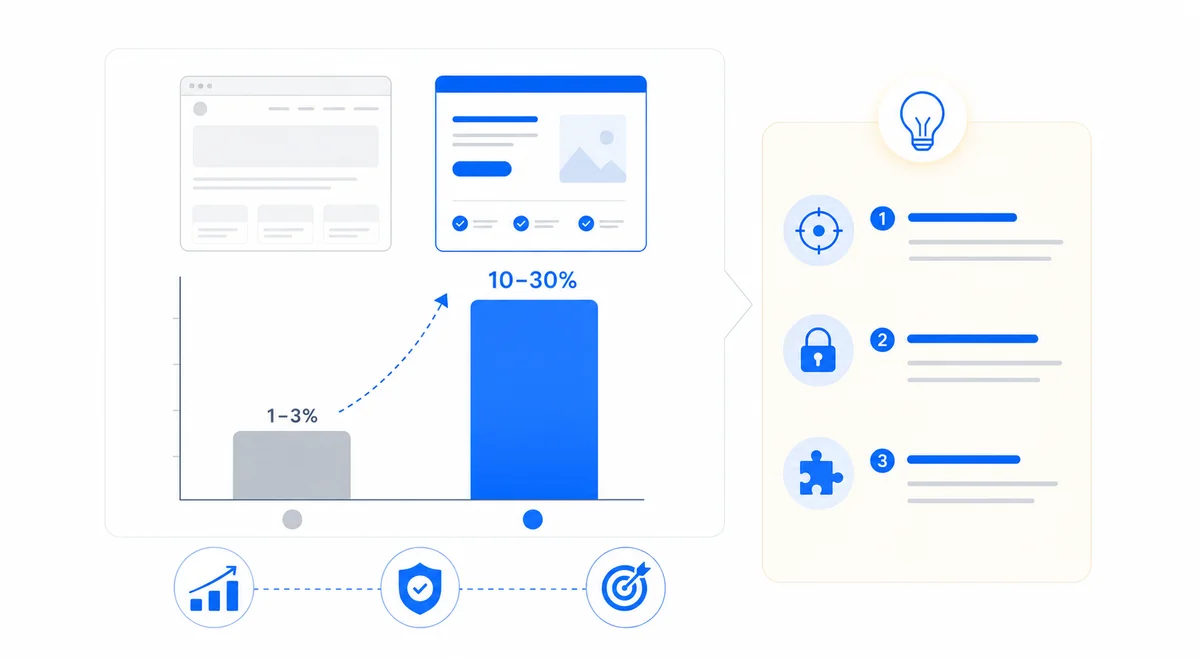
Homepage conversion for home services sits around 1.5-2.5%. Service-specific pages run 6-12%, which makes your ad spend 3-4x more efficient. Every Google Ads click costs $8-$45, so sending that traffic to a generic homepage wastes your budget. The landing page matches the ad promise exactly: headline echoes the ad, offer matches it, CTA repeats the invitation.
Landing page optimization means testing and improving conversion on a live page. Ship version 1, watch 100-500 visitors, then change one element at a time. The elements that move conversion: headline, hero photo, CTA wording, and form field count. Button color matters less than every blog claims. Start with clarity, add proof, reduce friction, then polish.
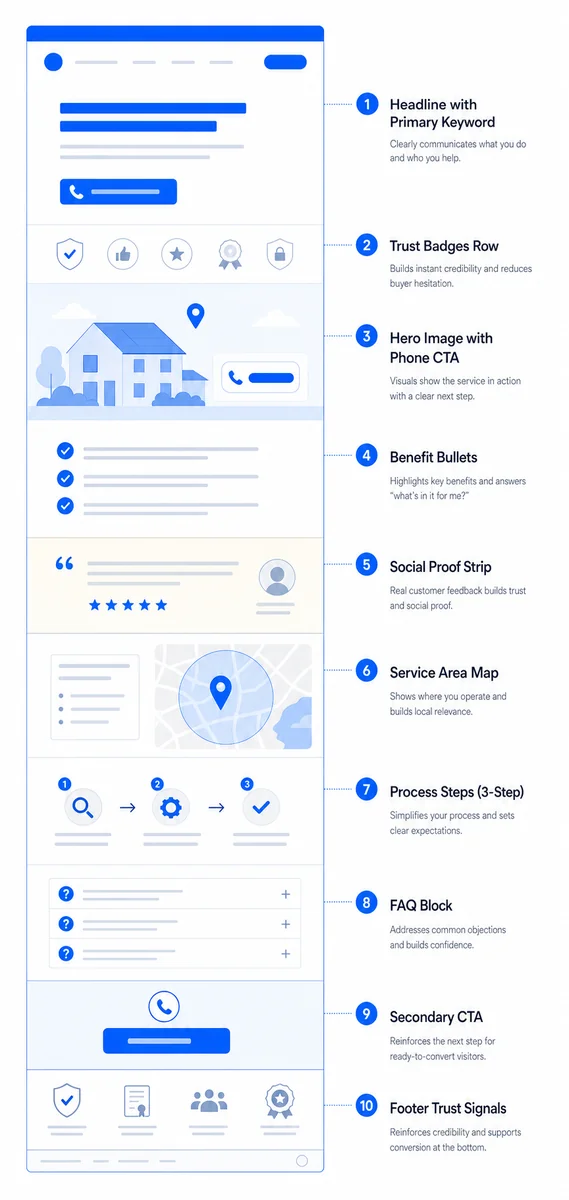
Or runs Denver Garage Door in Denver, CO. His main competitor had 253 Google reviews; Or had 13. Instead of chasing reviews we built 11 service-and-city landing pages: service-and-neighborhood headline, phone above the fold, his real photo, a visible license number, named reviews, PageSpeed 92. Within 7 months he ranked first for "garage door spring repair denver" and 8 other commercial keywords, and monthly leads went from 28 to 116. The competitor still has more reviews. We competed on landing page quality instead.
| Approach | Cost | SEO control | Best for |
|---|---|---|---|
| Unbounce / Leadpages | $99-$199/mo | Limited | Pure paid traffic campaigns |
| WordPress + Elementor | $15-$40/mo hosting | Full | Long-term organic + paid hybrid |
| Wix / Squarespace | $23-$49/mo | Limited | Solo operators, single service |
| Custom HTML | $1500-$5000 one-time | Full | Multi-location contractors |
| Agency build (HouseCall SEO) | $750-$3000+/mo | Full + ongoing optimization | Contractors who want it done right |
Builders work fine for week-one ad tests. For a contractor running paid traffic 12+ months who also wants organic rankings, WordPress or custom HTML wins. I have seen Unbounce pages score 38 on PageSpeed. That is paid traffic on fire.
| Tool | What it does | Cost |
|---|---|---|
| Google PageSpeed Insights | Load speed and Core Web Vitals | Free |
| Microsoft Clarity | Heatmaps and session recordings | Free |
| Google Analytics 4 | Conversion tracking | Free |
| CallRail | Track phone calls per landing page | $45-$145/mo |
| VWO or Optimizely | A/B testing | $0-$500/mo |
B2B landing page best practices for contractors selling to property managers need a different shape. The buyer is research-driven, not panicked. The page wants longer copy, hard numbers, a calendar booking tool instead of a phone CTA, and a form with more fields. Conversion runs 2-4% but deal sizes are 10-50x bigger. Tomer's commercial division uses this format and closes two $8000+ contracts a month.
I built HouseCall SEO for US home service businesses, and I am a software developer first, SEO specialist second. We apply every rule above to each client build: real photos, honest pricing, phone-first CTAs, visible license numbers, PageSpeed above 90, single goal. The House Call Method runs in four phases: Audit, Fix, Build, Track. Or's 116 monthly leads came from doing the slow work right. For what each package includes, see HouseCall SEO's conversion rate optimization pricing.
Two things I see weekly that no other landing page article covers. First, chat widgets stall conversion rates. I have removed them from 14 client sites this year and every one climbed 8-22% inside a month. The widget loads slow, blocks the corner where mobile users tap, and routes leads to nobody after hours.
Second, SEMrush and Ahrefs miss roughly 40% of what people ask ChatGPT and Gemini directly in 2026. Build for both: keyword-rich for Google, fact-dense and quotable for AI Overview citations. Customers cross-check Google results in ChatGPT and then return to Google before they call, so if you are missing from either layer you lose the buyer at two touchpoints. When a "marketing expert" tells your client keywords do not matter, that is what charlatans say when they cannot rank a page. Anchoring keywords to real value and to conversion mechanics that reinforce each other is what makes rankings turn into booked jobs.
The headline. Nothing else matters if it does not match what the visitor came to find. "Quality Service" fails; "Emergency Garage Door Repair Denver" works. Write it first, then build the page around it. If you cannot summarize the offer in 8-12 words, the offer itself is muddy.
No. Navigation menus give visitors an exit ramp, and conversion drops 10-30% with a full nav. The only exception is a small footer with privacy policy, terms, and contact links. Everything else stays off the page.
Long enough to answer every objection and not a word longer. For a low-commitment offer like a free quote, 500-1000 words works. For high-commitment work like a $5000 driveway resurfacing, 2000-4000 words outperforms. Length depends on price point and intent, not a formula.
For paid traffic, 6-12% is healthy. For organic, 3-8% is normal because those visitors buy later. Under 3% means a clarity problem in the hero. Over 15% usually means low-quality leads that will not convert to jobs.
This guide was written by Lior Daniel, founder of HouseCall SEO. Lior is a software developer and SEO specialist with 6+ years of experience, formerly at government and airline-sector organizations. He builds and optimizes landing pages for US home service businesses across garage door, chimney sweep, locksmith, plumbing, HVAC, and med spa. Last updated November 2026.
If you are running paid ads to a homepage and conversion sits under 4%, the landing page is the problem, not the traffic. We build pages optimized for conversion for US home service businesses at three tiers: Starter $750/mo, Pro $1500/mo, Custom $3000+/mo. Every page follows the rules in this guide. Book a free SEO consultation with HouseCall SEO and I will audit your current page on the call and point at the three things killing conversion.

I specialize in home services SEO: taking websites that sit invisible on page three and turning them into the business Google and ChatGPT recommend first. I started on the developer side, writing software and doing SEO on the side, until I saw how much home-service owners were overpaying for work that quietly hurt them. So I built a method that fixes the broken technical work and the outdated thinking behind it.
From garage door companies to plumbers, roofers, locksmiths and cleaning services, the playbook is the same: rank where your customers actually search, earn real reviews, and back it with a fast site that books the job. No PBNs, no bought reviews, no directory spam. Only work that survives Google’s next five updates. See exactly how it’s priced on the pricing page.
Free 30-minute strategy call