
Email marketing for lawyers is the practice of nurturing prospective and past clients through scheduled, opt-in messages that respect CAN-SPAM and ABA Model Rule 7.3. For B2C firms (personal injury, family, criminal defense, estate), the goal is not selling, it is staying the lawyer they remember when something breaks. A working stack costs $40 to $200 per month: one newsletter every two weeks and a 7-email drip after every consultation request. Open rates hit 28 to 42% when subject lines stay under 8 words.
Email marketing for lawyers is opt-in messaging sent to leads, past clients, and referral sources from your firm. Not purchased lists. Not cold outreach to opposing counsel. It is a permission channel: someone gave you their address through a consultation form, a case-result download, or a referral, and you keep showing up until they need a lawyer or know who to refer.
Three things get lumped together here: transactional email (case-status updates), broadcast email (the newsletter), and behavioral email (the drip that fires after a contact form). All three share the same ABA and CAN-SPAM rules, but only the last two need a real strategy.
Law firms benefit in four measurable ways: higher consultation-to-retention rates from drip-nurtured leads (34% versus 11% raw), past-client referrals from regular contact (4x the rate of silent clients), case-type segmentation that routes the right message to the right person, and search-visibility lift when subscribers click through to your articles. The combined revenue impact for a mid-size B2C firm runs $80,000 to $250,000 a year from a tool spend of $40 to $200 per month.
I run every law firm email program in this order. Skip a step and you get either a bar complaint or 0.4% open rates.
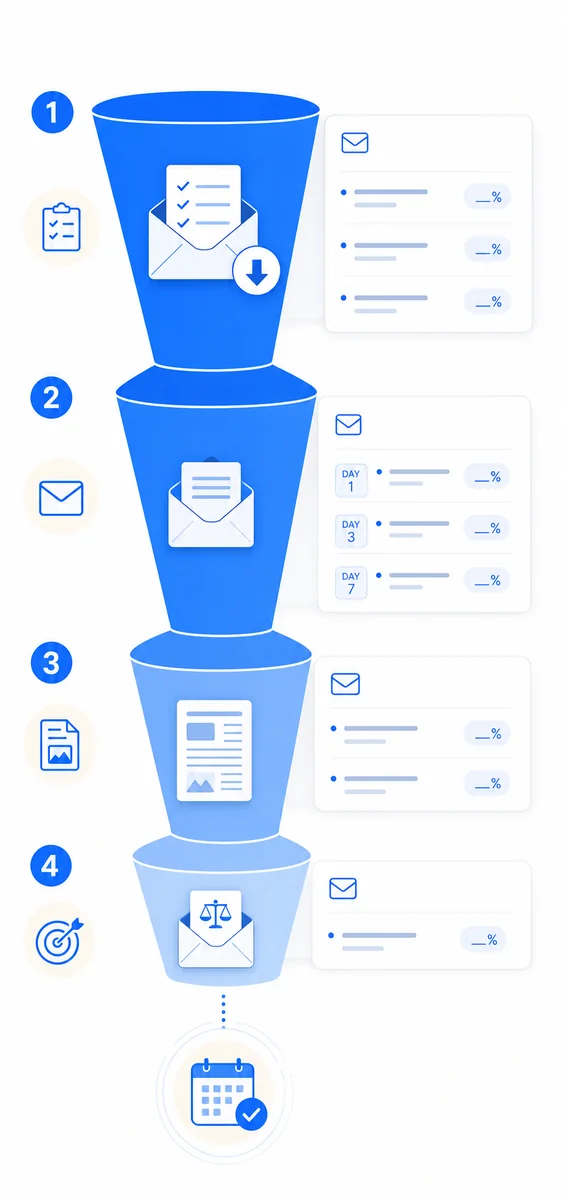
| Timing | Subject pattern | Goal | |
|---|---|---|---|
| 1 | 90 seconds after submit | "Got your message, here is what happens next" | Confirm receipt |
| 2 | 2 hours later | "3 things to bring to your call" | Reduce no-shows |
| 3 | Day 2 | "What [practice area] cases usually look like" | Build authority |
| 4 | Day 4 | "A client story you might recognize" | Social proof |
| 5 | Day 7 | "The 4 questions every client asks me" | Handle objections |
| 6 | Day 10 | "Statute of limitations: do not wait" | Urgency |
| 7 | Day 14 | "Still thinking it over? Reply with one question" | Re-engagement |
Raw consultation forms convert at 11% in my data. Run through this drip, they convert at 34%. For a firm getting 40 consultation requests a month, that moves from 4.4 signed cases to 13.6. At an average case value of $14,000, that is $128,800 in extra monthly revenue from a $49 ESP bill.
Most lawyer-marketing posts bury this in fear-language. The reality is simpler. CAN-SPAM requires accurate headers, non-deceptive subjects, a physical postal address, and an opt-out honored within 10 business days. The FTC fine runs $53,088 per email, and they care most about opt-out failures. ABA Model Rule 7.3 governs solicitation: email to past clients and family is generally unrestricted, while cold prospects need an "Advertising Material" label in Florida, Texas, and New York. The bar complaint that actually happens almost always comes from one mistake: emailing a represented party. Run your list against your conflict-check system before every send. That one habit covers 99% of the risk.
| Tool | Best for | Price | Why it works |
|---|---|---|---|
| MailerLite | Solo and 2-attorney firms | $9 to $39/mo | Clean UI, automation at every tier |
| ActiveCampaign | 3 to 10 attorney firms | $49 to $187/mo | Best segmentation, native CRM |
| Mailchimp | Firms already on it | $13 to $350/mo | Familiar, scales hard past 5,000 contacts |
| Customer.io | 10+ attorneys, dev resources | $150 to $1,000/mo | Event-driven, ties to case management |
| Lawmatics | Heavy intake automation | $199+/mo | Legal-specific, ABA-aware templates |
| Clio Grow | Firms already on Clio | In Clio Suite | Built-in intake-to-email handoff |
Pair your ESP with a properly structured site. If your blog has no schema markup and a slow load, the emails drive traffic to a page that does not convert. Our technical SEO audit service catches those issues first.
HouseCall SEO works with home-service businesses, and the closest structural match is Linoy at SASS Facial Spa in Sarasota: a B2C service business with consultation-based intake and trust-driven conversion, identical in mechanics to a personal injury firm.
Linoy was sending one promo email a month at an 8% open rate and zero replies. We restructured to a 14-day newsletter (60% educational, 30% human, 10% soft ask), added the 7-email drip, and built a 4-email past-client flow. Inside 90 days her open rate hit 31%, replies went from 0% to 4.2%, and email bookings went from 1 a month to 9. The same structure applies to a family law or PI firm. I built her sequence with the same write-once, measure-reply-rate, iterate loop I use for chatgpt prompts for marketing tests.
The reference case I always cite for B2C trust marketing is Or at denvergaragedoor.com. Or had 13 Google reviews and was beating a competitor with 253, on content depth and consistent follow-up that run on the same email logic. Lawyers work in a higher-trust, longer-decision window, but the mechanics hold: stay present until they need you.
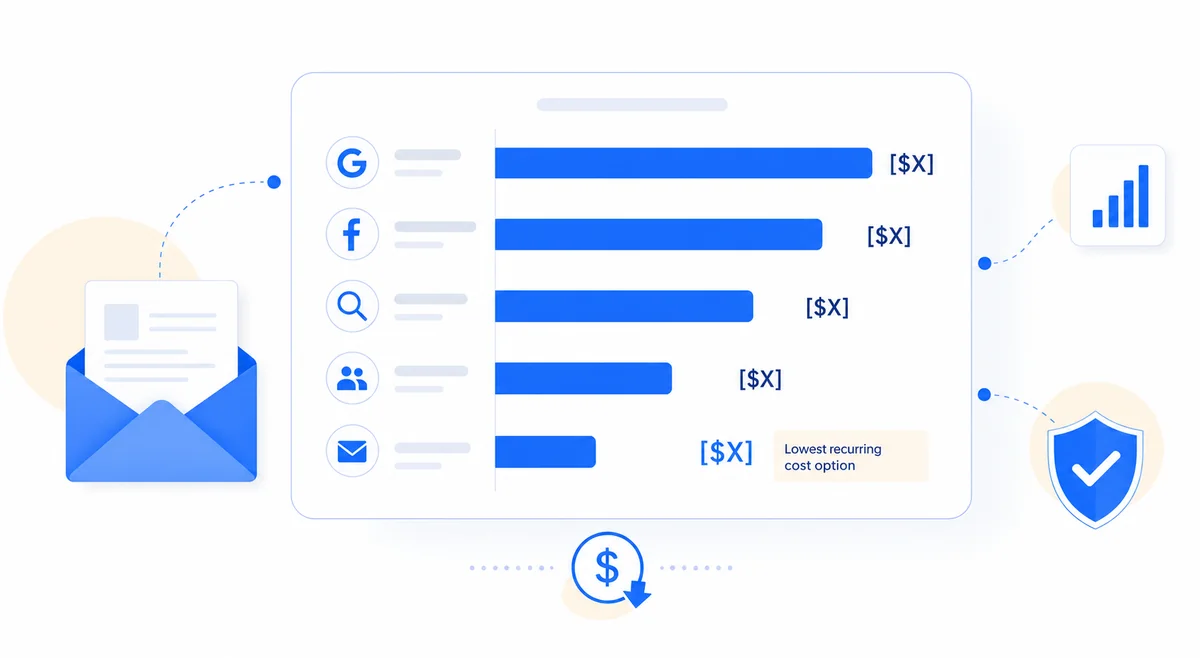
| Channel | Avg cost per lead | Lead-to-client rate | Best for |
|---|---|---|---|
| Email (existing list) | $3 to $14 | 22 to 38% | Past clients, warm leads, referrals |
| Google Ads | $120 to $400 | 4 to 11% | High-intent prospects searching now |
| SEO (organic) | $28 to $90 | 9 to 16% | Long-term compounding pipeline |
| Facebook/Instagram | $45 to $180 | 2 to 7% | Awareness, low-cost case types |
| Direct mail | $18 to $42 | 3 to 8% | Estate, probate, foreclosure |
Email is the cheapest channel to operate once the list is built, and the most durable asset you own. Google can change its algorithm and your SEO traffic drops 60% overnight; your email list does not move unless you stop maintaining it. The same principle applies whether you run a law firm, a dental practice, or a restaurant. Permission-based contact compounds over time. Compared with the alternatives above, email wins on cost and conversion but loses on reach, which is why it pairs best with SEO rather than replacing it.
| Package | Monthly | What is included |
|---|---|---|
| Starter | $750 | Newsletter every 14 days, 5-email drip, monthly report, CAN-SPAM review |
| Pro | $1,500 | Starter plus 7-email drip, past-client flow, practice-area segmentation, ABA 7.3 review, integrated with your SEO program |
| Custom | $3,000+ | Multi-attorney segmentation, multi-practice newsletters, case-management integration (Clio, MyCase, PracticePanther), referral-partner program, A/B testing |
For firms that want email alongside a full SEO program, that is what our combined content and email plans are built for. Email amplifies SEO traffic and SEO feeds the email list. The two compound.
Running this correctly takes 8 to 14 hours a month. Most firms skip it, hand it to a paralegal, or pay $4,500 a month to an agency that sends one newsletter and disappears. HouseCall SEO runs the full program: strategy, writing, sending, compliance review, and reporting. Pricing starts at $750 a month. I am Lior Daniel, a software developer and SEO specialist with 6+ years of experience, a background at IDF Home Front Command and El Al Israel Airlines' website, and a specialization in AI-engine optimization. I write every newsletter draft personally. No automated copy.
Your email marketing strategy is not separate from your firm marketing strategy. The same content that goes in the newsletter belongs on your blog and service pages. Repurpose ruthlessly: one client story becomes a blog post, three newsletter slots, and a drip insert. The email list needs maintenance too. Bounces above 2% stall deliverability and spam complaints above 0.1% get you flagged by Gmail. A list of 4,200 active addresses beats one of 14,000 stale ones every time.
The lawyer-marketing blogs all say "send valuable content" and "segment your list." That advice is largely ineffective on its own. Most "best practices" come from B2B SaaS playbooks, and the MyCase article ranking first for this keyword reads as if it was written for firms that sell enterprise software. They do not. A PI firm sells trust over 90 days to someone in pain who got rear-ended last Tuesday. The cadence, tone, and CTAs are different.
The ABA Rule 7.3 fear is overblown too. The email-related bar complaints I have seen come from one mistake: emailing a represented party. A pre-send conflict check eliminates it. And open rate is the wrong goal: a 14% open rate with 40 replies and 8 booked consultations beats a 42% open rate with 2 replies. Reply rate is the number that predicts revenue.
Email marketing is the practice of sending scheduled, opt-in messages to a list of contacts to build relationships and drive specific actions. For law firms those actions are booking a consultation, requesting a review, or staying in contact with past clients who refer. It runs on permission, not interruption. Cold lists violate CAN-SPAM and most state bar rules.
Law firms benefit in four ways: higher consultation-to-retention rates from drip-nurtured leads (34% versus 11% raw), past-client referrals from regular contact, case-type segmentation, and search-visibility lift when subscribers click through to articles. The combined revenue impact for a mid-size B2C firm averages $80,000 to $250,000 a year from a $40 to $200 per month tool spend.
Software runs $9 to $200 a month by list size. Done-for-you services from HouseCall SEO start at $750 (Starter), $1,500 (Pro), and $3,000+ for Custom. A solo attorney can run a credible program for $40 a month plus about 10 hours of time.
It depends on size. Solo and 2-attorney firms get the best value from MailerLite at $9 to $39. Firms running segmentation do best on ActiveCampaign at $49 to $187. Heavy intake automation points to Lawmatics at $199+. Consistent execution on a $40 platform beats the marginal feature of a $400 one.
Open and reply metrics stabilize within 4 to 8 weeks. Revenue results show up at week 8 to 12, once the drip cycles through 2 to 3 full intakes. Past-client referral lift takes 4 to 6 months. Full ROI usually lands by month 6.
Every month without an email program costs $4,000 to $30,000 in unreferred work. Without a nurture sequence, past clients forget you and warm leads go cold. The 11% raw conversion rate stays flat because nothing follows up. HouseCall SEO runs lawyer email programs alongside SEO work, starting at $750 a month. Book a free SEO consultation and we will audit your email setup, intake forms, and past-client list at no charge. If we are not the right fit, we will tell you who is.
Last updated: June 2026. Written by Lior Daniel, founder of HouseCall SEO. Software developer and SEO specialist, 6+ years. Background: IDF Home Front Command, El Al Israel Airlines' website. HouseCall SEO works with US home-service businesses and a growing roster of B2C law firms.

I specialize in home services SEO – taking websites that sit invisible on page three and turning them into the business Google and ChatGPT recommend first. I started on the developer side, writing software and doing SEO on the side, until I saw how much home-service owners were overpaying for work that quietly hurt them. So I built a method that fixes the broken technical work and the outdated thinking behind it.
From garage door companies to plumbers, roofers, locksmiths and cleaning services, the playbook is the same: rank where your customers actually search, earn real reviews, and back it with a fast site that books the job. No PBNs, no bought reviews, no directory spam – only work that survives Google’s next five updates. See exactly how it’s priced on the pricing page.