
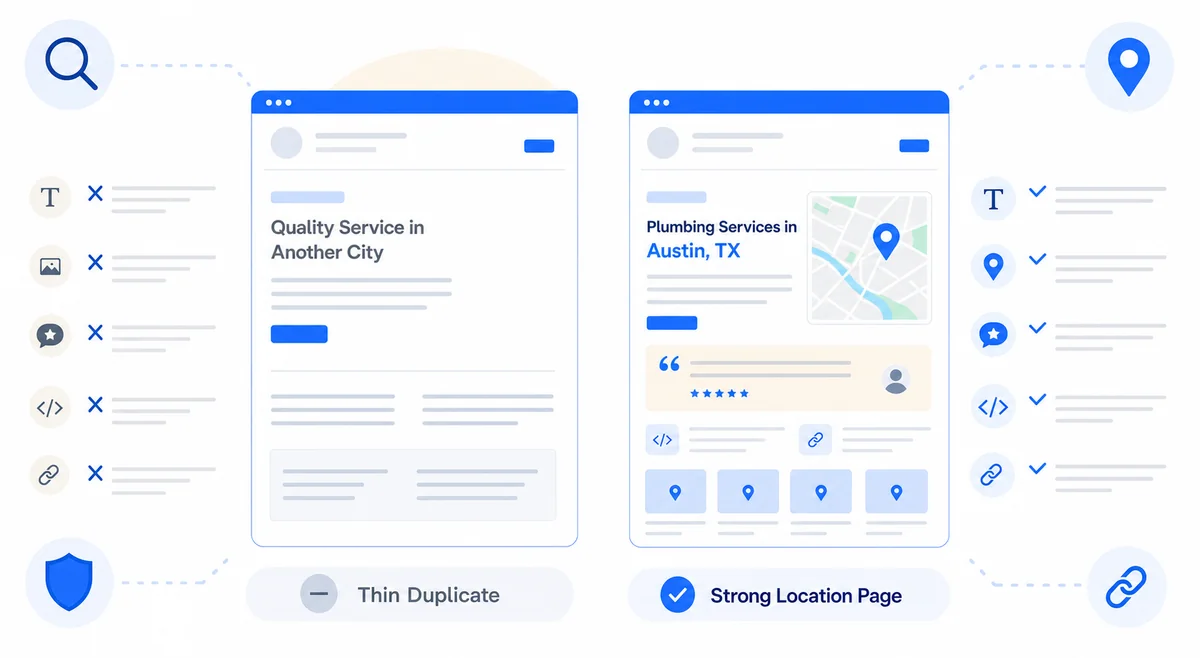
Tree service seo strategy local pages location-based content means organizing a tree care site into three connected layers: service hubs (removal, pruning, emergency, stump grinding, insurance work), city location pages, and neighborhood or ZIP sub-pages with genuinely unique local content. Every page carries ISA credential proof, insurance display, and storm-damage triggers per region. Thin pages with only the city name swapped get flagged as doorway spam under Google's Helpful Content System, so the work runs on disciplined SEO content writing, not templated swaps.
Tree service is more hyperlocal than almost any home service. Storm patterns, species, and insurance carriers shift by ZIP, so a homeowner in West Highland, Denver searches differently than one in Cherry Creek. From my client audits, a site with 4 generic city pages converts about 1.2% of organic traffic to calls. Rebuilt with 12 city pages, 28 neighborhood pages, and 6 storm-damage pages of unique content, the same domain converts at 3.4% to 4.1%.
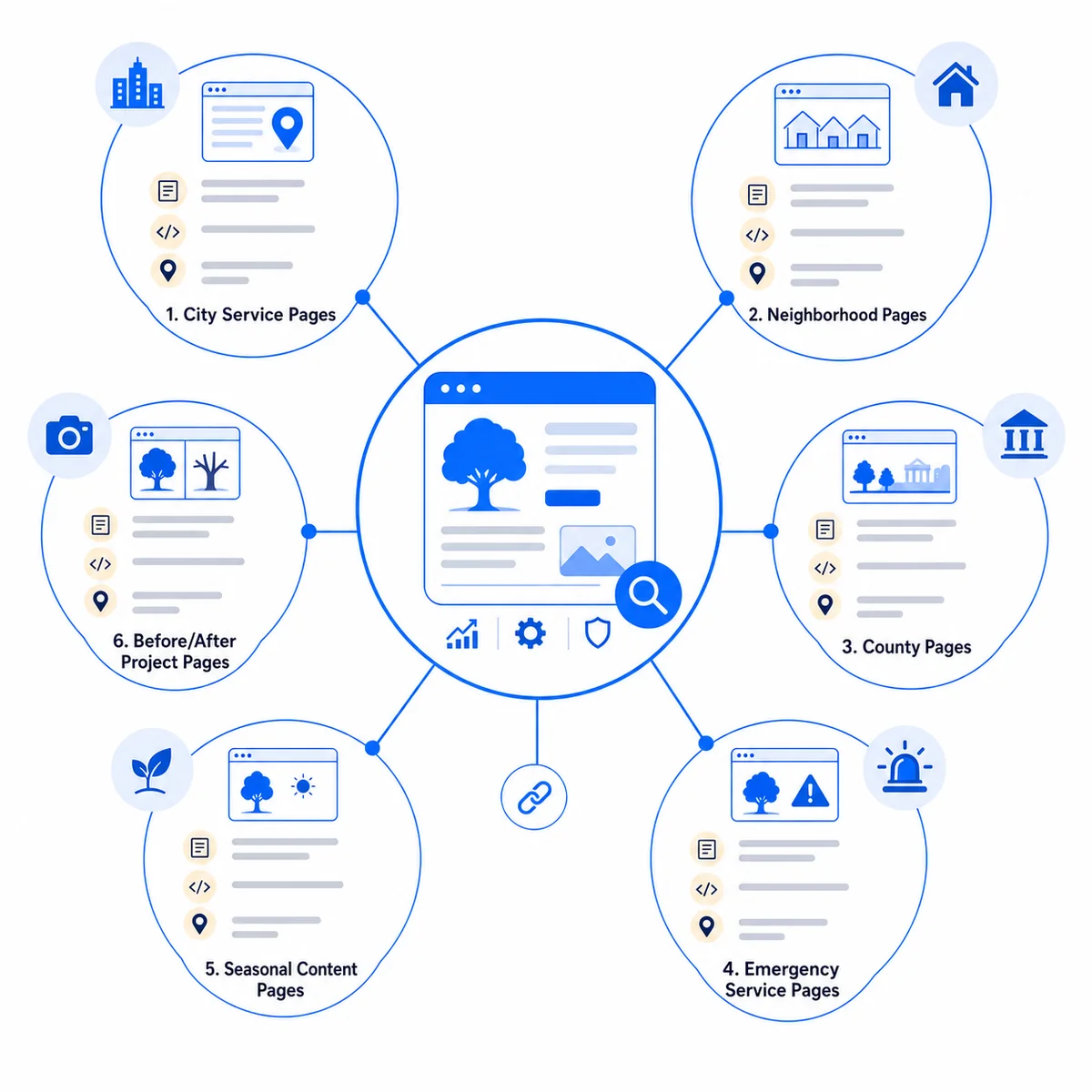
City pages usually lift by week 6 and neighborhood pages take 10-16 weeks. Storm pages rank fast during weather events, because the algorithm rewards fresh location-coded content.
Four layers must work before the location architecture earns its lift, in this order.
Local SEO. Google Business Profile optimized with the correct primary category ("Tree Service," not "Landscaper"), service area set by ZIP, weekly photos, itemized services. NAP consistency across the top 40 citations (GBP, Apple Maps, Yelp, BBB, Angi, HomeAdvisor), plus local links from ISA chapters, HOA partnerships, and storm-recovery coalitions.
Trust signals. The ISA Certified Arborist credential with number and verification link belongs on every location page, not only the about page. TCIA badge if held, liability coverage stated plainly, workers comp carrier named, insurance acceptance list with no false partnership claims. This is where a licensed, insured, bonded operator separates from the chainsaw-and-Facebook crowd.
On-page. Title tags under 60 characters with the primary keyword and a benefit hook, meta descriptions with the keyword early, and an H2 flow from definition to process, pricing, and proof.
Reviews. A documented ask after every job and a response within 48 hours, because Google weighs recency over total count. Steady reviews with photos beat a stale pile, the mechanic behind the case study below.
The honest stack I run across clients, not the affiliate version.
| Tool | What it does | Cost | My take |
|---|---|---|---|
| Google Business Profile | Maps 3-pack ranking, primary local surface | Free | Highest-ROI tool in the stack, non-negotiable |
| Google Search Console | Query data, indexation, CTR | Free | Better signal than any paid tool, it's real Google data |
| SEMrush / Ahrefs | Keyword research, backlink and gap analysis | $129-$140/mo | Useful for sizing, but volume is inflated and ChatGPT data is absent |
| Surfer SEO | On-page NLP scoring | $89/mo | I dropped it. Uniformity across agencies equals generic content |
| ChatGPT Plus / Perplexity | AI visibility testing, drafting | $20/mo each | The new ranking surface. Track AI citations monthly |
What I bring is a direct parallel from my garage door work on the same mechanics. My client Or runs denvergaragedoor.com, a garage door repair SEO case study worth reading in full. He had 13 reviews against a competitor's 253. We rebuilt around hyperlocal depth, named-client reviews, and AI optimization, and inside 7 months Or outranked that competitor on Maps and won ChatGPT citations.
The same credential build works in tree care as it does in garage doors or med spa marketing agency. Trust signals shift by trade; the architecture holds.
Location-based SEO is one of four ways to chase tree work. Here is how the channels compare on the metrics that decide profit.
| Channel | Cost per call | Lead exclusivity | Storm-spike capture | Asset built |
|---|---|---|---|---|
| Local pages SEO | $15-$40 by year three | Exclusive | 4x-8x lift, free | Owned pages and citations |
| Google Ads | $80-$250, ongoing | Exclusive | CPC spikes during storms | None, stops when you stop paying |
| Lead aggregators | $15-$45 per shared lead | Sold to 3-5 competitors | Resold faster, not cheaper | None |
| Door-to-door | Labor hours only | Exclusive | Reactive, does not scale | None |
Over 36 months, $180,000 on Google Ads leaves you owning no asset. The same budget on SEO builds 60-120 location pages, a citation profile, and AI authority, dropping year-three lead cost to $15-$40 per call versus $80-$250 on paid. Storm events lift organic traffic 4x-8x for free while storm-period CPCs spike, so SEO is the only channel that captures the storm surge without paying per click.
The House Call Method runs in four phases. Audit (weeks 1-2): technical review, content gap analysis against your top 3 competitors, and an AI visibility test on 20 keywords. Fix (weeks 3-6): technical remediation, thin-page consolidation, citations cleaned. Build (weeks 5-16): the city-neighborhood-storm architecture, credential blocks, review systems. Track (monthly): keyword rankings, AI citation appearances, and inbound call volume.
General agencies run one playbook for plumber, HVAC, roofer, and tree service alike. It breaks here, because tree work has its own credential layer (ISA, TCIA, TRAQ) and storm-driven urgency. I keep a small book because the work is hands-on and founder-led. Lior Daniel: software developer and SEO specialist for 6+ years, government and airline-sector background, focused on AI-engine optimization. Every link and every page is built by hand.
| Tier | Monthly | What's included | Best for |
|---|---|---|---|
| Starter | $750 | GBP optimization, 4 service pages, 6 location pages, citation cleanup, monthly report | Single-location tree services |
| Pro | $1,500 | Starter plus monthly content, AI citation campaign, review velocity strategy, GBP health audits | Multi-city operations |
| Custom | From $2,500 | Multi-location, storm-page builds, full link building, weekly reporting | Regional and statewide tree care |
For full plan details, see our SEO packages page. If you're weighing cost across trades, best SEO for contractors covers the unit economics, and our map listing work runs alongside every tier.
Review count is not the lever the industry thinks it is. Agencies push reviews because the metric is easy to sell. A real local content marketing program is where rankings actually come from. One agency told a client that keywords don't matter, rankings collapsed within two months. Keywords are still the query layer; ignore them and you are invisible. Build every page around the query the buyer types and triangulate across Google, ChatGPT, and customer interviews, not one SEMrush export.
HouseCall SEO runs from $750 to From $2,500 per month across the three tiers above. Cheap $300/month providers ship templated city pages that trigger Google's thin-doorway flag, so over 18 months the math favors real local depth.
City pages typically lift at week 6-8 and neighborhood pages at 10-16 weeks, while storm-response pages can rank in under 30 days. Full Maps 3-pack dominance takes 4-9 months, with AI citations appearing around month 3-4 once named-entity content is indexed.
I'm biased, since I run HouseCall SEO. The honest answer: the best agency builds real local content, displays ISA credentials and insurance proof on every location page, refuses thin doorway pages, and tracks AI citations alongside rankings. Avoid anyone promising top-3 in 30 days.
Lean and seasonal beats high-volume: one cornerstone a month, one FAQ post a week, and a quick storm-response piece when weather hits. Run the blog on the tree-service calendar, spring storm prep, fall pruning, winter ice load, and turn each post into a short clip.
The core architecture (service hubs, city pages, neighborhood depth, AI citations) applies across home service trades. What differs is the credential layer: tree service needs ISA and TCIA, chimney needs CSIA, locksmith needs ALOA. The mechanics repeat; the trust signals shift by niche.
The full build runs 60-120 hours in the first quarter. Most owners running a crew don't have that time, so I do the build while you run the trucks. Book a free SEO consultation and I'll walk your site, name the three biggest gaps, and show what deployment looks like. Lior Daniel, founder, HouseCall SEO.

I specialize in home services SEO: taking websites that sit invisible on page three and turning them into the business Google and ChatGPT recommend first. I started on the developer side, writing software and doing SEO on the side, until I saw how much home-service owners were overpaying for work that quietly hurt them. So I built a method that fixes the broken technical work and the outdated thinking behind it.
From garage door companies to plumbers, roofers, locksmiths and cleaning services, the playbook is the same: rank where your customers actually search, earn real reviews, and back it with a fast site that books the job. No PBNs, no bought reviews, no directory spam. Only work that survives Google’s next five updates. See exactly how it’s priced on the pricing page.
Free 30-minute strategy call